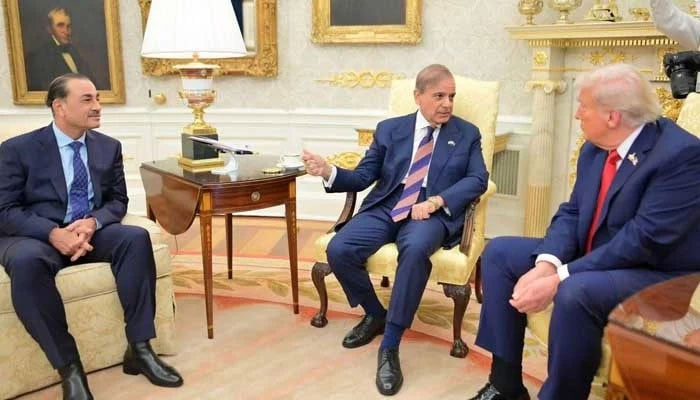
LAS VEGAS/ANTALYA/ISLAMABAD: Hinting that an Iran peace deal was all but done, US President Donald Trump on Friday thanked “fantastic” Prime Minister Shehbaz Sharif and Field Marshal and Chief of Defence Forces (CDF) General Asim Munir for brokering the negotiations.
He also thanked Saudi Arabia, the United Arab Emirates and Qatar for their “great bravery and help” after Iranian strikes, reports AFP.
The celebratory tone continued with a series of shout-outs to mediator Pakistan and Gulf allies.
Shehbaz lauds Trump: In a post on his X handle, Shehbaz said, “Mr President, on behalf of the people of Pakistan, Field Marshal Syed Asim Munir, and on my behalf, I express my deep and profound appreciation for your kind and gracious words.”
Meanwhile, welcoming President Trump’s appreciation, Prime Minister Shehbaz Sharif lauded him for his leadership leading to the successful conclusion of ceasefire in Lebanon, APP reports.
The prime minister expressed his warm regards during a courtesy call paid on him by Senior Advisor to the US President for Arab and African Affairs Massad Boulos on the sidelines of the 5th Antalya Diplomacy Forum (ADF 2026) in Antalya, Türkiye, a Prime Minister’s Office news release said.
During the cordial meeting, the prime minister conveyed his warm regards for President Donald Trump, while fondly recalling his own warm and cordial interactions with him.
He reiterated deep appreciation for President Trump’s bold and decisive leadership that had led to the ceasefire between Pakistan and India last year, when both countries were on the brink of war.
The two sides also discussed current regional developments, including Pakistan’s peace efforts that led to the ceasefire as well as the historic Islamabad Talks.
The prime minister emphasized the importance of strengthening Pakistan-US relations, especially economic and trade cooperation, as well as matters of mutual interest in multilateral diplomacy.
Massad Boulos conveyed greetings to the prime minister from President Donald Trump and appreciated Pakistan’s constructive contributions to regional stability.
He also reiterated the United States interest in deepening engagement with Pakistan on shared priorities, including counter-terrorism, economic development, and addressing global challenges.
Deputy Prime Minister Senator Mohammad Ishaq Dar, Federal Minister for Information Attaullah Tarar and SAPM Syed Tariq Fatemi also attended the meeting.
Shehbaz held a series of informal yet significant interactions with global leaders on the sidelines of the Antalya Diplomacy Forum, reaffirming Pakistan’s diplomatic engagement on regional and international issues.
Shehbaz met with President of Türkiye Recep Tayyip Erdogan, Amir of the State of Qatar Tamim bin Hamad Al Thani, President of Kazakhstan Kassym-Jomart Tokayev, President of Azerbaijan Ilham Aliyev, and President of Syria Ahmed al-Sharaa.
He also held separate meetings with Prime Minister and Minister of Foreign Affairs of Qatar, Mohammed bin Abdulrahman bin Jassim Al Thani, and President of Kosovo Vjosa Osmani.
The meetings were held in a cordial and friendly atmosphere, with Prime Minister Shehbaz Sharif emerging as a key focal point of engagement among participating leaders.
The discussions covered evolving regional and global developments, as well as avenues to further strengthen bilateral cooperation across political, economic, and security sectors.
During the warm and cordial meeting, President Erdogan welcomed the Prime Minister to Türkiye and thanked him for his participation in the 5th Antalya Diplomacy Forum.
He praised the prime minister’s peace efforts and said Türkiye would continue to support Pakistan’s diplomatic initiative to bring peace to the region.
The prime minister thanked President Erdogan for his warm invitation and traditional Turkish hospitality extended to him and his delegation during his stay in Antalya.
He congratulated the Turkish president on the success of the 5th Antalya Diplomacy Forum, which he said, had transformed into an important global event.
The two leaders exchanged views on recent regional developments, particularly the evolving situation in the Middle East.
The prime minister thanked President Erdogan for his strong support and encouragement of Pakistan’s peace efforts and shared with him the updates on how to extend the ceasefire and resume talks so that a peace agreement could be reached.
The two leaders emphasized the importance of effectively utilizing the current window of opportunity to advance a durable and lasting regional peace.
Separately, Iran’s President Masoud Pezeshkian has praised Pakistan’s role in mediation efforts that helped secure a ceasefire, according to Iran’s state news agency IRNA.
During talks in Tehran with Field Marshal Asim Munir, President Pezeshkian praised him and Prime Minister Shehbaz Sharif for their “effective role” in the mediation process and in helping facilitate the ceasefire. He also thanked Pakistan for hosting the Iranian delegation during talks in Islamabad. He added that Iran was “not seeking instability in the region”.
PAF fighters escort Iranian negotiators: In a related development, Reuters reported that the Pakistan Air Force (PAF) escorted Iranian negotiators home from inconclusive peace talks with the US last weekend.
Pakistan deployed some two-dozen jets in the escort, as well as the force’s Airborne Warning and Control System (AWACS) for aerial surveillance to ensure the safety of the delegation back from Islamabad, said two Pakistani sources with knowledge of the operation.
One said similar security protection would be provided for subsequent talks if the Iranians ask for it, “otherwise Pakistani aircraft would receive them in Pakistan’s airspace”.
A third source involved in the talks said measures were already in the works ahead of an expected further round of talks as soon as this weekend.
A regional diplomat briefed by Tehran, however, said Pakistan insisted on the escort after Iranian delegates raised the “hypothetical” possibility of a threat.
The discussions with the Iranian delegation about a potential threat while travelling and the presence of a Pakistani air escort into Iran have not previously been reported.
The Israeli prime minister’s office did not immediately respond to a request for comment.
Iran’s permanent mission in Geneva did not immediately respond to a request for comment.
Pakistan Air Force and military did not respond to questions about the operation. The US embassy in Islamabad did not respond to a request for comment.
“When the talks failed, the Iranians were wary that things had not gone right. It was their suspicion that they might be targeted,” one security source said.
“This was a massive operational mission if you look at it from a pilot’s point of view. You are taking responsibility for a delegation that is coming for talks, you are giving them air cover, you have potent fighters that counter any threat,” he said.
The source involved in the talks, the highest-level engagement between the two countries since the 1979 Islamic Revolution, confirmed the air escort but did not provide details about the operation.
Moghadam stresses reliable trust, goodwill for lasting peace: Meanwhile, Iran’s Ambassador to Pakistan Reza Amiri Moghadam on Friday emphasised that trust and coordinated regional efforts would be key to achieving lasting peace in the region, Jamila Achakzai reports.
“Reliable Trust, Goodwill, avoiding redundancy in action and words, RESPECT, ‘Practical Will to Action’ as well as particularly Synergy among the countries of the region can bridge the existing gaps to achieve the significant goals,” he wrote in a post on X.
The envoy said recent developments, including a ceasefire in Lebanon and the reopening of the Strait of Hormuz, had created space for diplomacy, with Pakistan playing a key role in facilitating engagement.
“With Iran’s inevitable robust defense and steadfast resistance, with ceasefire accessible in Lebanon, and with previously Open Straits Hormuz opened again; Now giving Diplomacy a chance through intense Pakistan initiatives, paves the ground, more or less, for comprehensive, unified and united efforts to establish permanent peace and collective security, sustainable development, progress and prosperity for All in the region and beyond,” he said.
Highlighting the importance of broader societal engagement, the ambassador noted that intellectuals, policymakers and the media could help narrow divisions and foster convergence.
“The intelligentsia, politicians, scholars and media can play a significant role in helping bridge the current chasm towards convergence,” he noted.