KARACHI: Pakistan’s real effective exchange rate (REER) index appreciated to 105.2 in March, an increase from 103.1 in February, the central bank data showed on Thursday.
“A rising REER (>100) suggests that the relative value of the home currency is becoming overvalued compared to peer countries,” said Topline Research. “We expect PKR/USD to close around Rs 280-282 by June 2026,” the brokerage firm added.
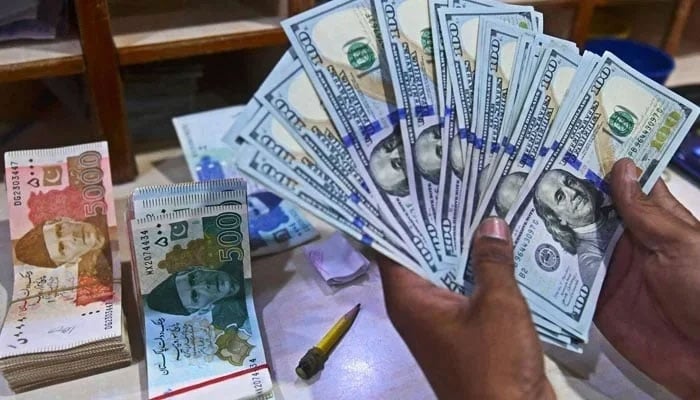
The rupee ended flat on Thursday even though Pakistan’s current account balance recorded a surplus in March and in the nine months of the current fiscal year. The local currency closed at 278.95 against the dollar in the interbank market. It had ended at 278.96 on Wednesday.
Some experts suggest that the authorities are actively preventing the rupee from weakening, even though indicators like REER suggest it should. In his post on X, Khyber Pakhtunkhwa Chief Minister’s Adviser on Finance Muzammil Aslam said that the REER index indicates the “currency needs adjustment”.
However, Faisal Mamsa, CEO at Tresmark, a leading financial information portal, shared that REER is not a currency valuation meter; it is more of a trade competitiveness indicator. “Countries like China and India have also operated with elevated REER levels for extended periods,” Mamsa said.
“In Pakistan’s case, the current account surplus, strong remittances and support from friendly countries are offsetting some of the war and inflation-related pressures,” he added. “REER becomes more significant if it stays elevated for several months alongside high oil prices and reserve pressure.”
According to Mamsa, there is currently no pressure on the rupee because the current account is in surplus, there are excess dollars in the interbank market, and foreign exchange reserves are stable. For these reasons, he does not anticipate any depreciation of the currency at this time. However, he notes that if oil prices rise and remittances fall in the future, such a scenario could put some pressure on the rupee.
In its latest report titled ‘REER Dynamics and External Competitiveness of Pakistan’, the Pakistan Business Council (PBC) said that “recent exchange-rate stability has been underpinned by IMF-anchored inflows, bilateral rollovers, strong remittance growth, and improved foreign-exchange market functioning. These factors have helped contain volatility and anchor expectations even as import demand recovered. At the same time, higher domestic inflation relative to trading partners has kept the real exchange rate mildly elevated, indicating that nominal stability has not translated into a corresponding improvement in external competitiveness.”
“While reserve accumulation has strengthened short-term buffers and reduced near-term volatility, structural trade imbalances and continued reliance on external financing continue to shape the real exchange rate. Experience suggests that delaying real adjustment increases the risk of abrupt and disruptive corrections,” the report added.
The country posted a current account surplus of $1.07 billion in March, compared with a $231 million surplus in the previous month. On a cumulative basis, the current account recorded a surplus of $8 million in July-March FY26, compared with a surplus of $1.674 billion in the same period last year.
The latest REER data comes after Pakistan secured a $3 billion financial support package from Saudi Arabia. This has provided a timely boost to FX reserves and eased near-term external account pressures.