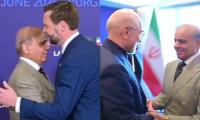
ISLAMABAD: President Asif Ali Zardari on Tuesday appreciated Pakistan’s untiring efforts for hosting the recent US-Iran dialogue in an effort to de-escalate tensions in the Middle East, which have exposed the world to a host of global security, energy and economic challenges.
The president met with Prime Minister Shehbaz Sharif at the Aiwan-e-Sadr and discussed the prevailing security and diplomatic situation in the region.
The president said the situation had a far-reaching impact not only on the region but also on the global security, economy and politics at large.
Shehbaz briefed the president in detail on various stages of the dialogue and progress achieved through Pakistan’s mediation. He also apprised the president of his upcoming visit to Saudi Arabia and Turkiye for further engagement to promote the peace efforts.
Zardari praised the prime minister, deputy prime minister/foreign minister, chief of defence forces and all state institutions for their untiring efforts toward making this diplomatic initiative a great success. He noted that the seamless coordination among all stakeholders was instrumental in facilitating this high-level engagement.
The president highlighted the historic role Pakistan has played in promoting global peace and regional stability. He remarked that by providing a platform for such a critical dialogue, Pakistan had reaffirmed its position as a responsible and pivotal state in the international community and proved its peace-making credentials to the world once more.
Zardari said the prime minister and deputy prime minister should remain proactively engaged with the United States and Iran, as well as major regional and global powers, to ensure sustainability of the peace process and regional harmony.
The meeting was attended by the Deputy Prime Minister Ishaq Dar and federal minister Senator Rana Sanaullah. The president was assisted by former prime minister Raja Pervaiz Ashraf, PPP’s parliamentary leader in the Senate Senator Sherry Rehman and former Senate chairman Nayyar Bukhari.
Mariana Baabar adds: In a closely related development, foreign ministers from Pakistan, Saudi Arabia, Turkiye and Egypt, the Quad members, will meet once again in Türkiye on April 17 on the sidelines of Antalya Diplomacy Forum (ADF), with Pakistan emphasising a cooperative framework among the four countries, focusing on shared goals of peace, prosperity and economic development, and finding ways to de-escalate regional tensions in the Middle East.
Held under the theme “Mapping Tomorrow, Managing Uncertainties”, the ADF will bring together leaders to address global instability and shape the future of international diplomacy.
More than 20 heads of state, 15 deputy leaders and over 50 foreign ministers, including Mohammad Ishaq Dar from Pakistan, Prince Faisal bin Farhan Al Saud from Saudi Arabia, Hakan Fidan from Türkiye and Badr Abdelatty from Egypt, are expected to take part.
This will be the third meeting of the Quad, the first held in Riyadh with the second one held in Islamabad when the foreign ministers highlighted Pakistan’s role in initiating dialogues between Iran and the US to mitigate the conflict and ensure safe navigation in the region.
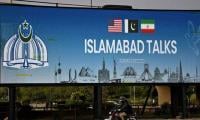
The Antalya meeting comes after the recently concluded Islamabad talks when for the first time in decades, Iran and the United States sat face to face, with both sides eager for another round of talks. The Islamabad meeting had also focused on fostering de-escalation, establishing a “Muslim Quad” to manage regional stability, and strengthening diplomatic ties among the four nations.
The Foreign Office on Tuesday saw a meeting of Senior Officials of the Ministries (SOMs) of Foreign Affairs of the respective countries as a follow-up of the consultative meeting of foreign ministers of Pakistan, Saudi Arabia, Türkiye and Egypt held earlier in March in Islamabad.
“Deliberations at the SOM will be submitted for consideration at the forthcoming foreign ministers meeting of the four brotherly countries, scheduled to be held in Antalya, Türkiye on April 17 on the sidelines of Antalya Diplomacy Forum (ADF),” said the Foreign Office in a statement.
Pakistan’s delegation to the Senior Officials Meeting (SOM) on Tuesday was led by Ambassador Tahir Andrabi, Additional Foreign Secretary/Spokesperson. The delegations of Türkiye, Egypt and Saudi Arabia were headed respectively by Ambassador Musa Kulaklikaya, Deputy Foreign Minister; Ambassador Nazih El Naggari, Assistant Foreign Minister; and Prince Dr. Abdullah bin Khalid bin Saud Al-Kabeer AlSaud, Director General of the MFA.
Later, the delegation called on Foreign Minister Mohammad Ishaq Dar who appreciated the close, brotherly relations and convergence of views on important regional and global matters among the four brotherly countries. He called for devising a cooperative framework among the four countries, focusing on the shared goals of peace, prosperity and economic development.
Meanwhile, the Foreign Office said over the past seven days, Foreign Minister Dar’s leadership had been widely recognised by international actors for his pivotal role in diplomatic mediation and crisis management amid escalating tensions in the Middle East. “Senior officials and authoritative voices from South Africa, Iran, the United States, China, Saudi Arabia, Turkey, Azerbaijan, Bahrain, Uzbekistan, and Egypt have referenced his efforts in facilitating ceasefire talks and promoting regional stability. Sentiment is overwhelmingly favorable,” said the statement.
“In this regard, the international media and diplomatic channels highlight his credibility, strategic positioning, and commitment to de-escalation. Dar ranks as the #1 Most Positively Viewed World Leader globally (April 5-11, 2026), with the highest positive-to-negative ratio among all world leaders measured. In the most recent 24-hour window (April 10–11), he records 30.5% positive sentiment against only 8.5% negative — placing him ahead of Xi Jinping, Mohammed Bin Salman, Emmanuel Macron and Friedrich Merz,” added the statement.
In another closely related development, the Foreign Office said Deputy Prime Minister/ Foreign Minister Senator Mohammad Ishaq Dar spoke with the Turkish Foreign Minister Hakan Fidan.
“Both leaders exchanged views on the regional situation, including the latest developments, and reaffirmed the importance of close coordination on issues of mutual interest. Both leaders also discussed important engagements at the upcoming Antalya Diplomacy Forum,” said a statement.
In yet another development, Prime Minister Shehbaz Sharif is set to undertake a three-nation visit, beginning with Saudi Arabia, as Pakistan intensifies diplomatic engagement amid evolving regional tensions.
According to well-placed sources, the visit, initially reported only to Saudi Arabia, has been rescheduled, with the premier expected to meet key leaderships across the region to discuss pressing diplomatic and security matters, reports Geo News.
Shehbaz will first travel to Saudi Arabia, followed by Qatar, and conclude his tour in Turkiye, the sources added. The trip to friendly countries will focus on consultations over diplomatic developments and regional stability.
The prime minister is scheduled to meet Saudi Crown Prince Mohammed bin Salman, where both sides will discuss key bilateral issues, the sources said.
“Important bilateral matters between Pakistan and Saudi Arabia will come under discussion,” they said, adding that regional and global developments, including the Islamabad Talks, will also be a part of the agenda.
The sources further said consultations with friendly nations were expected on the situation of Strait of Hormuz and the next round of US-Iran talks, as tensions continue to shape regional dynamics.
Both sides are also expected to deliberate on strengthening Pakistan-Saudi Arabia relations, with focus on enhancing cooperation across multiple sectors.
Pakistan has been thrust into the international spotlight as it is mediating between the US and Iran to end the war.
The much-anticipated talks in Islamabad, which ran from Saturday into early Sunday, were the first direct US-Iranian meeting in more than a decade and the highest-level discussions since Iran’s 1979 Islamic Revolution.
The negotiations came days after a ceasefire began last Tuesday, aimed at ending six weeks of fighting that has killed hundreds of people across the Gulf, throttled vital supplies of energy and sparked fears of a wider regional conflict.
Reuters, citing four sources, has reported that negotiating teams from the United States and Iran could return to Islamabad this week.