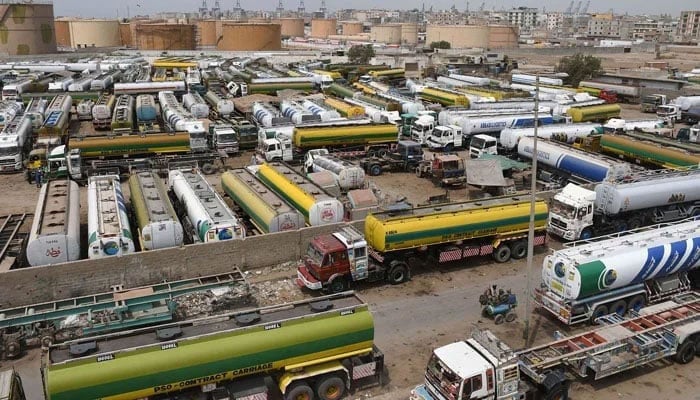
ISLAMABAD: Owing to the freezing of oil prices in March 2026 in the aftermath of the eruption of war in the Gulf region, the Price Differential Claims (PDC) have ballooned to Rs125 billion. This requires a forensic audit to ascertain facts on the inventory of fuel stocks.
Top official sources confirmed to The News on Tuesday that the opacity of the PDC system, which ballooned to Rs125 billion during the March 2026 freeze, invites in-depth investigation. The Auditor General (AG) and the Federal Investigation Agency (FIA) must immediately launch a forensic audit of the industry’s inventory.
There is a need to determine if someone is engaged in “inventory hoarding” by powerful Oil Marketing Companies (OMCs) or at the retail stage by fuel pumps during the three-week freeze to maximise their windfall when the April 3 hike was eventually announced. Any gains made from selling “old-priced” stock at the new rate of Rs378 per litre for petrol and at much higher rates for diesel should be identified, recovered and returned to the public treasury. There is a need to bring transparency, which is the only antidote to the suspicion of “regulatory capture.”
Governance cannot improve in the dark. We must implement a “Sunshine Rule” for energy pricing. This includes real-time dashboards, meaning Oil and Gas Regulatory Authority (Ogra) must maintain a public, real-time digital dashboard showing the daily landed cost, exchange rate impact and the exact petroleum levy being charged. It also includes digital supply tracking: before promising “subsidy apps,” the government must first digitise the supply side. We need end-to-end digital tracking of every litre from the port to the pump to eliminate the “ghost claims” that currently bleed the PDC fund.
Finally, there is a need to address the structural addiction. Petroleum currently accounts for nearly 15 percent of Pakistan’s total tax revenue. This is a dangerous over-reliance on a single, volatile commodity. The state must show the same “fiscal ferocity” in taxing high-wealth non-filers, real estate speculators and large-scale retailers that it currently shows to the person at the petrol pump.
Until the tax base is broadened, the fuel tank will remain the government’s primary “ATM,” and the citizen will continue to pay the world’s highest “inefficiency tax.” Stability requires a state that taxes income fairly, rather than one that taxes survival through the nozzle of a petrol pump.
Pakistan cannot control the geopolitical volatility in the Middle East, but it has absolute control over its own domestic regulatory integrity. The current “petrol bomb” is a symptom of a governance framework that has become a subservient arm of fiscal desperation. To break this cycle, a fundamental shift toward rule-based pricing is required, one that reflects the realised landed cost rather than political convenience.
The capacity of the regulator, Ogra, must be the first point of reform. Currently, the regulator often appears as a bystander to decisions made in the Ministry of Finance or Ministry of Petroleum. Parliament must summon the regulator to a public hearing with a single, pointed mandate: explain the delta between the global crude price and the pump price with line-item granularity.
Parliament must ask to what extent the current price-build-up formula is protecting inefficient refineries and bloated OMCs’ margins at the cost of the consumer. If the regulator lacks the technical capacity to verify the “import parity” claims of the industry, it is not a regulator; it is a rubber stamp. Its board must be populated with independent energy economists, not career bureaucrats, said independent economists.