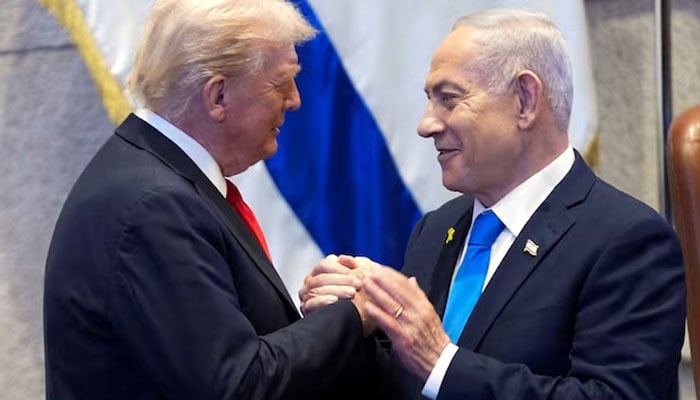
KARACHI: The black SUV carrying Benjamin Netanyahu arrived at the White House just before 11am on 11 February, according to a report by The New York Times. The Israeli leader, who had long pushed for a US-backed assault on Iran, was taken directly inside for a high-stakes meeting.
In a report titled “How Trump Took the US to War With Iran”, the newspaper said Netanyahu presented a classified briefing in the White House Situation Room to Donald Trump and senior officials. Appearing virtually alongside him were David Barnea and Israeli military officials, reinforcing the image of a wartime leadership team.
Netanyahu argued that Iran was vulnerable and that a joint operation could cripple its missile programme and potentially trigger regime change. He suggested protests inside Iran could be reignited and even pointed to figures like Reza Pahlavi as possible future leaders. The meeting was kept highly restricted. Key figures including Vice President JD Vance were absent. Senior officials present included Marco Rubio, Pete Hegseth, CIA Director John Ratcliffe and General Dan Caine.
US intelligence reviewed Netanyahu’s proposals the next day. While they found that targeting Iran’s leadership and military capabilities was feasible, they dismissed regime change scenarios as unrealistic. Ratcliffe reportedly described them as “farcical”, while Rubio bluntly called them “bullshit”.
Despite scepticism, Trump remained focused on military objectives. He appeared less concerned about long-term outcomes such as regime change, instead prioritising immediate strategic gains.
General Caine warned that a major conflict would strain US weapons stockpiles and highlighted the difficulty of securing the Strait of Hormuz. He also noted risks of disruption to global oil flows, though Trump believed the war would be swift.
Inside the administration, divisions persisted. Rubio favoured continued pressure over war, while Vance strongly opposed a full-scale conflict, calling it costly and distracting. However, few openly challenged the president’s inclination.
On 26 February, during a final Situation Room meeting, Trump made his decision. “I think we need to do it,” he said, emphasising the need to prevent Iran from acquiring nuclear weapons and threatening the region.
The following day, aboard Air Force One, Trump approved the operation. “Operation Epic Fury is approved. No aborts. Good luck,” he ordered, setting the United States on a path to war.