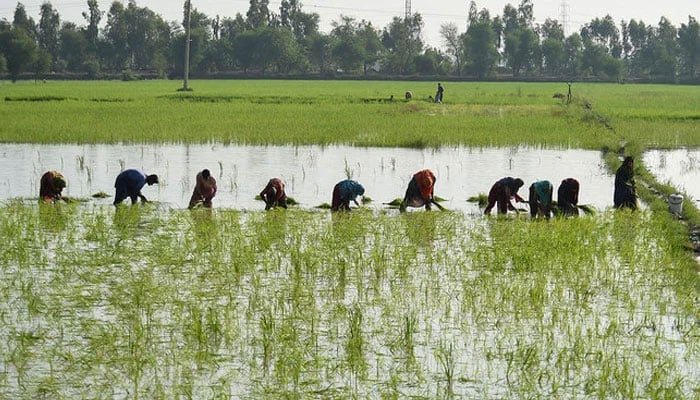
ISLAMABAD: Pakistan’s water regulator approved a 15 per cent water shortfall for the first half of the summer crop (Kharif) season Tuesday, even as reservoir storage levels hit a six-year high, complicating an already fragile agricultural outlook for a country of 240 million people.
The Indus River System Authority’s Advisory Committee (IAC), met here under Chairman Amjad Saeed, unanimously approved the anticipated water availability framework for Kharif 2026, the critical April–September growing season that feeds Pakistan’s rice, cotton, and sugarcane harvests.
It anticipates system shortfall of 15pc for early Kharif (April to June 10), subject to review in first week of May 2026. The shortfall for late Kharif was approved at 5pc.
System losses for the Indus Zone were assessed at 25pc for April and 35pc for the period 01st May to 10th June, subject to review in the first week of May based on actual reach-wise observations. For late Kharif, losses were estimated at 15pc.
Total provincial water withdrawals for Kharif 2026 were set at 67.451 MAF, up from 60.558 MAF last year and the 10-year average of 62.252 MAF, with Punjab allocated 33.357 MAF, Sindh 30.403 MAF, Balochistan 2.868 MAF, and Khyber Pakhtunkhwa (CRBC) 0.823 MAF.
Despite the shortfall, Pakistan enters Kharif with stronger reserves, as system storage stood at 2.307 MAF on March 31, 2026, nearly six times higher than last year’s 0.384 MAF and 71% above the 10-year average of 1.351 MAF.
Rim-station inflows for Kharif are projected at 103.30 MAF, including 24.48 MAF for early Kharif and 78.81 MAF for Late Kharif. The Pakistan Meteorological Department forecasts normal to above-normal rainfall from April to June, particularly in western and northern regions and eastern Sindh, but warns above-normal temperatures nationwide could accelerate snowmelt and increase evaporation.
The committee said Rabi 2025–26 inflows totaled 21.782 MAF, slightly below the 22.016 MAF forecast, marking a 1pc shortfall, while downstream Kotri releases reached 3.596 MAF. It also raised alarm over Tarbela Reservoir, which has lost about 48% of its live storage capacity due to sedimentation.
Live storage at Tarbela Dam has fallen from 5.827 million acre-feet (MAF) in May 2022 to 5.580 MAF in March 2026, with a sharp 0.148 MAF decline in 2025, the steepest in at least 15 years, driven by rising sediment inflows. In response, the water regulator raised the minimum operating level to RL 1402 ft.
The Wapda-led committee has been directed to submit a detailed sedimentation report, while operational constraints are under review. The T4 Hydropower Plant (45,000 cusecs) will resume post-May 7, with the Low Level Outlet slated for testing May 8.