ISLAMABAD: Pakistan on Wednesday vehemently condemned Iran’s latest drone and missile attacks on Saudi Arabia on Monday night, in which energy facilities and infrastructure in the eastern region of the Kingdom of Saudi Arabia were.
Prime Minister Shahbaz Sharif, the Foreign Office and the 247th Corps Commanders Conference at GHQ saw these attacks as a serious violation of Saudi Arabia’s sovereignty and territorial integrity and a dangerous escalation that undermines regional peace and stability as it amounted to “unnecessary escalation”.
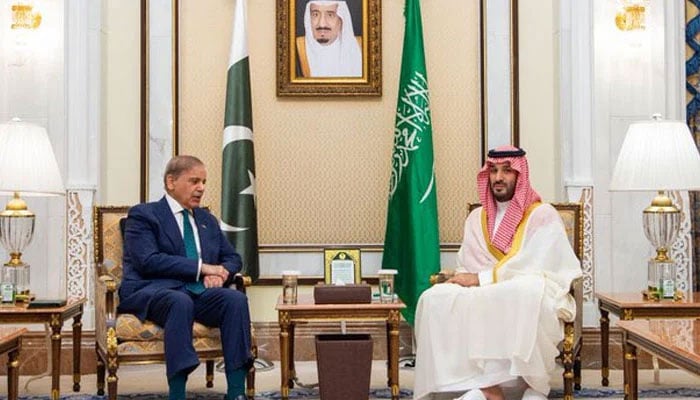
The prime minister Shahbaz Sharif reached out to Saudi Arabia Crown Prince and Prime Minister Prince Mohammed bin Salman on telephone. “I conveyed Pakistan’s unwavering solidarity with the Kingdom of Saudi Arabia. Condemned today’s attack on the Al Jubeil oil facility. We stand shoulder to shoulder with our Saudi brothers and sisters.
“Appreciated the Kingdom’s restraint under the wise and sagacious leadership of His Royal Highness the Crown Prince and reaffirmed Pakistan’s commitment to advancing peace efforts for de-escalation in the region,” Shehbaz said in a post on ‘X’. The Foreign Office clearly named Iran for the attack. “Government of Pakistan expresses its deep concern and unequivocal condemnation of the missile and drone attacks carried out by the Islamic Republic of Iran last [Monday] night against energy facilities in the Eastern Region of the Kingdom of Saudi Arabia,” said the statement.
The attacks on Saudi Arabia come at a time when Pakistan is engaged in hectic closed-doors diplomacy to bring together Iran and the United States to the negotiating table with speculations indicating that progress was being made.
An early morning tweet on ‘X’ by Iran’s Ambassador in Islamabad Reza Amiri Moghadam, announced that “Pakistan’s positive and productive endeavours in Good Will and Good Office to stop the war is approaching a critical, sensitive stage ... Stay Tuned for more”.
However, the Foreign Office while condoling with the Saudi government said that Pakistan mourns the loss of life resulting from these attacks and strongly deplores the damage inflicted on vital infrastructure.
“The Government of Pakistan conveys its sincere condolences to the families of the victims and firmly stands in solidarity with the Government and people of the Kingdom of Saudi Arabia during this difficult time,” said the Foreign Office.
Pakistan considers these attacks a serious violation of Saudi Arabia’s sovereignty and territorial integrity and a dangerous escalation that undermines regional peace and stability.
“Pakistan reaffirms its unwavering support for the Kingdom’s security”, it added.
The army’s top brass according to the Inter Services Public Relations (ISPR) also condemned attacks on Saudi Arabia’s energy infrastructure amid the ongoing US-Israeli war on Iran as “an unnecessary escalation”.
Chief of Army Staff and Chief of Defence Forces Field Marshal Asim Munir presided over the 274th Corps Commanders’ Conference at General Headquarters (GHQ) in Rawalpindi,
It said that the forum appreciated the “hectic efforts” taken by the government to bring an end to the war in the Middle East, “echoing the call for restraint, dialogue, and de-escalation, reaffirming Pakistan’s commitment to principled diplomacy and constructive engagement”.
It added that the forum noted with “concern and vehemently condemned the latest attacks on Saudi Arabia’s petrochemical and industrial complex as an unnecessary escalation which spoils sincere efforts to resolve the conflict through peaceful means”.
The statement added that the forum noted that the restraint and calibration exhibited by the Kingdom, despite “grave provocations”, enabled mediation and diplomatic resolution.
However, it added that “such unwarranted aggressions have serious repercussions, to spoil the ongoing peaceful options and conducive environment” as Iran targeted a petrochemical complex in Saudi Arabia’s Jubail industrial city, located in the eastern province.
“The forum reiterated Pakistan’s role as a responsible regional stakeholder, actively contributing to peace and stability as a Regional Security Stabiliser,” the ISPR said.
The forum offered Fateha for the Shuhada of the Armed Forces, Law Enforcement Agencies and innocent civilians who laid down their lives in defence of the motherland. Paying solemn tribute to their unmatched sacrifices, the forum reaffirmed that their legacy remains the bedrock of Pakistan’s national security.
The forum undertook a comprehensive review of the prevailing internal and external security environment, reaffirming that all terrorist proxies operating on behest of Indian and other external sponsors, along with their facilitators and abettors, will be pursued and eliminated, relentlessly and without exception.
The pace of Operation Ghazab-lil-Haq will be maintained till the culmination of terrorists’ safe heavens and use of the Afghan soil against Pakistan is decisively brought to an end. The COAS & CDF expressed his satisfaction and commended the Pakistan Armed Forces for their unwavering professionalism, operational excellence and steadfast commitment towards defence of the country and sustained, intelligence-based counter-terrorism operations.
He underscored that through the synergy of the government, Armed Forces and the people, Pakistan continues to consolidate security gains, strengthen economic resilience, and enhance its regional and global standing.
The forum categorically rejected persistent disinformation, baseless allegations, and false flag narratives attributed to India, noting that such tactics stand discredited internationally. The forum expressed concern over continued human rights violations by Indian authorities in Indian Illegally Occupied Jammu and Kashmir and noted the recent spate of fake encounters at various locations to cover up extrajudicial killings. In his concluding remarks, the COAS & CDF directed commanders to maintain the highest standards of operational readiness, professionalism and adaptability, expressing full confidence in the Armed Forces’ ability to counter all forms of threats and to ensure the sovereignty and territorial integrity of Pakistan.
Meanwhile, telephone diplomacy continued at the Foreign Office where Foreign Minister Ishaq Dar talked to Foreign Minister of Bahrain Abdullatif bin Rashid Al Zayani. The two leaders expressed concern over recent developments in the region, discussed ongoing deliberations on current business at the United Nations Security Council, and underscored the importance of maintaining peace and stability. They agreed to remain in touch,” said the FO.
This was in reference to a Bahrain drafted resolution at the UNSC on the Strait of Hormuz. Dar also spoke to Egypt’s Foreign Minister Badr Abdelatty, to discuss the latest regional developments. Both the leaders underscored the need for de-escalation and dialogue, and agreed to stay closely engaged as the situation evolves.
Later, Dar talked to the Foreign Minister of Norway, Espen Barth Eide. “They discussed recent developments in the Middle East and the wider region. The Norwegian foreign minister expressed appreciation and full support for Pakistan’s efforts toward dialogue and diplomacy for peace and stability in the region.
Meanwhile, Pakistan condemned in the strongest possible terms the storming of Al-Aqsa mosque by Israeli occupation forces.
“This reprehensible act constitutes a direct assault on the sanctity and historic character of the holy site and is a violation of international law and relevant UN resolutions,” said the Foreign Office.
Meanwhile, Speaking in the Senate, DPM/FM Ishaq Dar voiced deep concern over the recent developments in the Middle East following a massive attack on Iran by Israel, amid hectic peace efforts.
He said that Pakistan was playing a proactive diplomatic role to reduce tensions in the region, but recent developments have dealt a severe blow to peace efforts.
Dar underlined that he was very optimistic before Monday night, but the recent dangerous developments have once again made the situation tense.
He pointed out that just as both parties were close to sitting at the negotiating table, Israel attacked Iran, which led Iran to target oil installations in Saudi Arabia’s Jubail city. This situation has severely damaged the peace process.
Pakistan, he emphasised, was the first Muslim country to openly condemn the attack on Iran. He recalled that when the US attacked Iran, he was in Saudi Arabia and contacted the Iranian foreign minister from Medina to convey Pakistan’s stance.
The foreign minister said Pakistan decided to immediately contact all important countries in the region and played a facilitating role for a ceasefire. Both the parties accepted Pakistan’s mediation and agreed to talks in Islamabad. He made it clear that Pakistan does not desire any medal or credit; the goal was to establish peace in the region. He noted that Prime Minister Shehbaz Sharif and Field Marshal Asim Munir made tremendous efforts, and he himself played a full role as foreign minister. Dar said Pakistan conveyed the US’s 15-point conditions to Iran and Tehran’s 5-point proposals to Washington, leading to a ceasefire possibility and progress. However, he expressed regret that just as both parties were close to negotiations, Israel attacked Iran, and Iran targeted Saudi Arabia’s oil installations, severely damaging the peace process.
The deputy premier said he was optimistic before last night, but recent developments have made the situation tense again. He explained that Pakistan consulted with China and other countries on the peace agenda, and the international community, including the UN secretary-general, appreciated Pakistan’s role.
He expressed the resolve that Pakistan will continue efforts to establish peace in the region, fulfilling its responsibility.
Earlier, initiating a debate in the House on the recent rise in petroleum product prices and the prevailing regional situation, Leader of the Opposition in the Senate, Allama Raja Nasir Abbas, welcomed Pakistan’s mediation efforts. However, he wished Islamabad had stood up and tried to stop the US from destabilising the entire region.
“Why are you coming to this region? Do you have any border dispute here? Why are you coming from such a long distance to commit aggression?” he said, addressing the US president. “We should continue playing our role to prevent the spread of war, as neither President Donald Trump nor Netanyahu have any regard for world institutions or the law. They are riding on a donkey of arrogance and might,” he charged. But he also wondered who would give guarantees on behalf of Trump.
He regretted that it appeared the United Nations, the Security Council, and their resolutions no longer existed, and only Trump and Netanyahu’s law was in practice, as whatever they wish, they speak, and whatever they wish, they do. The opposition leader lamented that both had their eyes on the region’s resources, while Netanyahu had openly declared his intentions to establish a ‘Greater Israel’.
He pointed out that when Trump had expressed his intentions to mount aggression on Iran—which had announced it would never make a nuclear bomb and was engaged in talks—it was attacked right in the middle of negotiations, yet no one spoke against him or tried to stop him. The opposition leader warned that if Iran fell, the entire region would be reshaped and resized, and if it stood firm, the region would still not be the same.
He strongly criticised US and Israeli policies, saying their attempts to create a war-like situation in the region are condemnable. He also warned that the situation in the Middle East could become a threat to global peace.
Meanwhile, efforts to facilitate talks between the US and Iran are ongoing, two Pakistani sources with knowledge of the discussions told Reuters on Tuesday.
However, one of the sources, a senior security official, said Iran’s overnight strikes on Saudi Arabia’s industrial facilities linked to US firms threatened to derail the talks.
If Saudi Arabia were to retaliate, the talks would be over, the source said, adding that could draw Pakistan into the conflict under its defence pact with Riyadh which binds both nations to fight for each other in case of a war.
The second source with knowledge of the talks said Iran was “walking on thin ice” and that the next three to four hours were critical for the future of dialogue.
Pakistan has been the main go-between for proposals shared by both sides, but there has been no sign of a compromise. “We are in touch with the Iranians. They have lately shown flexibility that they could join the talks, but they are at the same time taking hard lines as a prerequisite for any negotiations,” the Pakistani security source said.
He added that Islamabad was persuading Tehran to enter negotiations without prior conditions.
Iran’s foreign ministry spokesperson said on Monday that messages are still being exchanged between Iran and the US via mediators.
A senior Iranian source said Tehran had rejected a proposal for a temporary ceasefire with talks dependent on an end to US-Israeli strikes and compensation for damages. Pakistan wants to avoid being pulled into the war, which could wreak havoc along its shared western border with Iran and roil discontent among its large Shi’ite population, the second largest in the world after Iran.
Analysts say the defence agreement may not trigger immediate military action but could be activated if conflict escalates. Iran’s willingness to risk embarrassing Pakistan at a time when “it is crucial to brokering a ceasefire reveals just how committed Tehran is to a tit-for-tat strategy that punishes the Gulf for US and Israeli strikes,” said Adam Weinstein, an expert on Pakistan, Afghanistan and US politics at the Quincy Institute.