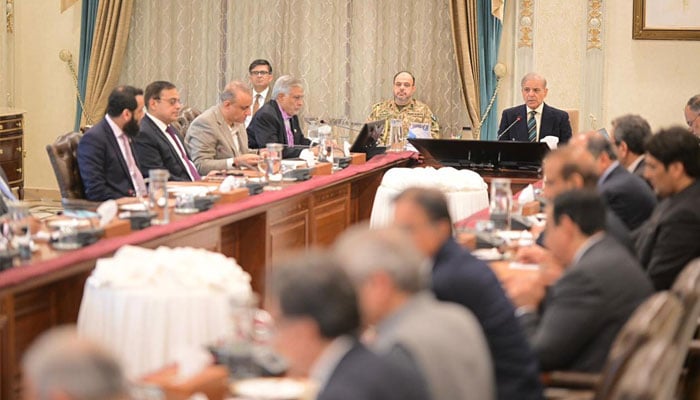
ISLAMABAD: Prime Minister Shehbaz Sharif, while mentioning significant share of renewable energy in power generation, Tuesday said that despite disruptions in oil supply due to regional tensions, no electricity crisis had emerged in the country.
He was chairing a meeting regarding long-term energy planning and export strategy during current international situation. “Solar energy and other renewable energy sources are the future of the power sector,” he said and directed to formulate a comprehensive strategy to further expand renewable energy sources at the national level. He also directed to expedite work on the Battery Energy Storage System project.
He also noted that despite regional tensions, successful diplomacy has ensured the continued supply of Pakistani exports to Gulf countries. Pakistani exports to Gulf countries were continuing despite recent global tensions and challenges. He also directed the Pakistan National Shipping Corporation (PNSC) to arrange ships to increase exports via maritime routes.
The prime minister was informed that diplomatic efforts with Gulf countries are going on to facilitate national exports in light of recent regional tensions. He was briefed on the long-term strategy for electricity generation, opportunities for exports in the current global situation, challenges faced, and measures to address them. The meeting was informed that at present 55 percent of total electricity generation comes from renewable sources, while 45 percent comes from fossil fuels. The meeting was informed that planning is underway to increase electricity generation from renewable sources to 90 percent and reduce fossil fuel-based generation to 10 percent over the next 10 years. The meeting was further told that demand for Pakistani agricultural products in Gulf countries had been steadily increasing.
Deputy Prime Minister and Foreign Minister Ishaq Dar, federal ministers Ahsan Iqbal, Rana Tanveer Hussain, Jam Kamal Khan, Musadik Malik, Ahad Cheema, Muhammad Aurangzeb, Attaullah Tarar, Ali Pervaiz Malik, Owais Ahmed Leghari, Junaid Anwar, Minister of State for Finance Bilal Azhar, Special Assistants Haroon Akhtar and Tariq Bajwa, State Bank of Pakistan Governor Jameel Ahmad and senior officials from relevant institutions attended the meeting.
Meanwhile, the prime minister chaired another high-level review meeting to assess the implementation of measures related to petroleum conservation, energy efficiency and austerity amid the current regional situation, PM Office Media Wing said in a press release. Shehbaz emphasised that given the seriousness of the regional situation, the entire nation must contribute to the drive aimed at fuel conservation and austerity. He maintained that hoarding petroleum products was an “unforgivable” act, and strict legal action would be taken against those involved in such heinous practices. Highlighting the country’s energy challenges, he noted that a portion of electricity generation relied on petroleum products. He further opined that market closures and other austerity measures were designed not only to save valuable foreign exchange but also to ensure uninterrupted electricity supply.
The meeting was briefed on steps taken to enforce austerity decisions aimed at ensuring economic stability in light of rising regional tensions.
The officials apprised the prime minister about the steps taken for the closure of markets and shopping malls across Punjab, Khyber Pakhtunkhwa, Balochistan, Azad Jammu and Kashmir, Gilgit-Baltistan and Islamabad at 8:00 pm, effective from Tuesday. The meeting was attended by Deputy Prime Minister and Foreign Minister Ishaq Dar, ministers including Ahsan Iqbal, Abdul Aleem Khan, Musadik Malik, Ahad Khan Cheema, Attaullah Tarar, Shaza Fatima Khawaja and Awais Ahmed Leghari along with Minister of State for Finance Bilal Azhar Kayani, special advisers Tariq Bajwa and Talha Burki, State Bank of Pakistan governor, chief secretaries, officials and inspectors general of police from all provinces, Azad Jammu and Kashmir and Gilgit-Baltistan.
The meeting was further informed that consultations were ongoing with the Sindh government regarding the implementation of 8:00 pm market closure policy.
The relevant authorities also briefed that provincial governments started submitting data of individuals eligible for the fuel subsidies. After verification, subsidies were being disbursed through a transparent digital system.
From April 4, subsidies for the transport vehicles, including trucks and buses, were being continuously provided in collaboration between the Ministry of IT and the State Bank of Pakistan, it was added.
Separately, chairing a review meeting on reforms in the National Tariff Commission, the prime minister directed the digitisation of the National Tariff Commission’s functions for transparency and standards, and emphasised that the institution’s restructuring was also essential to boost industrial growth and attract investment in the country. He directed the resolution of NTC’s legal and administrative issues under a comprehensive strategy to promote industry, trade and investment. He instructed the special measures to facilitate investors and industrialists and protect them from legal and other complications, and stressed the need to study global best practices to align the Commission’s restructuring and performance with international standards. The prime minister called for adopting innovation in the NTC through the use of information technology, artificial intelligence and other modern tools, besides directing the simplification of legal complexities in its appellate tribunal. He said the NTC’s staff must be trained according to international standards, and that the services of professional experts must be engaged to provide practical guidance on the reformative measures.
Warning against any delay in disposal of cases, Prime Minister Shehbaz directed to establish a system to ensure the disposal of all cases within a specified timeframe. During the meeting, the NTC chairman briefed the participants on the legal, administrative and financial reforms being carried out under the approved roadmap. Federal ministers Muhammad Aurangzeb, Jam Kamal Khan, Azam Nazeer Tarar, Musadiq Malik and Ahad Khan Cheema, SAPM Haroon Akhtar and other senior government officials attended the meeting. Meanwhile, in a meeting with Prime Minister Youth Programme Chairman Rana Mashhood Ahmad here, Shehbaz assured that all youth welfare and development projects under the programme would continue uninterrupted without being interrupted by the current regional situation. He described the youth as the “future of the nation” and directed the relevant authorities to speed up ongoing projects and intensify the efforts to provide them with maximum opportunities. He said that providing employment, education, technical training and other opportunities to the youth were among the government’s priorities. The prime minister said that the government was striving to introduce Pakistan’s youth as the best workforce in the global market. During the meeting, Chairman Rana Mashhood briefed the prime minister on the progress of various projects being implemented under the PM Youth Programme.