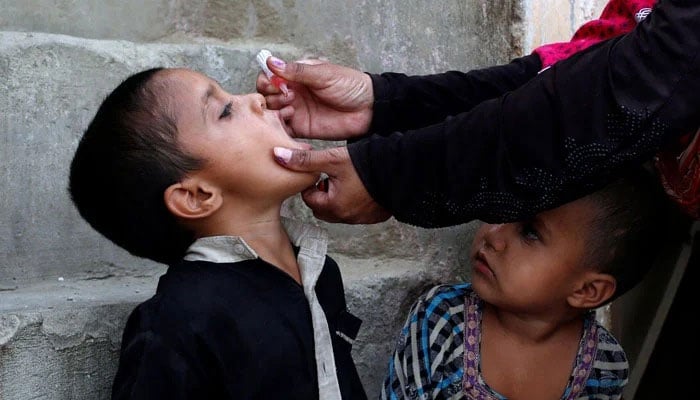
PESHAWAR: Khyber Pakhtunkhwa has moved closer to interrupting poliovirus transmission as no confirmed case of the crippling disease has been reported in the province in 2026 so far.
The environment samples have turned negative in Peshawar, which was regarded as a reservoir for polio, marking a decisive shift in Pakistan’s eradication trajectory.The development is particularly significant as Pakistan remains among the few countries where polio is still endemic.
In 2025, the country reported 31 cases of wild poliovirus type 1 (WPV1), including 20 from Khyber Pakhtunkhwa, nine from Sindh, and one each from Punjab and Gilgit-Baltistan, placing the province at the centre of national concern. Official data now indicates a sustained reversal of that trend.
According to the Emergency Operations Centre (EOC), Khyber Pakhtunkhwa has 34 environmental surveillance sites, with Peshawar accounting for six, the highest in the province, all of which have turned negative since June 2025.
The shift signals a break in virus circulation in one of the most complex urban transmission zones.Only limited pockets continue to report the presence of the virus. Environmental samples remain positive at Hinjal and Noorabad in Bannu, and Haiderkhel in North Waziristan, highlighting that transmission persists primarily in the southern belt where operational challenges remain pronounced.
Health officials attributed the gains to sustained improvements across access, supervision, campaign quality, and community engagement.“No single intervention explains this outcome; it reflects consistent alignment across all operational pillars,” an EOC Communication official said, adding that the Peshawar experience demonstrated how targeted, data-driven strategies can interrupt transmission even in high-risk settings.
Despite the progress, the southern districts of the province continued to pose difficulties due to security constraints and limited local advocacy, which affect campaign reach and acceptance.
In Peshawar, key performance indicators show consistent upward trends. Household vaccination coverage increased from 745,557 in October 2025 to 750,444 in December and further to 755,325 in February 2026. Coverage of migrants and mobile populations rose from 277,872 in October to 278,127 in December and reached 287,560 in February.
At the same time, refusals, a persistent challenge in previous campaigns, declined from 6,094 in October 2025 to 6,011 in December and further to 5,777 in February 2026, reflecting improved community acceptance. Guest vaccination, necessitated by Peshawar’s status as a provincial hub, also showed an overall increase, reaching 42,967 in February compared to 37,972 in October.
Post-campaign validation through Lot Quality Assurance Sampling (LQAS) further underscored the improvement. Peshawar recorded 83 percent coverage in October 2025 and has consistently achieved 100 percent results from December 2025 onwards, indicating a high standard of campaign execution.
The district, comprising 43 high-risk union councils, has demonstrated measurable gains across these vulnerable areas, reinforcing confidence in the province’s targeted approach.Efforts to curb virus importation have also intensified. Between January and March 2026, a total of 92,079 children were vaccinated at key entry points into Peshawar, including 61,781 at the Kohat Tunnel covering populations arriving from southern districts and 30,298 at Khushal Garh Bridge, facilitating inter-provincial movement.
At the national level, Pakistan reported its first WPV1 case of 2026 in a four-year-old child from Sujawal district in Sindh. While environmental surveillance detected 24 positive samples in January, only one paralysed case was confirmed during the early part of the year, indicating a narrowing gap between virus detection and clinical incidence.
Health authorities cautioned that while the trajectory in Khyber Pakhtunkhwa was encouraging, the risk of resurgence persisted, particularly in underserved and security-compromised areas.
The province’s current position, they stressed, represented a critical window where sustained operational discipline and community engagement could finally interrupt transmission and push the region towards a polio-free status.