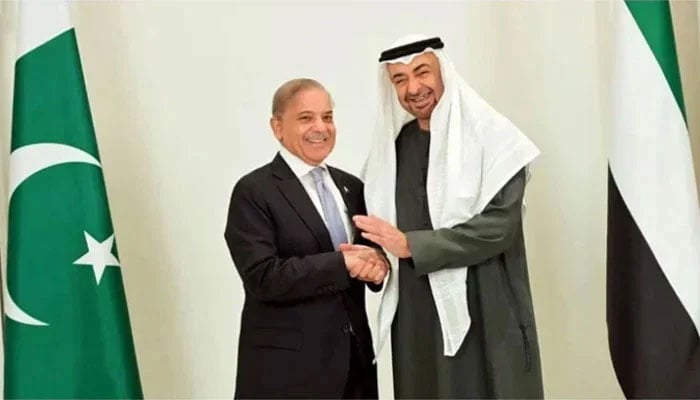
KARACHI: As Pakistan prepares to repay loans to the United Arab Emirates, hopes of managing these outflows amid stable foreign exchange reserves and expected loan disbursement from the International Monetary Fund keep the currency markets calm, allowing the rupee to remain stable against the dollar.
This optimism comes after Khurram Schehzad, adviser to the minister of finance, revealed that Pakistan has successfully repaid its $1.3 billion Eurobond maturing on April 8 (Thursday) on schedule. Additionally, the country has fulfilled its $126.125 million coupon obligations on other Eurobond issuances. In total, the debt payments amounted to $1.43 billion.
“Debt servicing continues to be executed as a non-event, reflecting consistency, discipline and strengthened capacity,” Schehzad said on the social media platform X on Tuesday. According to Schehzad, this performance is supported by stable external buffers and improved liquidity, as well as continued macroeconomic stabilisation and resilience, which strengthen investor confidence and create a more sustainable and disciplined debt trajectory.
Islamabad has decided to repay approximately $3.5 billion in loans to the UAE, having made arrangements to manage this outflow. However, details about the inflows are not yet available, according to a report from a brokerage firm.
Interestingly, the foreign exchange market remained calm following this development, with the rupee showing a slight appreciation despite expectations of depreciation, said Topline Securities in a report. Similarly, there was no observed panic among exchange companies, and there are no reports of significant premiums in the informal market. On Monday, the dollar bond market remained stable, despite many markets closing for Easter.
The rupee closed at 279.06 against the dollar in the interbank market, nearly unchanged from its close at 270.07 in the previous session. In the open market, the rupee remained flat at 280.13 per dollar.
“In the short run, we believe PKR/USD will remain in check as the Central Bank of Pakistan (SBP) has a reasonable level of reserves,” the report said. “Moreover, the SBP may take administrative measures to manage FX reserves and balance of payment based on past practice,” it added.
Currently, Pakistan’s FX reserves are at a four-year high, with SBP reserves of $16.3 billion, commercial banks’ reserves of $5.4 billion, and gold reserves of $10 billion. The government has reportedly arranged funds from two friendly countries to tackle this payment requirement. The government had requested Saudi Arabia to convert $5 billion into long-term deposits and to increase its oil facility for deferred payment to $5 billion from $1.2 billion. Thus, this could be one option to manage the outflow of $4.8 billion.
“We believe that if the government is able to secure long-term financing from friendly countries, that will be a positive development. Pakistan’s biggest challenge is its excessive reliance on short-term external debt, though public external debt to GDP has come down to 26 per cent from 32 per cent in June 2023,” the report said.
In addition to borrowing from allied countries, the government may consider arrangements through swaps until June 2026, along with interventions by the SBP in the FX market to purchase dollars.
“The currency swaps exposure of Pakistan currently stands at $1.8 billion versus a maximum of $5.7 billion in February 2023. This increase may cover up for the reserves’ fall in the short term; however, this will affect the IMF quarter-end Net International Reserves (NIR) target,” it added. “Another option that could be considered is to aggressively buy a few of the requirements from the market and take a small hit on reserves for the balance amount.”