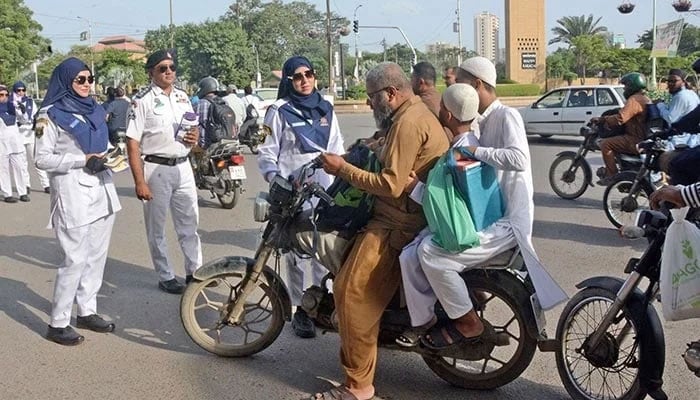
The Sindh High Court (SHC) has directed the traffic authorities, Sindh law department and others to file comments on the petitions challenging the imposition of e-challan on traffic violations.
The bus owners association, Karachi Jamaat-e-Islami Emir Monem Zafar Khan and others had challenged the “flawed” procedure and “excessive” amounts prescribed in the new e-challan system.
They had submitted that the e-challan penalties were heavy and unjustified and they could not be imposed on the basis of personal desire and officials’ discretion. They said ID cards had been blocked of vehicle owners on traffic violations.
The petitioners had submitted that many traffic signals were not in a working condition on roads in different areas of the city, including the Hasan Square, Gulshan-e-Iqbal, Saddar, Nazimabad, Garden and Old City areas, but e-challans were being sent to vehicle owners through the cameras installed by the traffic police.
They had said many roads were under development or broken and without proper infrastructure and in such circumstances, the imposition of heavy fines was unjust and uncalled for. They had informed the high court that speed limit boards were not visible on many roads and cameras used for e-challan did not provide conclusive proof of a law violation.
The petitioners had questioned discrimination in picking only Karachi for e-challans stating that such a system was not being enforced in other cities of the province like Hyderabad, Sukkur and Larkana.
One of the petitioners, Tariq Mansoor Advocate, submitted that comments on behalf of various respondents were still awaited. An SHC division bench headed by Justice Yousuf Ali Sayeed directed the provincial law officer to file comments on behalf of the respondents before May 7.
The Sindh government had earlier defended the enforcement of e-challans before the high court submitting that legislation with regard to e-challan was made for public safety and to protect the road users, transporters, passengers and pedestrians.
Filing comments on petitions challenging legislation with regard to the imposition of e-challan and amendments to the provincial motor vehicles law, the Sindh mass transit department said that penalties had been increased to control rising traffic violations, causalities, fatal accidents and traffic congestion in order to safeguard the road users and regulate the traffic.
It said the e-challan had been introduced in the first phase on main roads where infrastructure was fine with proper road lanes, operational signals, service roads and deployment of traffic police. It added that the e-challan system had been introduced after consultations with all stakeholders and proper media campaign.