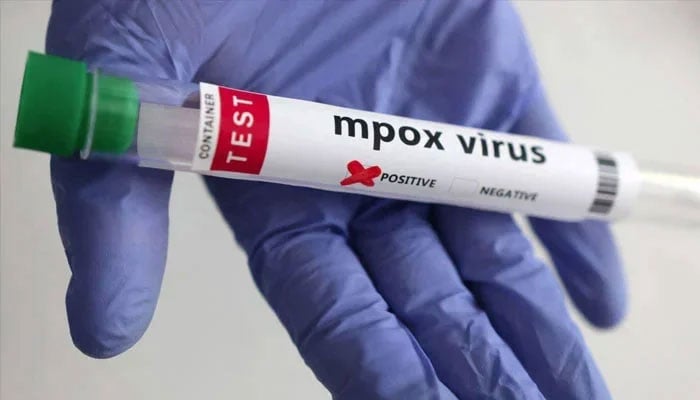
A suspected outbreak of Mpox among children in Khairpur and adjoining areas of Sindh has prompted the provincial health department to seek urgent laboratory support from the Aga Khan University Laboratory in Karachi, bypassing public sector facilities, as at least nine suspected cases have surfaced in the region, officials said on Friday.
Officials in the Sindh health department confirmed that multiple children presenting with unusual skin lesions had been reported from Khairpur district, including one case brought to the outpatient department of the Gambat Institute of Medical Sciences on Friday, raising serious concerns about a possible outbreak of Mpox.
In a formal communication issued by the Directorate General Health Services Sindh, the laboratory manager at the Aga Khan University has been requested to facilitate priority testing and confirmation of suspected Mpox cases reported from Khairpur.
The notification states that suspected cases of Mpox have been identified in Khairpur and emphasises that timely laboratory confirmation is critical for prompt case management, implementation of infection prevention measures and containment of further transmission. It also notes that at least eight suspected cases had already been identified at the time of writing and require urgent diagnostic support.
A senior official of the Sindh health department said the provincial authorities were seeking support from the AKU laboratory for rapid and reliable testing in view of the public health importance of the situation.
“We need early confirmation to initiate containment measures and prevent further spread. That is why priority testing has been requested,” the official said. However, the decision to send samples to a private sector laboratory instead of utilising the available capacity at the National Institute of Health (NIH) in Islamabad or the Dow University of Health Sciences (DUHS) in Karachi has raised serious questions within public health circles.
Epidemiologists and health experts alleged that the provincial disease surveillance system, particularly the Field Epidemiology and Laboratory Training Programme, has a history of underreporting and delaying disclosure of outbreaks, and that diverting samples away from national public health institutions could limit transparency and coordinated response.
The development follows earlier reports of an outbreak of Mpox like illness affecting children in Gambat, Khairpur and Larkana, where paediatricians had raised alarms over cases presenting with lesions that did not resemble common infections such as chickenpox or measles.
“I have seen several cases which clinically resemble Mpox, with distinct lesions on children’s bodies. These are not typical viral infections we commonly see,” a senior paediatrician at the Gambat Institute of Medical Sciences had said, adding that similar cases were being reported from across the region.
Khairpur District Health Officer Dr Barkat Ali had also confirmed that children in Kot Diji and surrounding villages were affected by a suspicious skin disease, prompting requests for investigation teams and sample collection.
Despite initial claims that samples had been sent for laboratory testing, officials at the Dow University of Health Sciences had earlier stated that they had not received any specimens from the affected areas, creating confusion and delaying confirmation of the disease.
Officials at the National Institute of Health had also expressed concern over the lack of sample sharing and data reporting from provincial authorities, warning that delays in laboratory confirmation could hamper timely response to a potential outbreak.
Health experts warn that parts of upper Sindh have previously reported a high burden of HIV among children, which may increase susceptibility to infections and complicate disease outcomes.
There are also unverified reports of child deaths linked to the illness, although no official confirmation has been made. Experts say weak surveillance systems and lack of routine postmortem examinations in rural areas make it difficult to determine the true scale of such outbreaks.
With suspected cases rising and laboratory confirmation still awaited, doctors on the ground warn that any further delay in diagnosis and response could allow the disease to spread among vulnerable communities in upper Sindh.