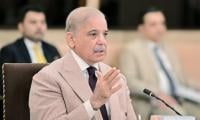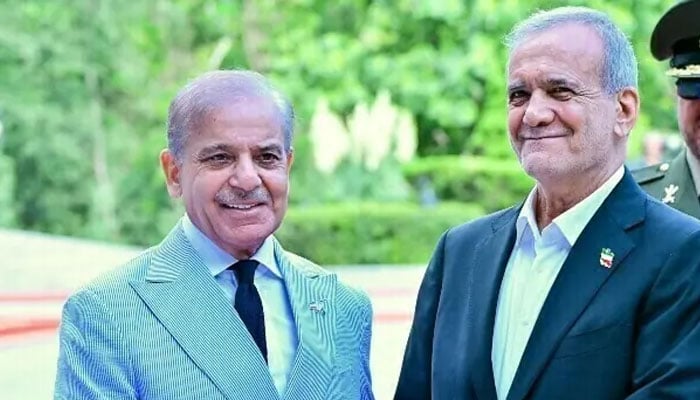
ISLAMABAD: Iran’s President Masoud Pezeshkian on Saturday appreciated Prime Minister Shehbaz Sharif for his “sincere diplomatic efforts” aimed at de-escalating tensions in the Middle East, while stressing that trust is essential to facilitate dialogue and mediation. The remarks came during an hour-long telephonic conversation between the two leaders, during which they held extensive discussions on the ongoing hostilities in the region and efforts to restore peace.
Following the discussion, DPM Ishaq Dar made an important announcement in the evening, saying that Iran would allow 20 more Pakistani ships to pass through the Strait of Hormuz, two ships a day. This follows Iran’s decision to allow two Pakistani tankers to pass through the Strait of Hormuz. On X platform, Dar said: “I am pleased to share a great news that the Government of Iran has agreed to allow 20 more ships under the Pakistani flag to pass through the Strait of Hormuz; two ships will cross the Strait daily.” The foreign minister described the move as a constructive and encouraging gesture that deserves appreciation, adding that it reflects efforts to ease tensions and promote stability in the region. He said such developments could play an important role in improving the overall situation and supporting peace efforts. Emphasising the importance of continued engagement, the minister said dialogue, diplomacy and confidence-building measures remain the only viable path forward.
According to the Prime Minister’s Office, President Pezeshkian shared Iran’s perspective on the conflict, particularly the hostilities involving Israel, and underscored that building trust is a prerequisite for meaningful negotiations. He praised Pakistan’s supportive and constructive role in promoting peace.
Prime Minister Shehbaz Sharif reaffirmed Pakistan’s commitment to regional stability and outlined an ongoing diplomatic outreach led by himself, Deputy Prime Minister/Foreign Minister Ishaq Dar and Chief of Defence Forces Syed Asim Munir. The outreach aims to engage the United States, as well as brotherly Gulf and Islamic countries, to help create a conducive environment for dialogue and de-escalation. He also took the Iranian leader into confidence on the upcoming high-level consultations in Islamabad involving key regional foreign ministers.
The PM briefed President Pezeshkian on the strong endorsement Pakistan’s peace initiative has received and expressed the hope that a viable and collective path towards ending hostilities could be achieved.
Reiterating Pakistan’s position, Sharif strongly condemned continued Israeli attacks on Iran, including the latest strikes on civilian infrastructure. He reaffirmed Pakistan’s solidarity with the Iranian people and conveyed condolences over the loss of more than 1,900 lives, while praying for the recovery of injured and displaced.
In a statement posted on X, the prime minister said he had reiterated Pakistan’s condemnation of Israeli actions and highlighted Islamabad’s ongoing diplomatic engagement with the United States, Gulf countries and other Islamic nations to promote dialogue and de-escalation. “Expressed once again my condolences on the tragic loss of precious lives and prayed for the swift recovery of the injured and displaced,” he said, while also thanking President Pezeshkian for appreciating Pakistan’s peace efforts. The PM assured the Iranian president that Pakistan would continue to play a constructive role in advancing peace, dialogue and stability in the region.
On the other hand, Deputy Prime Minister/Foreign Minister Ishaq Dar held a telephonic conversation with Foreign Minister of Iran, Abbas Araghchi. The two leaders discussed the evolving regional situation and ongoing developments. The DPM/FM emphasised the need for de-escalation, stressing that dialogue and diplomacy remain the only viable path for lasting peace. He also underscored the importance of an end to all attacks and hostilities. DPM/FM said that Pakistan remains committed to supporting all efforts aimed at restoring regional peace and stability.
In the changing situation, Pakistan has emerged as a central diplomatic player in efforts to de-escalate the rising tensions in the Middle East. Islamabad’s role has extended beyond hosting talks, with Foreign Minister Ishaq Dar confirming that Pakistan is also facilitating indirect communication between Tehran and Washington by relaying messages between the two sides.
As part of these efforts, Islamabad will host a high-level meeting on March 29-30 at the invitation of Dar. The foreign ministers of Saudi Arabia, Türkiye, and Egypt — Prince Faisal bin Farhan Al Saud, Hakan Fidan and Dr Badr Abdelatty — are expected to participate in the in-depth discussions focused on regional security and de-escalation on Sunday (today). “Looking forward to welcoming my brothers, the Foreign Ministers of Saudi Arabia, Türkiye, and Egypt, to Islamabad,” Dar said in a post on X.
According to the Foreign Office, the visit underscores Pakistan’s strong ties with these countries and offers an opportunity to enhance cooperation and coordination across multiple areas of mutual interest.
Sources indicate that the visiting dignitaries are expected to arrive in Islamabad around Saturday midnight, with formal talks scheduled to begin at the Foreign Office on Sunday (today) under Dar’s leadership. The ministers are also expected to call on Prime Minister Shehbaz Sharif before departing early Monday. However, officials noted that the programme remains fluid, with the possibility of extended engagements depending on the outcome of discussions.
The announcement of the Islamabad meeting was first made by Turkish Foreign Minister Hakan Fidan, who revealed in a media interview that the meeting was initially planned to take place in Türkiye. “We initially intended to hold the meeting in Türkiye, but since our Pakistani brother had to remain in his country, we shifted it to Pakistan,” Fidan said. He also highlighted the broader diplomatic context, noting that the ongoing US-Iran engagement requires sustained international involvement.
“US-Iran negotiations have begun. Messages are being conveyed via Pakistan. The US is coordinating with us, and we are also informing the Iranians. Today, we held lengthy talks with both sides,” he added, while stressing that any progress would also require the United States to exert meaningful influence on Israel.
Meanwhile, Deputy Prime Minister/Foreign Minister Ishaq Dar held separate telephonic conversations with senior leaders of Qatar and Indonesia, focusing on regional developments and efforts to ease tensions. In his call with Sheikh Mohammed bin Abdulrahman bin Jassim Al Thani, the two leaders discussed the prevailing regional and international issues and underscored the urgency of de-escalation. The Qatari leadership appreciated Pakistan’s ongoing efforts to promote peace and stability through dialogue and diplomacy. Both sides reaffirmed the deep-rooted, brotherly ties between Pakistan and Qatar and agreed to remain in close contact on evolving developments.
In a separate conversation, Dar spoke with Foreign Minister of Indonesia, Sugiono. The two discussed regional and international developments as well as bilateral matters of mutual interest. Reaffirming the strong fraternal relationship between Pakistan and Indonesia, they also agreed to maintain close coordination.
Pakistan’s diplomatic initiatives have received international backing. Chinese Foreign Minister Wang Yi held a telephonic conversation with Ishaq Dar and expressed China’s appreciation for Pakistan’s sustained efforts to de-escalate the situation and supported its role as a mediator.
According to the Foreign Office, Qatar also appreciated Pakistan’s ongoing diplomatic efforts and reaffirmed strong bilateral ties. Both sides agreed to remain in close contact as the regional situation continues to evolve. According to the Ministry of Foreign Affairs, Egyptian Foreign Minister Dr Badr Abdelatty has arrived in Islamabad on an official visit at the invitation of Deputy Prime Minister/Minister for Foreign Affairs Senator Mohammad Ishaq Dar. He will hold consultations on regional developments and call on the prime minister.
The visit reflects the close and brotherly relations between Pakistan and Egypt and their continued coordination on regional and international issues.