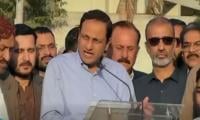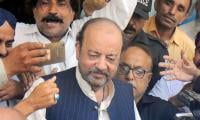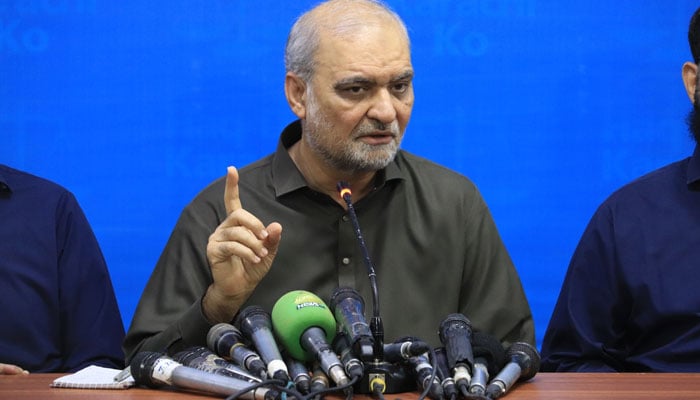
Jamaat-e-Islami (JI) Emir Hafiz Naeem ur Rehman on Saturday commended Pakistan’s role in mediating between Iran and Saudi Arabia and suggested that Iran and Turkiye be also included in the Pakistan-Saudi Arabia defence agreement.
Addressing a press conference at the Idara Noor-e-Haq, the Karachi JI headquarters, he said that once Iran and Turkiye had joined the defence pact, other Gulf states would likely join it as well creating a bloc that would symbolise the unity of the Muslim Ummah and weaken Israel.
Rehman said Muslim rulers must openly declare that any attack on Iran by the United States and Israel would amount to terrorism.
He added that peace in the region could not be achieved as long as Israel existed in its current form, calling it an illegitimate state.
He said the Gulf states must realise that American military bases were not there for their protection but for the protection of Israel, and urged them to review their multi-billion-dollar agreements.
Referring to regional conflict, the JI chief said Israel and the United States first carried out terrorism in Gaza, where 80,000 Palestinians were martyred, and they were now jointly carrying out carpet bombing in Iran, targeting civilian populations as well.
He said Donald Trump and Benjamin Netanyahu were leading a satanic group and stated that their terrorism in Iran began with an attack on a school in which 170 children were targeted.
Trump had presented himself as a comedian through contradictory statements, Rehman remarked.
About the Strait of Hormuz, he said Iran had already warned that if attacked, it would close the strait and strike wherever US bases existed, calling this Iran’s constitutional and moral right. However, he stressed that civilian populations in Gulf countries must not be targeted.
He also praised Pakistani religious scholars from Deobandi, Barelvi, Ahl-e-Hadith, Shia, and Sunni schools of thought for rising above sectarian differences and supporting Iran at this time.
He warned that those attempting to inflame Shia-Sunni divisions were serving the interests of the United States and Israel.
He criticised Pakistan’s participation in what he called Trump’s Gaza Board of Peace, questioning how Pakistan could act as a mediator while being part of that body.
He said mediation required neutrality, and once former US President Donald Trump was accepted as head of such a board and even nominated for a Nobel Prize, neutrality became impossible.
He said the so-called peace board had no legal status as it had been created in competition with the United Nations.
He said representatives of the board had spoken of disarming Hamas before any peace process could move forward, which, he said, meant speaking against the same party with whom peace was supposedly being negotiated. He stated that there was now no moral, legal, or humanitarian justification for Pakistan to remain part of the peace board.
He urged Pakistan not only to withdraw itself but also to persuade Saudi Arabia, Turkiye and all Gulf states to leave the board as well. He also praised Spain for openly condemning the United States.
On domestic governance, he demanded that no government vehicle, including those used by army officers, should exceed 1300cc under the current economic conditions. He clarified that the JI’s local government representatives did not use vehicles above that limit.
Criticising the federal government’s fuel policy, he said the government was collecting Rs120 to Rs125 per litre in taxes on petrol, including Rs105 as levy, which was unrelated to the base fuel price.
He also demanded that all schools, colleges, and universities be reopened and said there was no longer any justification for keeping Pakistan-Iran trade suspended.
Rehman stated that payments to independent power producers (IPPs) should be stopped and accused the government of favouring what he termed the ‘IPP mafia’.
He criticised the prime minister for arriving in Karachi for just three hours with a 37-vehicle protocol, and stated that President Zardari allegedly travelled to Nawabshah for Eid prayers with a 26-vehicle convoy.
He called upon the country’s major political parties — PML-N, PPP, and PTI — to clearly state their positions regarding the US-Israel-Iran conflict and openly condemn the United States and Israel.
On Karachi’s civic issues, he said the Red Line project had become a constant source of suffering for the city’s residents and claimed that Karachi did not even need the project. He argued that instead, the Sindh government could have brought 1,500 to 2,000 large buses.
He said that Rs4 billion had been spent on the Karimabad underpass project only to create two narrow lanes. He added that the Sindh Solid Waste Management Board, despite a budget of Rs43 billion, had completely failed, turning the city into a garbage dump.
He alleged the Pakistan Peoples Party had ruined Karachi and those who installed the mayor should fix the situation.
He reiterated the JI’s clear demand for the establishment of an empowered city government in Karachi, and called for a strong local government system across the entire country.