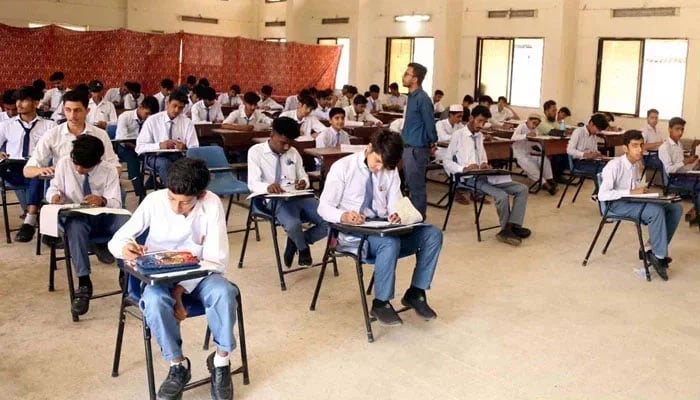
The annual matriculation and intermediate examinations in Sindh, scheduled to commence on April 7 and 25, will once again be conducted without regular controllers of examinations, secretaries and audit officers, raising serious concerns over administrative weaknesses and governance.
Around one million students are expected to appear in examinations conducted by eight educational boards across the province, including nearly 400,000 matriculation candidates from Karachi alone. Despite the scale of the exercise, none of the boards has had appointed regular key officials for the past eight years.
Sources said that instead of regular appointments, crucial administrative posts in educational boards continue to be managed on an ad hoc or additional charge basis, a practice that has heightened concerns about transparency and efficiency in the examination system.
In a recent development, Hyderabad Board Chairman Prof Dr Shuja Ahmed Mahesar has been suspended since December 19, 2025, over alleged delays in announcing results. Meanwhile, Sukkur Board Chairman Dr Zahid Ali Channa has been assigned additional charge of the Hyderabad Board, further complicating administrative affairs.
Officials noted that when the controlling authority of educational boards rested with the Sindh governor, chairmen, controllers and secretaries were appointed on a regular basis, ensuring relative institutional stability. However, after the authority was transferred to the chief minister, ad hocism took root. The subsequent shift of authority to a provincial minister is believed to have further undermined merit-based appointments.
It also emerged that a search committee conducted interviews for the posts of secretaries and controllers of examinations but found only three suitable candidates — Ashfaq Shah, Zarina Rashid and Naveed Ahmed Gujar. Despite qualifying on merit, none of them was appointed by the controlling authority.
Fresh advertisements were later issued for these positions, but appointments have yet to be made. Sources added that rules and procedures for recruiting regular controllers, secretaries and audit officers have been under formulation for the past year, but the process remains incomplete.
Reacting to the situation, Munawar Abbas, central president of the Sindh Professors and Lecturers Association, said the Boards and Universities Department had “completely failed” to appoint permanent officials in educational boards, leading to rising corruption and deterioration in the education system. He suggested that the department be abolished, with educational boards placed under the College Education Department and universities under the Higher Education Commission to ensure improvement.
Education experts warned that the absence of a permanent administrative structure could undermine the transparency of examinations, delay results and weaken anti-cheating mechanisms, thereby putting the academic future of hundreds of thousands of students at risk.