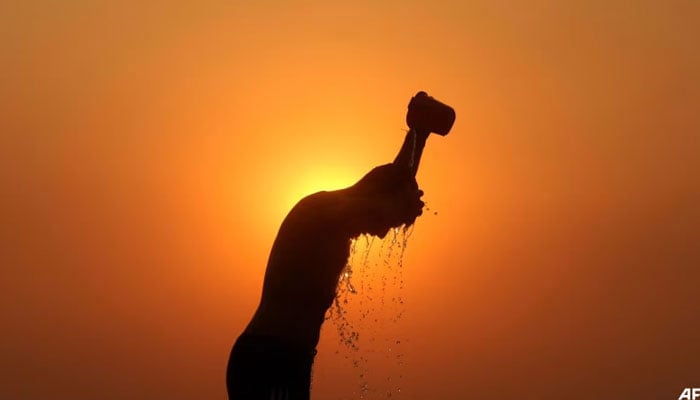
KARACHI: With global warming accelerating over the past 10 years, experts warned that Pakistan will bear the brunt of global climate change impacts and needs to update its adaptation strategies accordingly.
A study published in Geophysical Research Letters, a US-based open-access journal for geoscience disciplines, on March 6 claimed that global warming has accelerated in the last 10 years. The results revealed that the rate of warming has almost doubled since 2015 to around 0.35 C per decade.
The study relied on global temperature datasets, including those from NASA and the National Oceanic and Atmospheric Administration and removed the estimated influence of three main natural variability factors: El Nino, volcanism and solar variation.
As per Grant Foster, one of the authors of the study, this makes the “the underlying long-term warming signal more clearly visible”, showing that the 1.5 C warming limit set at the Paris Agreement is set to be breached before 2030.
This is a point that local experts concurred with. According to climate policy expert Dr Zainab Naeem, “the world is far behind the trajectory to achieve the 1.5 C [warming limit] target” and that achieving this target would require course correction by the countries that are creating climate change.
Pakistan is not one of these countries. According to the International Energy Agency, the country accounted for just 0.4 per cent of CO2 emissions from combustible fuels as of 2023. And yet, Pakistan was ranked the most vulnerable country to climate change in 2022 by the Germanwatch think tank, the same year catastrophic floods inundated a third of the country. Aside from floods, hailstorms, heatwaves, seawater intrusion and water scarcity are some of the other impacts that Pakistan can expect under the present trajectory, Dr Naeem said. She also highlighted how the debt incurred from these disasters will be a major challenge, adding that “most of the countries in the world, the debt that they get from the IMF is not spent on development projects, rather it is spent on recovering from disasters that are fuelled by climate change and this is happening in Pakistan as well”.
In addressing the challenges posed by global warming, experts emphasised the need to develop adaptation strategies. In her comments to The News, climate change expert Zile Huma noted that warming temperatures were changing rainfall patterns and the need to adjust crop-growing patterns accordingly. She also mentioned the need to conduct research on heat-resilient seeds and crops that can grow in extreme weather, and to prepare people to respond to such events.
While adaptation strategies are important, the study argues that global warming itself will stop when humanity reaches zero CO2 emissions. But the data shows that the world is moving in the opposite direction. The UN Environment Programme’s Emissions Gap Report 2025 found that greenhouse gas emissions rose by 2.3 per cent in 2024 compared to the previous year and claimed that “accelerated emission reductions require overcoming policy, governance, institutional and technical barriers; unparalleled increase in support to developing countries; and redesigning the international financial architecture”.
In a similar vein, Huma called for a ‘carrot-and-stick strategy’, arguing that rich countries will not implement the proper strategies to reduce carbon emissions “until we come up with a mechanism where maybe there can be diplomatic or trade sanctions” for those that fail to do so. “Similarly, if some countries are doing good work in reducing their carbon emissions, there must be some reward for them”.