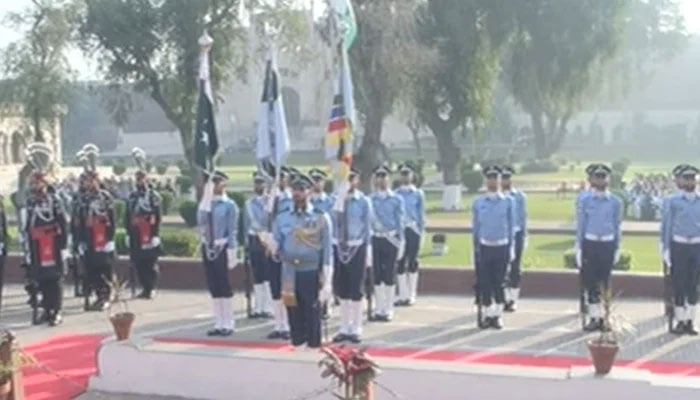
Under normal circumstances, yesterday’s focus would have been Pakistan Day and the associated parade. However, even this important date could not escape the shadow cast by the war unfolding in the Middle East and its impact on energy prices. The traditional parade was scrapped under the austerity measures the government introduced earlier to address the energy supply shocks rattling the country and the rest of the world. Other events have not been spared either. The upcoming PSL 11 will not have any live spectators. While US President Trump has claimed that he has postponed attacks on Iranian power plants, it remains unclear when the Strait of Hormuz will return to pre-war conditions. The government had already hiked petrol and diesel prices by around 20 per cent earlier this month and on Sunday it increased the levy on high-octane fuel by Rs200 per litre while also imposing an immediate ban on the use of high-octane petrol in government vehicles. With the Strait of Hormuz still closed and looking to remain so for the coming days, such a step was arguably inevitable. Reports are framing the move as an attempt to make fuel used in luxury vehicles more expensive while sparing the ordinary or mid-range vehicles used by most people. However, no one is escaping the higher petrol and diesel prices and the price of kerosene, often described as the ‘poor man’s fuel, has surged to Rs428.74 per litre.
To be fair to the state, it has tried to shoulder as much of the fuel burden as it can. The majority of the austerity measures have focused on government employees, including salary and fuel allowance cuts, and the people have been offered measures such as work from, taking some of the sting out of the fuel prices. There is also the fact that Pakistan is not alone when it comes to the energy crunch. Global oil prices have gone as high as $113 per barrel and the Asia Pacific region, heavily dependent on oil and gas from the Middle East, is uniquely exposed to the disruptions the world is now experiencing. Other countries in the region are going through similar pains. Sri Lanka, for example, has reportedly raised fuel prices by 25 per cent. Even the mighty US, a net exporter of fossil fuels, has been forced to ease sanctions on Iranian and Russian oil, and the energy crisis has not spared its stock market. Prime Minister Shehbaz Sharif has even rejected a proposal to raise petrol and diesel prices further. However, if the Strait of Hormuz remains closed, the country may not be able to resist such a measure for much longer. Even if there are no further increases, the elevated fuel prices the country is seeing right now will likely eventually filter down into higher food, transport and other essential goods and services. Summer is never a great time for electricity bills and with some analysts predicting that energy prices could remain elevated for months to come, one can only wonder what heights the power bills will touch this year.
One hopes the IMF will take note of this and adjust its future plans for Pakistan accordingly. Review talks on the next staff-level agreement are still ongoing and, before the current energy woes had truly set in, the government was already pushing for more leniency. This can no longer be a request; it ought to be a clear-cut demand. Pakistan did not start this war and its ensuing energy crisis and it should not be punished for events beyond its control. The country is already taking all the austerity it can bear. However, in broader terms, the country must also reconsider its overall energy position. While the shift towards solar and other local energy sources like nuclear and hydel might have prevented the ongoing crisis from being even worse, it is clear that our dependence on imported fuels is still too high. These imports are increasingly looking like the legacy of a more stable and predictable era in world history. Times have clearly changed.