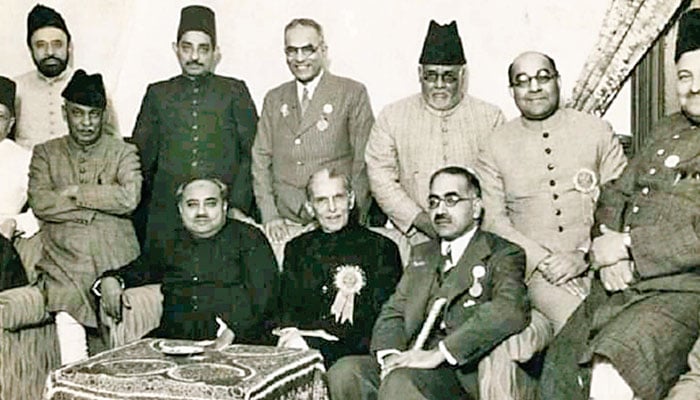
As many as eighty-six years have passed since the historic Lahore Resolution was adopted by the All India Muslim League envisaging a grouping of the “areas in which the Muslims are in a majority … to constitute independent states in which the constituent units shall be autonomous and sovereign". Apart from the controversy regarding the wording of the Resolution, the perception of the future Muslim state was undeniably that of a “federation of the Muslim homeland” (as asserted by Quaid-i-Azam on April 1, 1940) with autonomous constituent units bound together by consent rather than control. Conceived as a safeguard against over-centralisation, the resolution promised autonomy, diversity, and shared sovereignty—principles that continue to animate constitutional debates today. Unfortunately, after seventy-eight years of independence, the question of center-province relations remains problematic as ever. Recurring tensions between the federation and the smaller provinces (Sindh, KP and Balochistan) suggest that the federal spirit of 1940 has been repeatedly tested, and often neglected in practice. The result is a persistent federal unease that resurfaces with every debate over resources, authority, and constitutional balance.
The vision of 1940 was not merely inspirational; it was in effect adopted quite earlier in Jinnah’s Fourteen Points (1929) and was repeated at a number of later occasions. After independence, it found expression in the first (1956) and the second (1962) constitutions of Pakistan though in both cases the presence of one-unit system kept the federal spirit redundant leading to the growing unrest in provinces and eventually culminating in the breakup of the East Bengal province to form present Bangladesh in 1971.
Amidst post-dismemberment insecurities the third constitution of Pakistan (1973) was drafted providing for a federal system yet with some unitary features such as a long Concurrent List and balance of power tilted in favour of the centre. The promise of a truly federal polity could not be realised as the subsequent period remained replete with intermittent overthrows of political governments by extra constitutional means. In fact, several amendments to the constitution made it more centralised further shrinking the space for the provinces. In 2010 the landmark 18th Amendment brought back the federal spirit of the constitution, yet its efficacy is often marred by adverse conditions and comments.
Pakistan continues to wrestle with the balance between the centre and the provinces. Articles 141–159 of the Constitution, clearly define legislative domains, fiscal arrangements, and mechanisms for inter-provincial coordination outlining a carefully negotiated federal compact, dividing legislative authority, guaranteeing provincial participation in shared subjects, and institutionalizing coordination through the Council of Common Interests. When decisions on energy, water, natural resources, or regulatory authority are taken unilaterally by the centre, it is not merely a cause of persistent disputes—it represents a departure from the constitutional logic of shared rule that the Lahore Resolution originally envisioned.
At the heart of this tension lies a recurring contradiction: while Pakistan’s constitutional framework formally recognises provincial autonomy, political practice, often informed by administrative convenience and security considerations remains tilted towards centralisation.
Fiscal federalism
Fiscal relations are perhaps the most visible test of Pakistan’s federal commitment. The National Finance Commission was designed to ensure equitable resource distribution and provincial financial autonomy. Delays in NFC awards, disputes over population-based formulas, and the centre’s expanding expenditure have reinforced provincial grievances, particularly now when provinces are responsible for key social sectors such as health, education, and local governance. These tensions underline a deeper problem: a federal system cannot function when fiscal decentralisation lags behind constitutional promises.
Energy and water disputes
Provinces have repeatedly raised concerns over unilateral federal decisions on electricity pricing, gas allocation, management of power distribution companies and water issues—areas that directly affect provincial economies and governance capacity. When such decisions are taken without meaningful provincial consultation, they undermine the constitutional principle of shared ownership over natural resources, explicitly recognised in the post-18th Amendment framework.
Wither CCI?
The Council of Common Interests, constitutionally empowered as the primary forum for resolving center-province disputes is constitutionally bound to meet once in ninety days. Yet its irregular meetings and limited authority, with key policy decisions taken outside its ambit, have reduced its effectiveness. A weakened and often bypassed CCI not only undermines constitutional governance but also erodes trust between the federation and the provinces.
Taken together, these examples reveal a persistent pattern: constitutional mechanisms exist, but their spirit is often subordinated to administrative expediency. The Lahore Resolution’s federal vision was premised on autonomy, consent, and negotiated authority—not on unilateral control from the centre. When energy decisions bypass provincial input, when the CCI functions irregularly, and when fiscal arrangements remain unsettled, the resulting strain is not merely political but structural. The challenge, therefore, is not the absence of constitutional provisions, but the reluctance to fully internalise and operationalise the federal spirit.
When control replaces consent
Though, Sindh and KP provinces also complain of centralised authoritarianism, nowhere is the strain on Pakistan’s federal spirit more visible than in Balochistan, a province rich in resources (oil, gas and rare minerals), yet persistently marginalised in decision-making. Despite constitutional guarantees of joint ownership over natural resources, Balochistan has long voiced grievances over gas revenues, energy supply, and development priorities being determined at the centre. Recurrent disputes over gas royalties, delayed payments, and limited provincial control over extraction and distribution have reinforced perceptions that the province bears the costs of resource exploitation without enjoying its commensurate benefits.
The situation is compounded when issues directly affecting Balochistan—such as energy shortages, mineral development, or major infrastructure projects—are addressed outside the Council of Common Interests. This bypassing of constitutionally mandated forums deepens alienation and weakens trust in the federation. For a province whose accession to Pakistan was premised on assurances of autonomy and respect, the erosion of these commitments strikes at the very heart of the Federation.
18th Amendment as the modern expression of the Lahore Resolution
The 18th Amendment stands as the most concrete attempt to operationalise the federal spirit of the Lahore Resolution in contemporary Pakistan. By abolishing the Concurrent List and enhancing provincial control over key sectors, it sought to rebalance the federation. Resistance to its full implementation—often framed as administrative necessity or economic exigency—has revived old anxieties about central dominance, particularly in smaller provinces.
The Lahore Resolution was neither a call for administrative convenience or fiscal compulsion, nor a blueprint for central dominance. It was a political commitment to autonomy, partnership and constitutional balance. When the mechanisms designed to uphold that balance are weakened or bypassed, the strain on center–province relations is not accidental —it is structural.
The writer is a faculty at the Department of History, University of Karachi and an Associate Fellow of Royal Historical Society, UK. She can be accessed at: [email protected]