WASHINGTON: A former senior US counterterrorism official has sharply criticised the intelligence and decision-making process behind Washington’s war with Iran, saying there was no evidence of an imminent threat and alleging that policy may have been shaped by external influence and a restricted advisory circle.
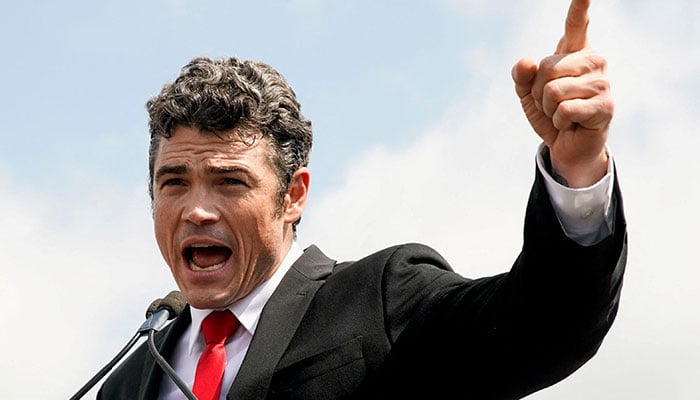
Joe Kent, who resigned earlier this week, made the remarks in an extended interview with conservative commentator Tucker Carlson, offering his most detailed account yet of internal deliberations leading up to the conflict.
Kent reiterated that US intelligence did not support claims that Iran posed an immediate danger or was close to acquiring nuclear weapons.
“Iran posed no imminent threat to our nation,” he said, adding that there was no intelligence indicating Tehran was preparing a large-scale surprise attack or rushing to build a nuclear bomb.
Asked directly whether Iran was on the verge of developing nuclear weapons, Kent responded: “No, they weren’t.”
Kent said intelligence assessments consistently showed that Iran had not made a decision to build a nuclear weapon and remained some distance from doing so. He described Tehran’s nuclear posture as “pragmatic,” aimed at preserving technical capability while avoiding outright weaponisation — a strategy shaped by regional security dynamics.
According to Kent, US intelligence agencies had no evidence that Iran was actively pursuing a nuclear weapon in the period leading up to the war, nor that it intended to launch an imminent attack.
“There was no intelligence that said they were going to conduct some kind of a 9/11 or Pearl Harbor-style strike,” he said, referring to the September 11 attacks and the Pearl Harbor attack.
Kent pointed to public statements by US officials, including Secretary of State Marco Rubio, indicating that Washington acted in anticipation of Israeli military action and possible Iranian retaliation.
“That takes away the argument that there was an imminent threat,” Kent said, suggesting that the timeline for US intervention was driven by allied considerations rather than direct Iranian intent.
He argued that alternative options, such as restraining Israel or pursuing diplomatic channels with Tehran, were not sufficiently explored.
Kent also questioned whether US strategic objectives were clearly defined, particularly in contrast to what he described as Israel’s focus on regime change.
A central theme of Kent’s remarks was his assertion that an “information ecosystem” — including media commentary, think tanks and unofficial channels — helped shape the narrative around Iran’s nuclear programme.
He alleged that this environment contributed to shifting US policy from preventing Iran from acquiring nuclear weapons to opposing any uranium enrichment, a position he said undermined the possibility of negotiations.
Kent further suggested that information from allied sources, particularly Israel, was sometimes presented outside formal intelligence channels and could influence policymakers.
“When we get information from a liaison service, it can be given to influence us as well as inform us,” he said, adding that such caveats were not always sufficiently emphasised.
He also pointed to extensive engagement between Israeli officials and senior US leaders, including multiple White House visits by Prime Minister Benjamin Netanyahu, as evidence of close coordination. Kent said the flow of intelligence to senior leadership may have been constrained by a narrow group of advisers.
“There wasn’t a robust debate,” he said, adding that key dissenting views were not fully conveyed to President Donald Trump.
He described a “clear gap” between intelligence assessments and the information ultimately shaping policy decisions, suggesting that the advisory process lacked sufficient diversity of views.
Kent also said that, compared to earlier deliberations — including those preceding previous US strikes on Iranian targets — internal debate had been significantly reduced in the latest instance.
The former official warned that efforts to pursue regime change in Iran could have far-reaching and unintended consequences. He argued that removing Iran’s leadership could strengthen more hardline elements within the system, including the Islamic Revolutionary Guard Corps (IRGC), and rally public support around the state. “If you strike the regime, it will only strengthen it,” he said.
Kent also raised concerns about the absence of a clear post-conflict plan, suggesting that instability in Iran could have broader implications for global energy markets, regional security and migration.
He cited risks to critical waterways such as the Strait of Hormuz and warned of potential spillover effects across the Middle East and beyond.
Despite his criticism, Kent emphasised that he was not opposed to the use of force in principle.
A military veteran with experience targeting Iranian-backed groups, he defended past US actions, including the killing of Iranian commander Qasem Soleimani, as effective in deterring threats.
However, he argued that such actions should be carefully calibrated and followed by diplomatic and economic measures, rather than escalating into broader conflict.
Kent’s remarks have drawn sharp criticism from some Republican leaders.
Mitch McConnell condemned what he described as unacceptable rhetoric, amid broader scrutiny of Kent’s resignation and past positions.
The controversy highlights deepening divisions in Washington over US policy toward Iran, the role of intelligence in decision-making and the influence of allies in shaping strategic choices.
Kent said he chose to speak publicly because his concerns were not being heard internally. “Our message just wasn’t getting through,” he said, warning that dissenting analysis within government channels was being “squashed” before reaching senior leadership. Kent also addressed a range of other causes of high interest within the MAGA movement, including the assassination of Charlie Kirk , saying in part that the Justice Department and FBI would not allow him to investigate possible foreign ties to the political activist’s killing. CNN previously reported that Kent drew a rebuke last year from FBI Director Kash Patel and other Justice Department officials after he sought to access FBI systems to investigate Kirk’s death, according to people briefed on the matter.
Pressed by Carlson on whether files related to the 1963 assassination of Kennedy are being withheld from the public, Kent said he didn’t think there is anything “earth-shattering” in any of the records, but added, “The system doesn’t want to get us used to things being rapidly declassified.”
Separately, CBS reported, citing a source familiar with the matte,r Joe Kent is under investigation by the FBI for allegedly leaking classified information,.
He is under investigation in connection with alleged leaks of classified information, with sources telling CBS that the probe began before his departure as US National Counterterrorism Center director.
The probe is being handled by the FBI’s criminal division and has been under way for some time, one source told CBS.
Shortly after Kent resigned, former deputy White House chief of staff Taylor Budowich claimed Kent was “often at the center of national security leaks” - but did not specify what they were.
He also claimed Kent “spent all of his time working to subvert the chain of command and undermine the President of the United States”.