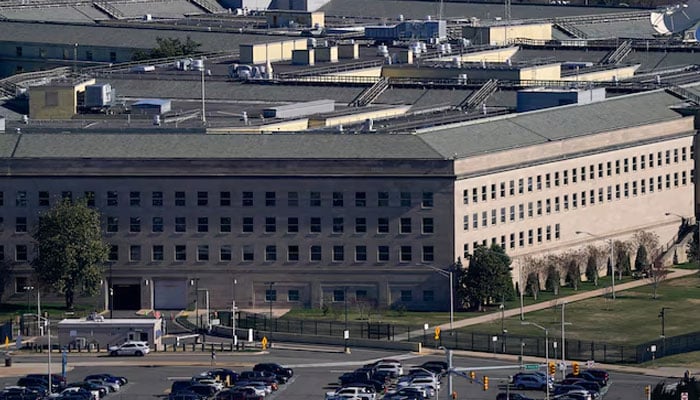
DOHA: The US military’s request for $200 billion in additional funding for the Iran war met with stiff opposition in the US Congress on Thursday, as Democrats and even some Republicans questioned the need for the money after large defense appropriations last year.
While Iranian attacks on the world’s largest LNG plant in Qatar and refineries in Saudi Arabia and Kuwait sent shock waves through energy markets as the United States said there was no deadline to end the Middle East war. A US F-35 fighter jet made an emergency landing at US air base in the Middle East after it was struck by what is believed to be Iranian fire, according to two sources familiar with the matter, CNN reported.
Amid growing fears over the economic
damage from the war, US President Donald Trump said there would be no repeat of Israel’s attack on Iran’s key South Pars gas field, but he warned of a furious US response if Tehran did not halt strikes on Qatar.
Iran responded that it would have “zero restraint” if its energy infrastructure was hit again.
Oil markets have already been shaken by Iran’s blocking of the Strait of Hormuz.
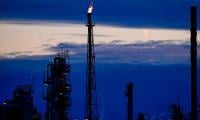
But the international benchmark Brent surged 10 percent to $119 a barrel before falling back to $112, while European gas prices rose 35 percent, after Iranian missiles hit Qatar’s huge Ras Laffan liquefied natural gas complex in retaliation for the Israeli strike on South Pars on Wednesday.
The nighttime attack on Ras Laffan, a repeated target since the start of the war on February 28, caused “extensive damage”, QatarEngery said.
Qatari Prime Minister Sheikh Mohammed bin Abdulrahman Al Thani said the attack was “clear proof” that Iran was going past its vow to only target US interests in the Gulf.
And attacks blamed on Iran spread.
A drone crashed into the Samref refinery in Saudi Arabia’s Red Sea port of Yanbu, the Saudi defence ministry said. The government reserved the “right to take military actions” in response.
In Kuwait, drone attacks sparked fires at the Mina Abdullah and Mina Al-Ahmadi refineries, which have a combined capacity of 800,000 barrels per day.
Even in Israel, media said an oil refinery in the port of Haifa was hit on Thursday, after the military warned of missiles launched by Iran.
Trump indicated he did not know in advance about Israel’s raid on South Pars, which supplies about 70 percent of Iran’s domestic needs. But he said he had told Israeli Prime Minister Benjamin Netanyahu not to hit more gas fields in Iran.
”We get along great. It’s coordinated, but on occasion, he’ll do something” that the United States opposes, Trump said.
Trump warned earlier that the United States would “blow up” South Pars if Tehran did not stop attacking Qatar. But he said Thursday there was no current plan to send troops into Iran.
”If I were, I certainly wouldn’t tell you. But I’m not putting troops,” Trump told reporters as he met Japanese Prime Minister Sanae Takaichi.
Iran responded to the threats with defiance.
The military’s Khatam Al-Anbiya operational command vowed the “complete destruction” of Gulf energy infrastructure if the Israeli attack was repeated, according to a statement carried by Fars news agency.
Foreign Minister Abbas Araghchi said on social media there would be “ZERO restraint” if Iran’s infrastructure was hit again.
There is growing concern among the world’s major economies over fallout from the conflict.
Britain, France, Germany, Italy, Japan and the Netherlands said they would “contribute to appropriate efforts to ensure safe passage through the Strait of Hormuz” but gave few details.
French President Emmanuel Macron condemned the “reckless escalation” in attacks and called for “direct talks between the Americans and Iranians on this matter”.
UK Prime Minister Keir Starmer’s office warned that “attacks on critical infrastructure risked pushing the region further into crisis”, after talks with Macron and Nato chief Mark Rutte.
India and China also expressed new concern about their supplies which flow through the Hormuz strait. Fuel shortages have sparked long queues at petrol stations across Asia and increased costs around the world.
US Defense Secretary Pete Hegseth said there is no time frame for ending the war, but that “we’re very much on track” and Trump would choose when to end fighting.
“It will be at the president’s choosing, ultimately, where we say, ‘Hey, we’ve achieved what we need to,’” he told a Washington news conference. Commentators said the energy attacks showed gaps between the United States and Israel over war tactics.
”The conflict is drifting into a war of attrition—with no clear signs of regime collapse in Iran,” said Danny Citrinowicz, a senior fellow at Israel’s Institute for National Security Studies, on X.
The attacks “underscored just how unstructured this campaign has become—lacking strategic clarity, long-term planning, and a defined end state”.
US media said the administration could seek more than $200 billion in additional war funding from Congress. ”I think that number could move. Obviously it takes money to kill bad guys,” Hegseth commented.
Iran is meanwhile gearing up for the key holiday of Nowruz, the Persian new year, on Friday.
A US-based rights group has reported more than 3,000 people killed in Iran by the US-Israeli strikes, a figure that could not be independently verified.
In Tehran, however, there was little to suggest that the country was mired in war or that it had lost its supreme leader Ayatollah Ali Khamenei and other key officials in US-Israeli strikes.
Though security was more intense than usual Thursday, Tehran’s city centre was filled with traffic jams and street vendors haggling over the price of clothes and fruit.
The head of US intelligence declined again Thursday to endorse President Donald Trump’s claim that Iran posed an “imminent” threat before the United States and Israel launched military strikes.
Testifying on the war in the Middle East before the House Intelligence Committee, Tulsi Gabbard doubled down on her claim from a day earlier that this determination is “the responsibility of the president”—a position that had already drawn sharp pushback from Democrats.
The United States has announced the approval of $16.46 billion in military sales to the United Arab Emirates and Kuwait, two Gulf states that have been hit hard by fallout from the Iran war.
US Secretary of State Marco Rubio has “determined and provided detailed justification that an emergency exists that requires the immediate sale” of the military equipment, thereby waiving the requirement that Congress give its approval.
The biggest single sale is of lower-tier air and missile defense sensor radars—which are designed to track high-speed targets and give data to a missile defense network—to Kuwait for $8 billion, according to a statement from the State Department.
The next largest was to the United Arab Emirates for a long-range discrimination radar—which tracks ballistic missile threats—and related equipment at a cost of $4.5 billion, the State Department said.
The UAE also received approval to buy systems designed to defeat small, unmanned aircraft for $2.1 billion, advanced air-to-air missiles for $1.22 billion, and F-16 warplane munitions and upgrades for $644 million.
Six major international powers, including Britain, France, Germany and Japan, said Thursday they were ready “to contribute to appropriate efforts to ensure safe passage through the Strait of Hormuz”.
”We welcome the commitment of nations who are engaging in preparatory planning” the grouping—which also includes Italy and the Netherlands—said in a joint statement, as they condemned “in the strongest terms recent attacks by Iran on unarmed commercial vessels in the Gulf”.
While the UN’s maritime body has called for the creation of a safe shipping “corridor” in the Gulf to evacuate stranded vessels and seafarers, after an emergency meeting that also condemned Iran.
Following two days of urgent talks in London convened due to the Middle East war, the International Maritime Organization (IMO) said the “safe maritime corridor” should be established as “a provisional and urgent measure”.
Iranian lawmakers have proposed a plan to impose tolls and taxes on ships passing through the strategic Strait of Hormuz, local media reported on Thursday.
US Energy Secretary Chris Wright said in a post on X that President Donald Trump’s administration has no plan to implement restrictions on oil and gas exports.
Lebanese Prime Minister Nawaf Salam said that tying Lebanon to regional calculations would give Israel a “pretext to expand its aggression” against the country, where Israel has been fighting Hezbollah for more than two weeks.
In a speech in Beirut Salam said that “linking Lebanon to regional calculations larger than it is does not protect it. Rather, it doubles the cost for it and gives Israel a pretext to expand its aggression”.
Iran has asked Berlin to clarify the role of the Ramstein airbase in the US-Israeli war on Iran, Tehran’s ambassador to Germany Majid Nili told AFP on Thursday. Nili said Iran believes Washington’s use of the airbase in western Germany may violate UN resolution 3314.
US Treasury Secretary Scott Bessent said that Washington might lift sanctions on Iranian oil that is already being shipped, as energy prices soar due to the war in the Middle East.
President Donald Trump’s administration is not considering a ban on oil exports, a US official told AFP on Thursday, as the government scrambles to contain surging energy costs.
The International Monetary Fund said it was monitoring the impacts of the war in Iran on global inflation and output, but that no countries had so far approached it for emergency assistance related to the conflict.
”If prolonged, higher energy prices will lead to higher headline inflation,” said IMF chief spokesperson Julie Kozack at a press briefing.
Kozack said that if oil prices remained above $100 for a year or more, the estimated impact on global inflation could be a rise of up to two percentage-points, with output dropping one percentage-point, according to “a broad rule of thumb.”
While the World Trade Organization (WTO) warned that the Middle East war could weigh heavily on already slowing global trade, potentially threatening global food security. If energy prices remain high, the WTO forecasts that merchandise trade volumes could grow just 1.4 percent this year, compared to 4.6 percent in 2025.
”Sustained increases in energy prices could increase risks for global trade, with potential spillovers for food security and cost pressures on consumers and businesses,” warned WTO chief Ngozi Okonjo-Iweala.The European Central Bank warned that the energy shock unleashed by the Middle East war would sharply push up inflation and hit the eurozone’s growth this year.
Saudi Arabia has not ruled out military action in response to repeated missile and drone attacks from Iran, Foreign Minister Prince Faisal bin Farhan said on Thursday. Speaking to reporters following a meeting in Riyadh of foreign ministers from the region, Prince Faisal said that Iran “tries to pressure its neighbours” with attacks.
”The kingdom is not going to succumb to pressure, and on the contrary, this pressure will backfire... and certainly, as we have stated quite clearly, we have reserved the right to take military actions if deemed necessary,” he said.
The prime ministers of Denmark and Italy have called for tougher border controls, warning that the war in the Middle East could trigger an influx of migrants and refugees into the European Union.
Mette Frederiksen and Giorgia Meloni wrote in a joint letter that Europe “cannot risk a repeat” of 2015-2016, when hundreds of thousands of people arrived—many fleeing the civil war in Syria.
The war in the Middle East has exposed Europe’s reliance on Gulf companies for flights to Asia, Europe’s airlines said on Thursday.
Since breaking out on February 28, the US-Israeli war on Iran has severely disrupted air traffic above the Gulf countries, which have carved out a niche as a stopover for long-haul flights between the United States, Europe, Asia and Oceania
An AFP journalist heard three blasts over the Tel Aviv area on Thursday, after the Israeli military announced it had detected missiles fired from Iran.
At least two loud explosions rocked Bahrain’s capital of Manama after warning sirens sounded, according to an AFP correspondent.
China’s foreign minister told his British counterpart on Thursday that the two countries had a responsibility to maintain international peace and security, and renewed calls for a ceasefire in the Middle East.
In a phone call, China’s Wang Yi told British Foreign Secretary Yvette Cooper that their countries should “consistently take actions conducive to peace”, according to a readout from Beijing’s foreign ministry.
China has condemned the killing of Iranian national security chief Ali Larijani by an Israeli air strike, calling it “unacceptable”. “We have always opposed the use of force in international relations. The acts of killing Iranian state leaders and attacking civilian targets are even more unacceptable,” China’s foreign ministry spokesman Lin Jian told a news conference when asked about Larijani’s death.
”China urges the parties concerned to immediately cease military operations and prevent the regional situation from spiralling out of control”, Lin said.
UN chief Antonio Guterres called on all parties to end the war. “To the United States and to Israel: it’s high time to end this war that is risking to get completely out of control,” he told reporters at an EU summit in Brussels. “To Iran, stop attacking your neighbours. They were never parties to the conflict.”
Iraq condemned recent strikes on oil and gas facilities in the Middle East. “Recent attacks targeting energy facilities in several of Iraq’s neighbouring countries and other brotherly nations in the region constitute a worrying escalation that threatens to undermine efforts to reduce tensions and jeopardise stability,” the foreign ministry said in a statement.
India condemned strikes on energy facilities in the Gulf as “unacceptable” on Thursday, warning they risk worsening global energy flows.
The latest strikes were “unacceptable and need to cease”, India’s foreign ministry said, reiterating New Delhi’s call to avoid targeting energy infrastructure.
Turkish Foreign Minister Hakan Fidan said that Turkiye was conveying “friendly” advice to Iran to avoid spreading its war with the United States and Israel to the Middle East, and added Tehran’s attacks on regional countries were unacceptable.
Speaking in Doha, Fidan said Israel was the main perpetrator of the war but that Iran had a “historic responsibility” not to attack regional countries. He said Ankara was in contact with both Washington and Tehran to understand where they stood, and that Turkey’s efforts to end the conflict would continue.
A negotiated deal between the United States and Iran to avert war “appeared really possible”, Oman’s foreign minister who mediated talks between the two sides said in an article published on Thursday, while blaming Israel for the ongoing conflict.
A projectile hit a tanker off the coast of the east coast of the United Arab Emirates, causing a fire and leaving the captain missing, officials and maritime monitors said Thursday.
The Israeli military said that its fighter jets had struck several Iranian naval vessels in the Caspian Sea the previous day, including vessels equipped with anti-submarine missiles.
The torpedoing of an Iranian frigate by a US submarine off Sri Lanka on March 4 is “highly likely” to have caused an oil spill, a British NGO has said.
Three people suspected of involvement in causing an explosion outside the US embassy in Norway’s capital Oslo have been released, their lawyers said Thursday. Lebanon’s health ministry said Thursday that Israeli attacks have killed 1,001 people in the country since war erupted between Israel and Hezbollah on March 2, raising a previous toll of 968 a day earlier.
An Israeli minister said that the US-Israeli strikes against Iran were “an immense blessing” for Israel. “The debate should not be about when (the war) will end, but about how we are going to prolong and deepen the damage caused,” said Zeev Elkin, a member of Prime Minister Benjamin Netanyahu’s right-wing Likud party.
Two Iranians appeared in court in London on Thursday accused of spying on the Jewish community in London on behalf of Tehran including allegedly carrying out reconnaissance of potential targets such as a synagogue.
Nematollah Shahsavani, 40, a dual Iranian and British national, and Alireza Farasati, 22, an Iranian national, are charged with engaging in contact likely to assist a foreign intelligence service between July 9 and August 15 last year.
A pro-Iran group in Iraq vowed Thursday to stop attacking the US embassy in Baghdad for five days, but only under certain conditions, with strikes targeting other locations in the country.
But on Thursday an explosion was heard near Erbil’s international airport in the autonomous Iraqi Kurdistan region, said AFP journalists who also saw smoke rising near the fence.
A witness said two similar explosions were heard in the morning. Erbil is home to a major US consulate complex, while its airport houses US-led coalition diplomatic advisors.
The blast struck without warning in the Palestinian town of Beit Awa, sending a hail of missile fragments through a beauty salon and killing four women inside. In the Israeli-occupied West Bank, the first Palestinian deaths in the Middle East war have sharpened a sense of helplessness as they find themselves ensnared in the crossfire of yet another conflict.
Iran executed three men on Thursday who were accused of killing police officers during protests in January, with activists warning of the risk of a new surge in hangings as war rages with Israel and the United States.
Iran’s Foreign Minister Abbas Araghchi criticised French President Emmanuel Macron, accusing him of failing to condemn Israel and the United States’ war with the Islamic republic, while voicing concern over Tehran’s retaliation.
Iranian attacks have knocked out 17 per cent of Qatar’s liquefied natural gas (LNG) export capacity, causing an estimated $20 billion in lost annual revenue and threatening supplies to Europe and Asia, QatarEnergy’s CEO and state minister for energy affairs told Reuters on Thursday.
Saad al-Kaabi said two of Qatar’s 14 LNG trains and one of its two gas-to-liquids (GTL) facilities were damaged in the unprecedented strikes. The repairs will sideline 12.8 million tons per year of LNG for three to five years, he said in an interview.
A US F-35 fighter jet made an emergency landing at US air base in the Middle East after it was struck by what is believed to be Iranian fire, according to two sources familiar with the matter, CNN reported.
Capt. Tim Hawkins, a spokesperson for US Central Command, said the fifth-generation stealth jet was “flying a combat mission over Iran” when it was forced to make an emergency landing. Hawkins said the aircraft landed safely and the incident is under investigation. The incident would be the first time Iran has hit a US aircraft in the war started in late February.
Iran no longer has the capacity to enrich uranium or make ballistic missiles after 20 days of US-Israeli air attacks, Israeli Prime Minister Benjamin Netanyahu told a news conference on Thursday.
“We are winning, and Iran is being decimated,” Netanyahu said, noting that Iran’s missile and drone arsenal is being massively degraded and will be destroyed. Netanyahu did not provide evidence for his claim that Iran no longer had the capacity to enrich uranium.
While the war so far has been conducted via air attacks, Netanyahu said there has to be a ground component as well and “there are many possibilities for this ground component.” He did not elaborate. Netanyahu also denied he dragged the United States into the conflict.