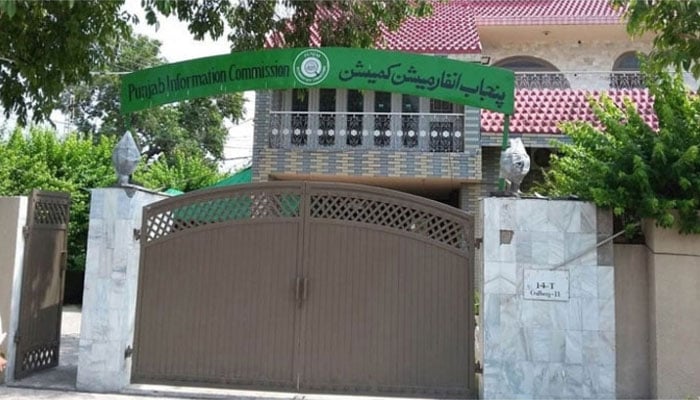
LAHORE: The Punjab Information Commission has directed Emerson University, Multan, to disclose extensive records related to the recruitment of its controller of examinations and an assistant professor after rejecting the university’s claim that the requested information was exempt from disclosure under the transparency law.
The order was issued on a complaint filed by Dr Muhammad Irfan Javaid, an assistant professor at the university, under the Punjab Transparency and Right to Information Act, 2013 seeking certified information and documentary evidence regarding the recruitment processes for the posts advertised in 2023.
According to the record, Dr Javaid submitted two applications to the university registrar on October 19 and October 30 last year invoking Sections 10 and 11 of the transparency law. The first application sought detailed information about the recruitment process, including candidates’ shortlisting criteria, marks obtained in tests and interviews etc, for the post of Controller of Examinations advertised through Advertisement No Ad EUM/Non-Teaching/2023-02.
In a separate application dated Oct 30, 2025, the complainant sought complete information relating to the recruitment to the post an assistant professor of English Linguistics, and the subsequent selection, under Advertisement No EUM/Faculty/2023-01.
After the university failed to provide the requested information, Dr Javaid filed a complaint before the commission. During the hearing held on Januray 22, 2026, the complainant appeared in person while Dr Ghulam Ishaq, deputy registrar, represented the respondent public body.
Rejecting university’s public information officer’s exemption plea, the commission observed that records relating to appointments against public posts could not be withheld on vague privacy grounds.
The commission further ruled that academic and professional documents as well as equivalence certificates submitted by candidates did not originate from the university and therefore attested copies could not be provided under Section 10(9) of the law. Instead, it directed the university to prepare a summary containing details of the qualifications and equivalence. The order also rejected the request for internal correspondence among officers of the university, stating that such material, being non-final in nature, did not fall within the definition of “information” under Section 2(f) of the act.
Allowing the complaint with these exceptions, the commission directed the university to provide the remaining information relating to the recruitment of Controller of Examinations. It further ruled that the same directions would apply to the second application concerning the appointment of the assistant professor.
The commission ordered the university to dispatch the information and record to the complainant within seven days of receiving the order and to inform the commission once compliance had been made. The order was issued by Chief Information Commissioner Muhammad Malik Bhulla and Information Commissioner Bushra Saqib.
When contacted, Deputy Registrar Ghulam Ishaq told this scribe that the university would make the record public in compliance with the commission’s orders. He said the relevant material was stored in archives and gathering the details was time consuming due to shorter office hours during the holy month of Ramazan.
He added that the administration had already issued directions through an official letter to the recruitment officer to provide the information available with him, while the remaining record was being collected so that it could be made public in accordance with the commission’s directives.