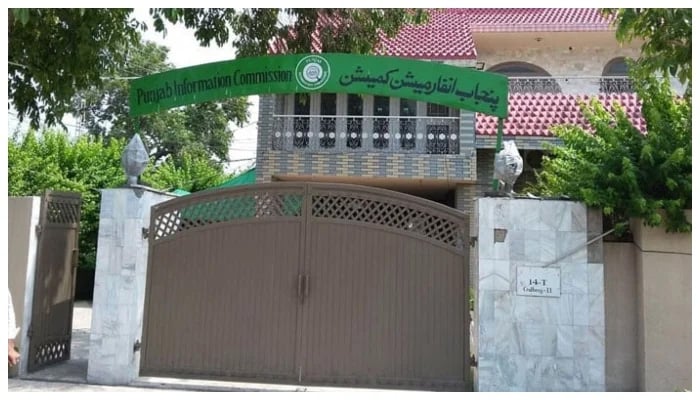
LAHORE: The Punjab Information Commission (PIC) has ordered the University of Gujrat (UOG) to furnish most of the information sought in connection with appointments to senior administrative positions at the university, while upholding the withholding of certain personal records under the Punjab Transparency and Right to Information Act 2013.
The directions were issued in Complaint No. 6-4-2026-21 titled Dr Rashid versus Vice Chancellor, University of Gujrat, during proceedings held at the Punjab Information Commission’s office in Lahore.
According to the official order sheet, the complainant, Dr Rashid, did not appear before the commission during the hearing. Barrister Shahzad Shabbir, legal adviser for the respondent public body, represented the University of Gujrat and submitted a written reply dated April 30 on behalf of the varsity administration.
The respondent contended that the original Right to Information (RTI) application contained certain procedural and technical deficiencies. However, the university informed the commission that it was prepared to provide all information falling outside the exemptions provided under Section 13(1) of the Punjab Transparency and Right to Information Act 2013.
During the proceedings, the commission asked the respondent’s counsel to clearly identify the portions of record being withheld. In response, the legal adviser stated that all information sought by the complainant except the material requested at serial numbers 7 and 8 of the RTI application would be supplied.
The dispute principally revolved around documents relating to the recruitment process for the posts of registrar and controller of examinations at the university.
The commission observed that the information sought at serial number 7 comprised copies of affidavits submitted by all candidates who had applied for the two posts. It noted that the affidavits contained personal and private information, including Computerised National Identity Card (CNIC) numbers and residential addresses of the applicants.
In its ruling, the commission held that disclosure of such material was protected from public access under Section 13(1)(b) of the RTI Act, which deals with exemption of personal and private information. The order further stated that the affidavits had “no effect on recruitment” and that no overriding aspect of public importance was attached to them, a standard linked to Article 19-A of the Constitution of the Islamic Republic of Pakistan, which guarantees citizens’ right of access to information in matters of public significance.
The commission also examined the complainant’s request for attested copies of academic transcripts and experience certificates of the three recommended candidates for the posts in question.
On this point, the commission accepted the respondent’s contention that the documents had not been issued by the University of Gujrat itself and, therefore, attested copies could not be provided by the public body concerned.
Nevertheless, the commission directed the university to disclose substantive details contained in those records in order to ensure transparency in the recruitment process. The order specifically instructed the respondent public body to provide information regarding the candidates’ academic qualifications, years in which degrees were conferred, roll numbers, names of educational institutions and duration of relevant professional experience.
The commission further ordered that the said information be compiled in documentary form and dispatched to the complainant along with the record sought at serial numbers 1 to 6 and 9 of the RTI application. The university was also directed to intimate the commission after compliance with the order.
The complaint was subsequently disposed of “in above terms” by Information Commissioner Bushra Saqib and Chief Information Commissioner Muhammad Malik Bhulla.
When contacted, University of Gujrat Public Information Officer and Assistant Registrar Zain Nabi told Daily Jang that the university had not yet received a copy of the commission’s order.
“As we receive the orders of the information commission, we will implement accordingly,” he said.
The ruling is being viewed as another important interpretation of the balance between transparency obligations and privacy protections under the Punjab Transparency and Right to Information Act 2013, particularly in matters relating to recruitment and administrative appointments in public sector institutions.