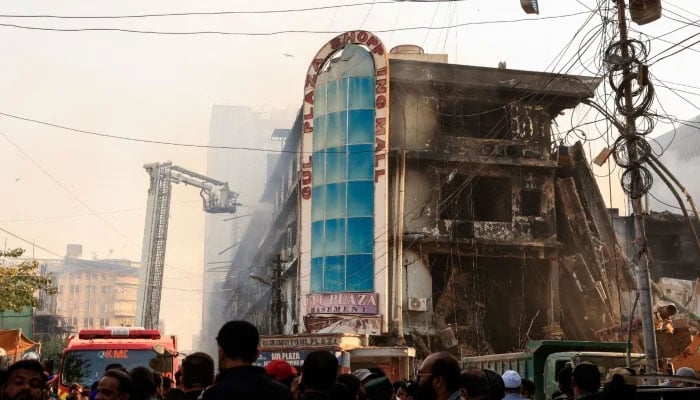
Rescue services had actually come into action in the Gul Plaza shopping centre fire incident after the Fajr prayer, but by that time it had been already too late because the fire had become uncontrollable, according to Gul Plaza Traders Association President Tanveer Pasta.
Submitting a response to the questionnaire of the inquiry commission on Saturday, Pasta said the pace of rescue services had been slow. In fact, he added, no attempt had been made by the rescuers to save the trapped people during the first few hours of the fire.
He said that initial rescue services had been hopeless and extremely slow, adding that they could have saved many precious lives but they neither had the proper equipment nor such a commitment.
He also said that the first fire engine had reached the Gul Plaza at around 10:55pm and had run out of water within 20 minutes.
Two fire engines had arrived at 11:30pm, but until that time the fire had spread to all three sites of the building on the ground floor, and after every few minutes the fire had been reaching out of the building, with the fire engines hardly being able to control it, he added.
Pasta said the firefighters had no tools, masks or equipment to enter the building and rescue the persons trapped on the mezzanine floor. They also had no foam to combat the fire, he added.
He said that the keys of the gates had been available with the watchman, and that the exits had been open and the access routes had been clear.
Smoke was the main reason for the disaster on the mezzanine floor, he added. He also said that more than 3,000 people had exited the building after the fire.
Several people had been rescued after they had called for help, but it is also a fact that several people could not be saved despite their calls for help because of a lack of proper rescue facilities by Rescue 1122 and the fire brigade, he added.
Pasta said the fire extinguishers had been refilled and refreshed before the expiry date, and there had been 100 fire extinguishers and 65 fire balls available inside the Gul Plaza at the time of the inferno.
The management record was burnt in the Gul Plaza fire, but the ownership record of all the shops has been updated and reconstructed at the Karachi Chamber of Commerce & Industry, which has provided it to the authorities, he added.
He said the fire audit of the Gul Plaza had been undertaken from time to time by the fire department, and they had not recommended any fire drill themselves or to be undertaken by rescue services, but proper training had been imparted to the Gul Plaza staff about firefighting equipment and emergency response.
The evacuation announcement could not be made due to electricity shutdown, but the verbal announcement procedure had been put into place, and shopkeepers themselves participated in the evacuation and verbal announcement process to evacuate people, he added.
He also said that 51 of the 72 people trapped in the Gul Plaza had been shopkeepers, while more than 3,000 people had been evacuated from the building, proving that the gates were open at the time of the fire.
On Friday the Karachi Metropolitan Corporation (KMC) chief fire officer had told the inquiry commission that had an electricity or emergency light system been installed in the Gul Plaza, the people trapped inside the burning building could have been evacuated.
Filing a response to the questionnaire of the inquiry commission, the chief fire officer submitted that when the first fire tender arrived at the Gul Plaza, the electricity was already shut down but no such direction had been given to the K-Electric by the fire department.
The officer said the first fire tender reached the building at 22:37 PM within ten minutes after receiving information of the fire from a man, Samad, at 10:26 PM. He said several emergency exists were blocked, locked or otherwise unusable prior to the incident. He added that the absence of effective emergency lighting, exit signage and trained floor wardens hindered safe evacuation.
The fire officer said that exits leading from the first floor to the upper floors were found locked. Other exits were also found locked. He said that no dedicated firefighter access/entry shafts or protected firefighting stairs were available.
He said multiple windows and entry points were secured with grills restricting internal access. He said that due to extreme heat, dense smoke, blocked access routes and structural instability risk, rescue and suppression operations were conducted primarily from exterior using ladders and snorkels while grills were cut where it was feasible to facilitate rescue.
To a question about not going for internal entry, he said that as per firefighting standard operating procedures, the firefighters had to lower the flame temperature of the premises prior to making internal entry in order to prevent life loss.
He said that at the time of the incident, the environment was characterised by extremely high temperatures, dense smoke accumulation and extensive flame involvement, creating interior conditions incompatible with human survival. He said that operational assessment indicated that any interior entry under such conditions would have exposed both public and responding personnel to immediate and severe life threatening hazards.
He said that primary cause of loss of life was lack of safety protocols in the Gul Plaza, including, but not limited to, failure of announcement in case of fire, lack of emergency fire exists, closed exit and discontinuation of electricity before evacuation of people present inside the building.
Responding to a question as to what critical failures most contributed to the tragedy, he said the absence of operating fire alarm and detection system, automatic sprinkler protection, absence of trained emergency response, unsafe electrical installations and operating conditions, disconnections of electricity, lack of emergency light system and block exist were major contributing failures to the tragedy.
On Thursday the station officer of the fire and rescue headquarters of the KMC told the Gul Plaza judicial commission that there is no wireless system at any fire station in the entire city.
Recording his statement before the judicial commission headed by Justice Agha Faisal, station officer Mohammad Taufeeq said the fire department staffers contact each other through the mobile phone.
To a commission query how the fire department works in a case the signal is low or the network is down, he said it is very difficult if the network is down during a procession and department staff coordinate with one another through a landline.
He further said the Gul Plaza fire was reported from the control room, and snorkels, bowsers and tenders were available at Rampa Plaza, but it was not possible to enter the Gul Plaza building due to the fire and smoke.
He told the commission that people were rescued from the roof with the help of snorkels. He said there were three snorkels, two fire tenders in the headquarters, one of which was out of order.
Taufeeq said there are more than sixty staff and four drivers who work in two shifts He said that all three snorkels are used in emergencies by the mechanic and the bowser was taken out first on the report of the fire.
He added that one snorkel was taken out in the rescue operation due to the shortage of drivers, and no one other than trained personnel can operate the tender or the snorkel. Taufeeq stated that a fire tender holds 1600 gallons of water and each fire station has its own tank.
He said they have around 55-60,000-gallon tank and Boulton Market and Saddar fire stations fill water from the headquarters. He noted that that fire station also lost power shortly after the fire and there was a UPS only for the control room.
To a query of the commission what they do if the power goes out, Taufeeq said that they have written a letter for exemption from load-shedding. He said water is supplied from a single line and for the first hour sewage water comes, and after wasting water for an hour, the tanks are filled with water.
He said the fire tender from the Saddar fire station went to Gul Plaza at 10:34pm. He said the fire department recorded the departure time of the fire tender but the time of reaching the spot is not recorded. He told the commission that first the fire is extinguished with water and if the fire is not under control, then foam is used.