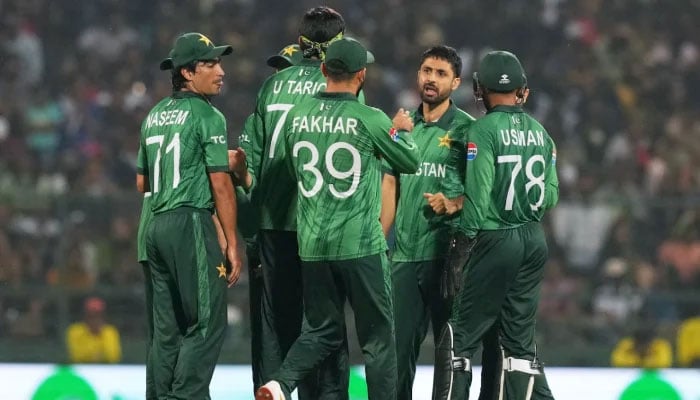
ISLAMABAD: The lingering question of players’ fitness once again echoed through Pakistan cricket circles on Saturday after the national selection committee’s media interaction reignited concerns about the physical readiness of some key members of Pakistan’s T20 World Cup squad.
During the media briefing, chief selector Aaqib Javed and his fellow committee members openly expressed reservations over the fitness levels of a few frontline players, prompting calls for an internal inquiry to determine the true physical condition of Babar Azam, Fakhar Zaman and Salman Mirza during and around the recently concluded ICC Men’s T20 World Cup.
The remarks have raised an even more troubling possibility: whether there were other players in the squad who were carrying injuries or lacking peak conditioning but were still entrusted with the responsibility of representing the country in one of the most demanding tournaments in modern cricket.
Such candid admissions from a senior member of the selection committee point toward a deeper issue, an apparent lack of coordination among the key stakeholders responsible for team preparation and finalization ahead of a global event. Questions are now being asked about whether comprehensive fitness tests were conducted prior to the World Cup or if certain players made the squad largely on reputation rather than physical readiness.
Fitness has long been regarded as the Achilles’ heel of Pakistan cricket. Time and again it has been treated as a secondary requirement rather than a core selection criterion. Yet in contemporary professional sport, physical conditioning forms the very foundation of elite performance. The difference between being “apparently fit” and possessing the conditioning level required of a world-class athlete is vast.
In the case of Pakistan, critics believe only a handful of players consistently meet international fitness benchmarks, while many others rely heavily on past achievements to maintain their place in the side. At times, even players who are not fully fit find their way into the playing XI, an approach that inevitably compromises team performance.
Talent undoubtedly remains a vital ingredient for success. However, in the modern era talent alone is rarely enough to sustain excellence. History across sports shows that countless gifted athletes have faded away because they failed to match the rigorous physical demands of international competition, while those who embraced superior fitness standards went on to dominate their respective fields.
Cricket today demands explosive power, endurance and relentless stamina, qualities that enable players to sustain intensity throughout a match and across packed international calendars. Unfortunately, this is precisely the area where Pakistan’s system continues to fall short.
Even a player of the stature and ability of Babar Azam, widely acknowledged for his class and consistency with the bat, cannot perform at his optimum if physical limitations creep in. As selectors themselves have indicated concerns about his fitness, it becomes impossible for observers and analysts to ignore the broader issue.
Addressing the matter, Aaqib Javed confirmed that the selection committee intends to investigate the circumstances surrounding the injuries and fitness concerns of Babar, Fakhar and Salman Mirza.
“Babar was keen to participate in the National T20 tournament,” Aaqib said. “However, we advised against it because he was not fully fit. Instead, we asked him to focus on regaining his fitness before upcoming events. That is why it is surprising to see the situation regarding players’ fitness immediately after the World Cup.”
Historically, inquiries within Pakistan cricket have often been announced with great intent but rarely see their findings made public. Nevertheless, insiders believe that this latest probe could have consequences within the team management setup.
Should the investigation uncover serious lapses in monitoring or maintaining players’ fitness, it may well result in a shake-up behind the scenes, with one of the team officials potentially paying the price and a new figure stepping in to take charge.