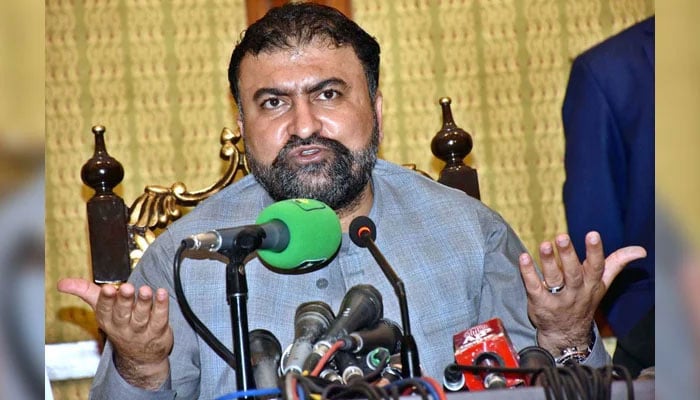
QUETTA: Balochistan Chief Minister Sarfaraz Bugti said on Friday that organised groups in Europe are luring young people — particularly university students — into militancy.
Speaking on a point of order during a session of the Balochistan Assembly, he announced that a de-radicalisation centre has been activated in Quetta where detainees are being provided facilities, including meetings with their families. “Taking young people out of universities and turning them into suicide bombers cannot be called a service,” he said.
The government has passed a law stating that after anyone is taken into custody, their family must be informed within 12 hours, the individual must be presented before a magistrate, and during a three-month detention period, weekly meetings with their family will be arranged.
The CM also showed a video of Quetta’s de-radicalisation centre. He added that any extension of detention at the de-radicalisation centre will require approval from the high court, and its in-charge will be a civilian SP.
During the session, Abdul Malik Baloch, head of the National Party, raised concerns about the government’s policy regarding Pasni Fish Harbour. Baloch also criticised the government’s decision to include additional and deputy secretaries from the Finance Department on the boards of language academies. He argued that sending senior officials to attend meetings of small academies — one of which receives an annual grant of only Rs500,000 and is located in Turbat — was impractical. He said Balochi, Brahvi, Pashto and Hazaragi academies already operate with limited resources and suggested auditing them if the government had concerns.
He further said that four to five members of the National Party had been killed within a week in areas including Jhao, Gishkor, and Kogdan, and demanded action.
Meanwhile, Mir Asadullah Baloch of BNP-Awami said promoting mother languages is a constitutional responsibility and that academies should be strengthened. He also expressed concern over ongoing violence in Panjgur, saying bodies were being found regularly and urged the government not to target the civilian population while confronting militants.
Responding to the concerns, Bugti acknowledged that the National Party had suffered losses in the fight against terrorism and said the entire house condemns incidents of violence in Panjgur and Turbat. He stressed that the government only wants to monitor the financial affairs of academies following issues highlighted in a Special Branch audit report. Bugti alleged that some poetry in the Balochi language is being used to incite youth against the state and encourage suicide attacks. “The government only wants to ensure that public funds are not used against the state,” he said.
Addressing the issue of missing persons, Bugti described it as complex and said his party has always opposed enforced disappearances. He said that the number of missing persons in Khyber-Pakhtunkhwa is higher than in Balochistan, but the issue receives less attention. He said de-radicalisation centres are being established to address the problem, with one already inaugurated in Quetta and funds approved for centres in southern districts.
Referring to militant leader Bashir Zeb, he alleged that his actions had led to the deaths of 190 Baloch. “Violence cannot free Balochistan,” Bugti said, adding that the government has opened doors for youth to study at international institutions, including Harvard University. “Our identity is first Pakistani; only then are we Baloch or Bugti,” he said, adding that while dialogue is welcome, disputes cannot be resolved through violence or at gunpoint.