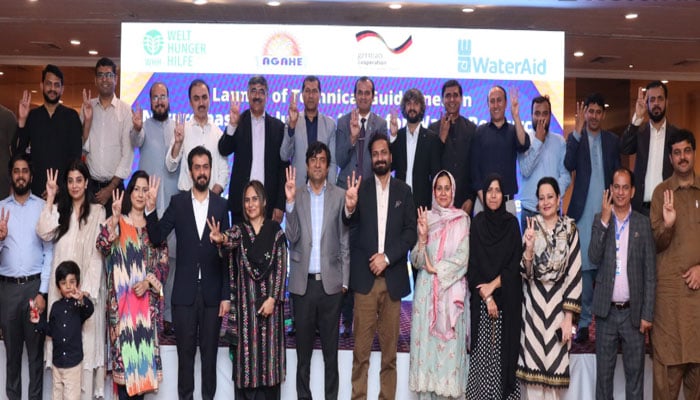
Islamabad:Technical guidelines on Nature-Based Solutions (NbS) for water resources management were launched at a learning exchange organised by WaterAid Pakistan in collaboration with Welthungerhilfe (WHH) and AGAHE, says a press release.
The event brought together senior government officials, development partners, civil society organisations and sector experts to accelerate the adoption of climate-resilient water, sanitation and hygiene (WASH) services in Pakistan and to showcase practical service delivery models designed to strengthen water security in the face of increasing climate pressures.
Ramesh Singh Arora, Minister for Human Rights and Minorities Affairs, Government of Punjab, emphasised the importance of integrating sustainable and nature-based approaches into public sector planning to address growing water stress and climate risks that especially impact the vulnerable communities in Pakistan.
Shakeel Ahmad Mian, Secretary, Local Government & Community Development Department (LG&CD), Government of Punjab, highlighted the need for stronger coordination between government institutions and development partners to ensure sustainable and resilient water services.
Amina Munir, DG Climate & Technology, Environment Protection & Climate Change Department, emphasised that integrating Nature-Based Solutions into planning is important for strengthening climate resilience and promoting sustainable water management in Pakistan
Mian Muhammad Junaid, Country Director, WaterAid Pakistan, noted that climate change is placing increasing pressure on water and sanitation systems across Pakistan.“Climate-resilient WASH systems are essential to protect communities and ensure service continuity. Nature-Based Solutions such as rainwater harvesting, groundwater recharge and nature-based wastewater treatment offer practical ways to strengthen water security while supporting ecosystem restoration.”
Mian Hamidullah, Sector Advisor, Welthungerhilfe (WHH), stressed the importance of partnerships in strengthening WASH systems.“Addressing water and sanitation challenges requires strong collaboration between communities, government institutions and development partners. Platforms like this help align efforts and accelerate progress towards climate-resilient development.”