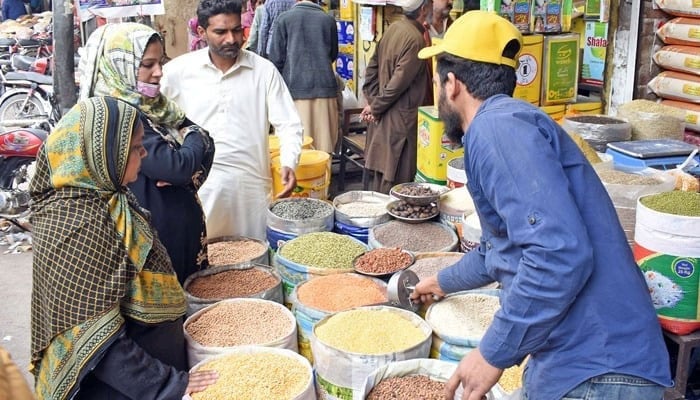
LAHORE : With more than half of Ramazan is already over, the district administration’s intensified campaign of ‘surprise’ market inspections has yet to deliver any meaningful relief to consumers.
Despite frequent visits by officials, residents say prices of essential food items remain far above the officially notified rates, widening the gap between government claims of enforcement and the realities in local markets.
Officials — including the deputy commissioner, assistant commissioners and the SACM on Food Safety and Consumer Protection — have continued to tour open markets, super marts and Sahulat Ramazan Bazaars. The visits are meant to signal strict monitoring and price control during the fasting month. Yet on the ground, traders continue to ignore official rate lists with little fear of sustained penalties, raising questions about the effectiveness of the ongoing crackdown.
What has drawn particular criticism is the apparent reluctance of authorities to address violations in key commodities such as meat, milk and curd. Consumers and market observers note that these items are rarely checked during official visits, even though overcharging is widely reported.
The government’s reliance on Sahulat Ramazan Bazaars has also come under scrutiny. Only a limited number of such bazaars operate across the sprawling city, making them insufficient to serve the needs of Lahore’s large population.
Residents complain that lower-grade meat is commonly offered at these outlets, while the freshness and quality of fruits and vegetables vary widely.
Meanwhile, open markets continue to witness widespread violations of official rates. Essential food items — from milk and curd to pulses and perishables — are rarely sold at the prices fixed by authorities. Although ACs occasionally impose fines during inspection visits, traders often resume overcharging shortly afterwards. In many cases, shopkeepers openly acknowledge that the penalties have little deterrent effect. For now, consumers remain largely at the mercy of market forces.
This week, live chicken prices increased by Rs15 per kg on the official list and were fixed at Rs329–343 per kg. However, the commodity was largely unavailable at these rates across many localities. Chicken meat followed the same trajectory, gaining Rs22 per kg to reach an official price of Rs497 per kg, while consumers paid between Rs540 and Rs610 per kg. Boneless chicken continued to sell at significantly higher rates, hovering around Rs850 per kg and above in several neighbourhoods.
Vegetable markets reflected a similar disconnect. Soft-skin new potatoes were officially fixed at Rs18–20 per kg but sold at Rs30–40 per kg. Tomatoes saw a Rs5 per kg reduction and were fixed at Rs60–65 per kg, yet retail prices ranged from Rs120 to Rs160 per kg. Onion prices were reduced by Re one per kg to Rs48–52 per kg, though they continued to sell between Rs80 and Rs100 per kg.
Local garlic prices declined by Rs10 per kg to Rs190–200 per kg but retailed at Rs280–300 per kg. Chinese garlic remained stable at Rs505–530 per kg and sold between Rs600 and Rs700 per kg. Ladyfinger was gained by Rs5 per kg, fixed at Rs200–210 per kg but sold at Rs350–400 per kg. Fruit prices showed mixed trends. Apples were officially fixed between Rs250 and Rs420 per kg but sold at Rs350–600 per kg depending on quality. Banana A-category fixed at Rs215–240 per dozen, yet retail rates ranged from Rs300 to Rs350 per dozen. B-category bananas were fixed at Rs125–140 per dozen but sold at Rs200–250 per dozen.
Guava prices were fixed at Rs138–145 per kg and sold between Rs250 and Rs300 per kg. Dates were fixed at Rs385–490 per kg but retailed between Rs800 and Rs2,200 per kg. Citrus fruit prices were fixed between Rs220 and Rs335 per dozen but retailed at Rs350–500 per dozen. Kandhari pomegranates were fixed at Rs601–630 per kg and sold between Rs800 and Rs1,000 per kg. Melon reduced by Rs40 per kg, fixed at Rs160–200 per kg but sold at Rs200–300 per kg. Strawberry prices were fixed at Rs362-380 per kg, sold at Rs450–500 per kg, while grapes, fixed at Rs420–440 per kg, retailed between Rs800 and Rs1,000 per kg.