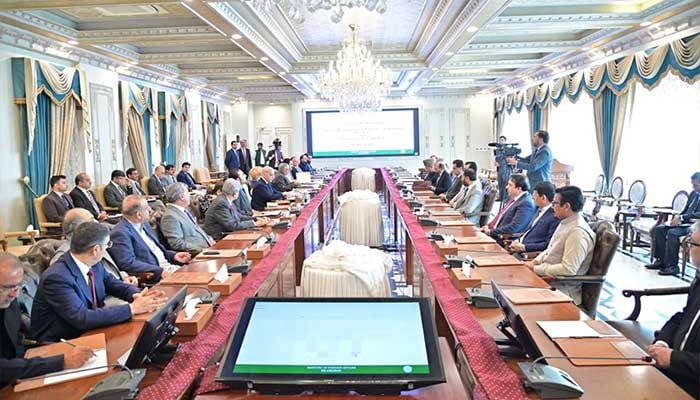
At moments of regional uncertainty, governments often turn to the language of unity. The in-camera briefing convened by Prime Minister Shehbaz Sharif yesterday for leaders of parliamentary parties was framed precisely in those terms: a collective effort to discuss the evolving regional situation and develop a coordinated national response. The parties were given a briefing on the ongoing Operation Ghazab Lil Haq against terrorist hideouts in Afghanistan, the war in Iran and the consequent situation in the Middle East and Gulf, as well as Pakistan’s diplomatic efforts in this regard. A statement from the PM Office said that the participants emphasised the need for national unity, consensus and unanimity in the current circumstances, hailed Pakistan’s diplomatic efforts for peace, stressed the need to intensify them and made recommendations for the future plan of action. They also reiterated their firm commitment to eradicating terrorism from the country. While PM Shehbaz made the right move by taking the entire political leadership into confidence, the PTI decided not to attend it unless a meeting with PTI founder chairman Imran Khan was arranged. It is quite unfortunate that a briefing that was about the external and internal threats to Pakistan was boycotted by the opposition because it seems everything is conditional.
A national conversation without the principal opposition party inevitably falls short of genuine consensus and one wonders when the PTI will start to see national politics and emergency issues for what they are: essential to sustain this country. At a time when Pakistan is fighting the Afghan Taliban regime for harbouring the TTP and the Baloch Liberation Army (BLA), the party that is the most affected due to the TTP’s terrorism and the policies of the Taliban regime decided to sit this one out for political reasons. The PTI needs to understand that this is not just a missed opportunity in political terms but also sends the wrong message to the world. This will not put more pressure on the government to let them meet Imran. It will instead be counter-productive.
Another debate unfolding in some quarters has further muddied the discussion. Certain commentators have attempted to draw a parallel between Pakistan’s strikes on militant hideouts across the Afghan border and the recent US-Israel attacks on Iran. Such comparisons are misleading and infact insulting to the intellect. Pakistan’s actions are acts of self-defence against groups responsible for repeated cross-border terrorist attacks – strikes undertaken after warnings and diplomatic engagement with an Afghan regime that has failed to curb the activities of these militants. By contrast, the attacks on Iran have been widely criticised by many observers as violations of international law. While the effectiveness and consistency of international legal norms are often debated, conflating two fundamentally different situations only adds confusion to an already tense regional environment. Pakistan has endured a sustained wave of terrorist violence since the fall of Kabul in 2021, with groups operating from Afghan territory carrying out attacks inside the country. Islamabad has repeatedly attempted to address the issue through diplomatic channels before resorting to limited military responses. This is also why consultations with the political leadership matter. Diplomatic initiatives, counterterrorism policies and border management strategies are far more durable when they command support across the political spectrum. Otherwise, decisions risk being viewed through the lens of partisan rivalry rather than national interest. The government deserves credit for extending the invitation and attempting to brief the wider political leadership. Pakistan’s strategic challenges, both internal and external, are unlikely to diminish in the coming months. The region is entering a period of heightened uncertainty, and Islamabad’s policy choices will demand careful calibration. In such a moment, the country can ill afford political fragmentation.