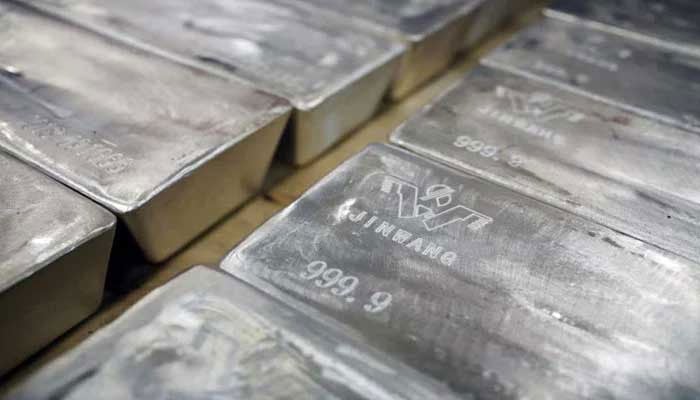
For five consecutive years, global silver demand has exceeded supply — creating a cumulative deficit of roughly 800 million ounces, the equivalent of an entire year’s mine production.
This is not a one-year anomaly. It is structural. From roughly 2020 onward, annual demand — industrial, jewellery, silverware and investment combined — has consistently outpaced total supply from mine production plus recycling. The annual shortfall has averaged well over 100 million ounces in several of those years. Add it up and the cumulative deficit approaches 800 million ounces.
Inventories at the world’s largest silver vaults are down sharply: COMEX down 30 per cent in a year, London vaults 40 per cent, Shanghai at decade lows. Even if prices triple, supply lags far behind demand because 70 per cent of silver is a byproduct of copper, zinc and lead mining. Even if prices triple, building new mines takes 8-12 years from discovery to permitting to financing to construction. This is not a cyclical shortage — it is a structural bottleneck.
Part of the perfect storm is the BRICS nations ditching the US dollar and piloting a precious metal-anchored currency unit. Last year, central banks — People’s Bank of China, Central Bank of the Republic of Turkiye, Reserve Bank of India, Narodowy Bank Polski and the Monetary Authority of Singapore — bought 900 tonnes of gold.
The Federal Reserve, along with other major central banks, continues to print currency at an unprecedented rate, debasing fiat currencies and pushing investors toward hard assets — lifting silver prices as monetary dilution accelerates.
Geopolitics is another accelerant. US carrier groups in the Gulf, wars in Eastern Europe and tensions in the South China Sea. Plus, supply chains have been weaponised. And, when uncertainty rises, capital seeks insurance. Gold moves first. Silver follows — and often outpaces — because it is both monetary metal and industrial input. In every episode of stress — 2008, 2011, 2020 — silver has behaved not just as a commodity, but as a volatility amplifier. Silver always moves on fear.
Silver is not just monetary. It is industrial — solar panels, electric vehicles, 5G, AI hardware and data centres. This is not discretionary demand. It is policy-driven demand.Remember, energy transition is not cyclical — it is legislated.
In January 2026, silver traded above $120 per ounce, a multi-decade high. Over the past 12 months, silver is up a wholesome 180 per cent. A growing cohort of analysts and institutional models now places $150 per ounce within the realm of possibility over the next 12 months.
Silver is not moving because of one storm. It is moving because monetary policy, industrial policy, and geopolitical risk are converging. Three forces. One metal.
The writer is an Islamabad-based columnist.