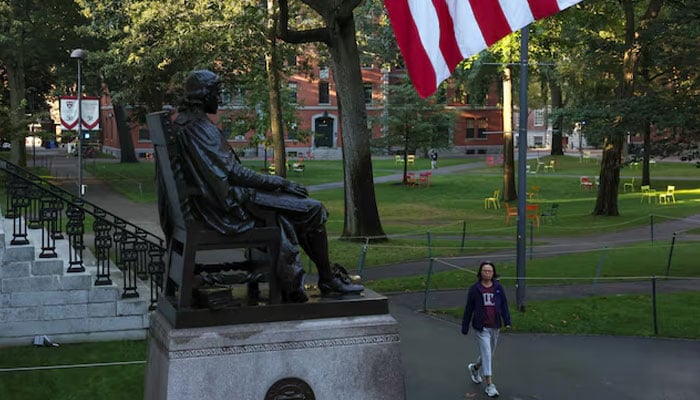
The US military’s termination of academic ties with Harvard University will result in the discontinuation of all graduate-level Professional Military Education (PME) at Harvard. Though a Harvard-specific decision, US Secretary of War Pete Hegseth cited ideological differences between Harvard and the US military’s needs, indicating a wide gap in perceptions between military and civilian institutions regarding the ways and outcomes of both.
The debate is bound to gain momentum as both sides voice their ideologies on pedagogy, research, knowledge creation, academic freedom and in a broader context on the role of the university and society.
The cessation of ties indicates a tectonic divide that goes far deeper than a mere response to the popular pro-Palestine student protests, encampments and confrontations that swept American campuses calling for a ceasefire, especially in prominent universities. Such protests were ‘natural’ in countries with freedom of speech during the Gaza massacres of over 70,000 Palestinians over the last two years.
Global thinking has been changing very fast due to open information and debate on the high-profile Israel-Palestine conflict, as well as simultaneous international developments like China’s rise to prominence, Iran’s emergence as a stronger regional power and the Ukraine-Russia war. So indeed, universities, as educational institutions, find themselves active in learning, teaching and conducting research to ‘find the truth’ which is the primary objective of knowledge.
Though the graduate programmes of a few hundred officers from the 235,000-237,000 active military commissioned officers will continue in several civilian universities across the US, they will end at Harvard only. The reason given for this is that officers returning from Harvard have “heads full of globalist and radical ideologies that do not improve our fighting ranks” and that the military “trains warriors, not wokesters”.
For Harvard particularly, the student protests accelerated the drift with the federal administration; in May 2025, President Trump ridiculed the need for remedial math, questioned Harvard’s admission standards, revoked Harvard’s ability to enrol international students, and cut federal research funding by $2 billion. For Harvard University, among the highest-ranked and world’s most prestigious centres of learning and knowledge creation, with a matching student-faculty ratio and an endowment fund of over $56.9 billion, these measures are unlikely to lower its standing or reputation in any serious way. They could, however, lead some faculty to compromise on ‘critical thinking’ which may undermine intellectual rigour, affect tenure and career progression, and hence hit on the most prized attribute of a university, which is its academic freedom.
The two most pronounced distinctions between military and civilian universities are governance and the conduct of academic operations. Military universities are characterised by a centralised, hierarchical structure and a high volume of Standard Operating Procedures (SOPs). In contrast, civilian universities exhibit a higher degree of distributed autonomy, especially for faculty, with little presence of any chain of command, as faculty members are drawn from the same ‘academic community’ and would therefore be expected to be familiar with professional and institutional norms and operational flow.
In situations of ambiguity, which are common in academic settings, faculty are entrusted with exercising sound professional judgement. In the conduct of academic operations, military universities adhere closely to pre-approved teaching plans and prescribed research areas, whereas civilian universities allow faculty considerable freedom in pedagogical approach within a broadly defined curriculum. In graduate education and research, a conceptual difference is found between military and civilian universities. Faculty are expected to provide original content, critical thinking, and high scholastic aptitude in students who will support faculty in pitching for grants in their areas of specialisation. These pedagogical skills and research application processes are highly competitive and demand a high level of publishable content, thereby creating new knowledge.
Graduate programmes further illustrate these differences in disciplinary practice, which are sharply varying across STEM and Social Science disciplines. STEM courses are largely objective, relying on mathematical modelling, empirical evidence or experimental data which generally limits or eliminates controversy. In contrast, social science disciplines are often interpretive and less quantitative, making them more susceptible to divergent perspectives and debates. This subjectivity is specially more pronounced when teaching or research intersects with political, national, cultural, or religious beliefs generating heightened scrutiny and potential criticism such as a possible military perception of a university producing ideological automatons, wokesters, or adherents of ‘globalist and radical ideologies’ rather than ‘warrior’ officers trained as in the traditional, disciplined mold of soldiers ready to act decisively on the command of their superiors.
It would be fair to conclude that while the governance of military and civilian universities will, and rightly should, remain fundamentally distinct, the core mission of education, teaching, research and knowledge creation must be based on academic freedom. This Harvard-US government issue appears to focus on the social sciences rather than STEM curricula and outcomes. Formulating and conducting teaching and research, and creating knowledge, in the social sciences will always remain a sensitive topic as long as there remains a clash of civilizations. In the final analysis, it is in no one’s interest to produce one-dimensional tunnel-vision ideological automatons.
An ideal university would be one where faculty are fully supported, encouraged and entrusted to produce graduates with high levels of knowledge in their areas capable of making sound decisions, for the larger and ‘common good’ of humanity, based on their insight and abilities for critical thinking and adaptation to unforeseen evolving challenges.
The writer is a retired professor and has a PhD in nuclear engineering and is author of the book ‘Nuclear Engineering’. He can be reached at: [email protected]