KARACHI: The coming week may bring cautious recovery at the Pakistan Stock Exchange (PSX) as easing geopolitical stress and improving macro signals support sentiment, though investors will likely stay selective ahead of key policy events and external reviews.
Analysts expect value hunting to emerge after the recent correction, with attention on foreign inflows, currency stability, and progress in talks with the International Monetary Fund (IMF).
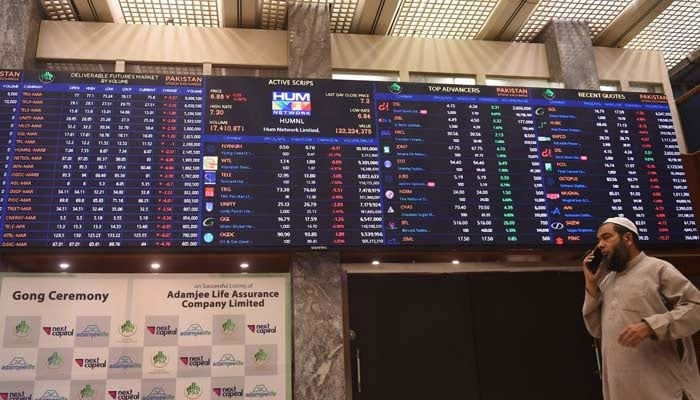
The benchmark KSE-100 index fell by 6,434 points, or 3.6 per cent week-on-week (WoW), to close at 173,170 points on Friday, reflecting global risk aversion and local political noise. Trading activity slowed during Ramazan, with average daily volumes declining 22 per cent to 831 million shares from 1.1 billion a week earlier.
Despite the pullback, economic indicators remained supportive. Pakistan posted a current account surplus of $121 million in January 2026, reversing earlier deficits on the back of stronger workers’ remittances.
Large-scale manufacturing grew 4.8 per cent year-on-year (YoY) in the first half of FY26, led by automobiles and textiles, signalling gradual industrial recovery. The government also notified around Rs5 per kWh reduction in industrial power tariffs, reinforcing expectations of lower production costs, while power generation rose 12 per cent YoY during January amid improved demand.
However, fertiliser offtake dropped 48 per cent year on year due to high inventories after advance buying in the previous month. Foreign exchange reserves held by the State Bank of Pakistan (SBP) edged up $19 million week on week to $16.2 billion as of February 13.
Quoting research, AKD Research said it expects the market to recover as domestic and geopolitical uncertainties subside, noting that equities are trading at attractive valuations with a forward price-to-earnings ratio of 7.3 times and a dividend yield of 6.4 per cent, and forecasting the index to reach 263,800 by December 2026 while investor confidence improves on the likelihood of foreign portfolio and direct investment flows, particularly amid improving relations with the United States and Saudi Arabia.
Nabeel Haroon, vice president for international equity sales at Topline Securities, attributed the week’s decline mainly to foreign corporate selling, with net outflows of about $28 million, while individuals and banks absorbed the pressure through net purchases of roughly $14.35 million and $12.05 million respectively.
He also highlighted encouraging macro signals, including a stronger external balance, a slight easing in the Real Effective Exchange Rate (REER) to 103.3 in January, and net foreign direct investment of $173 million compared with an outflow in December.
Syed Danyal Hussain of JS Global observed that global equities remained under strain due to rising tension between Washington and Tehran, which pushed Brent crude to a seven-month high near $72 per barrel and dampened investor appetite across emerging markets.
He noted that an IMF mission is expected later this month to review progress under the $7 billion programme and begin discussions on the FY27 budget, a development investors will watch closely.
Additional positives included IT exports rising 19 per cent year on year in January, textile exports inching up 1.3 per cent during 7MFY26, and Roshan Digital Account inflows crossing $12 billion.
On the sectoral front, vanaspati and woollen stocks posted modest gains, while refineries, modarabas, and oil marketing companies faced declines amid margin concerns. The government also raised Rs677 billion in a Treasury bill auction against a Rs450 billion target, with yields increasing by 9-20 basis points (bps), signalling tighter liquidity conditions.
Market participants now expect range-bound trading in the near term, with sentiment tied to external financing clarity, energy cost relief for industry, and any revival in foreign participation.