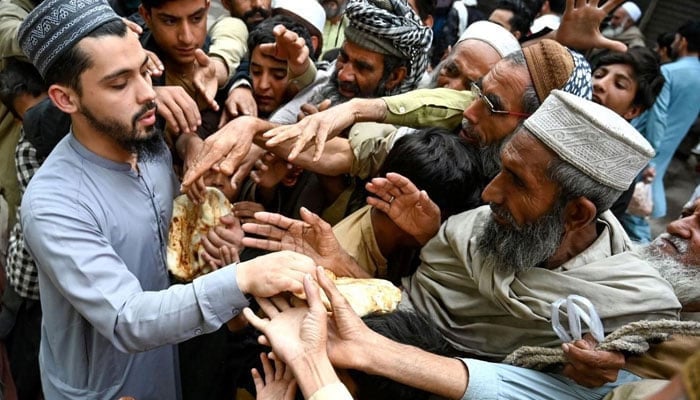
ISLAMABAD: Poverty and inequality in Pakistan have risen sharply in the backdrop of unprecedented inflationary pressures, lower growth, three IMF-sponsored bailout packages, eruption of COVID-19, massive depreciation of the exchange rate and two devastating floods, pushing the poverty level up to 28.9 percent in 2024-25.
Out of the country’s population of 240 million, the number of poor living below the poverty line has climbed to 69.4 million in accordance with the latest poverty figure of 28.9 percent.
These estimates have been shared by the Poverty Estimation Committee, comprising domestic and international donors’ experts, on the basis of Household Integrated Economic Survey (HIES) undertaken by the Pakistan Bureau of Statistics (PBS) in 2024-25.
The poverty rate rose from 21.9 percent in 2019 to 28.9 percent in 2025, going up by 7 percentage points. The CPI-adjusted poverty line stands at Rs8,484 per adult equivalent per month in FY25 against Rs3,757 in FY19.
Inequality, a gap between rich and poor, has further widened, and in accordance with Gini-coefficient, it rose to 32.7 percent in FY25 from 28.4 percent in FY19.
However, the head of Poverty Estimation Committee, Dr G.M Arif, stated that they could not differentiate the poverty level from 2019 to 2022 when the PTI was ruling the country and the period from 2022 to 2025 when the incumbent regime was in power.
He said it was a good sign that the methodology of Cost of Basic Needs (CBN) was not changed, so the series of poverty figures were consistent.
However, Minister for Planning Ahsan Iqbal blamed the PTI for clinching artificial consumption-led growth during its tenure in 2022 that had sown the seeds of instability on the economic front.
In the last two decades, the incidence of poverty declined, starting from 2005-6, from 50.4 percent to 44.1 percent in 2007-8. It stood at 36.8 percent in 2010-11, 36.3 percent in 2012-13, 29.5 percent in 2013-14, 24.3 percent in 2015-16 and 21.9 percent in 2018-19. This declining trend, the minister said, was reversed in 2024-25 when the poverty rate increased to 28.9 percent.
Among the four provinces, Sindh stands on the top on account of increase in poverty, as the poverty level in the PPP-led province went up by 8.1 percent in six years, as it increased from 24.5 percent in FY19 to 32.6 percent living below the poverty line in FY25.
Poverty level in Punjab, under the PMLN, increased by 6.8 percent in six years. The number of people below the poverty line rose from 16.5 percent in FY19 to 23.3 percent in FY25.
In KP led by PTI, poverty rose by 6.6 percent from 28.7 percent in FY19 to 35.3 percent in FY25. In Balochistan under the coalition dispensation, poverty increased from 41.8 percent in 2019 to 47 percent in FY25.
While launching the estimation on Poverty and Inequality in 2024-25, Minister for Planning Ahsan Iqbal said without achieving export-led growth, the country could not come out from the clutches of poverty. Flanked by Chief Economist and Head of Poverty Estimation Committee Dr G.M Arif, Ahsan said 9 million overseas Pakistanis were contributing $40 billion in the shape of remittances while the remaining 240 million could only earn $40 billion through total exports of goods and services in a year.
Rural poverty at the national level increased from 28.2 percent to 36.2 percent in FY25, while urban poverty went up from 11 percent to 17.4 percent. National inequality rose from 28.4 percent to 32.7 percent driven by sharper widening in both rural and urban areas.
The provincial levels also reflect upward trends, as it increased from 28.4 percent to 32 percent in Punjab, from 29.7 percent to 35.9 percent in Sindh, from 24.8 percent to 29.4 percent in KP and from 21 percent to 26.5 percent in Balochistan.
Answering a query about the IMF programmes, the minister said the IMF was not the choice but was essential to stabilise the economy first and then move towards growth trajectory.
When asked about levels of poverty from 2019 to 2022 under the PTI-led regime and impact on it during 2022 to 2025 period under PML dispensation, Dr G.M Arif replied that they did not check the data on these lines. However, Ahsan blamed the PTI for consumption-led growth due to which they were forced to stabilise the economy and swallowed the bitter pill.