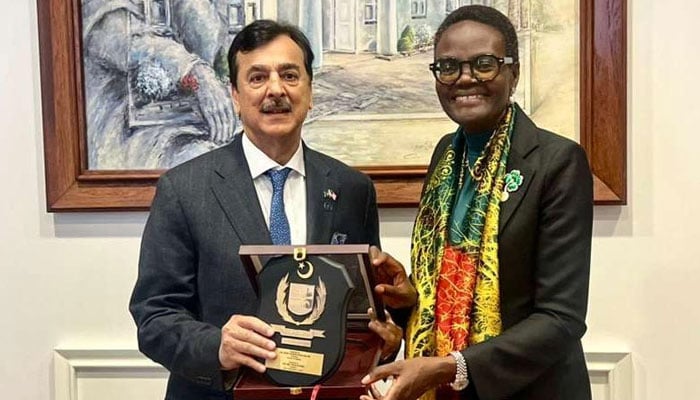
NEW YORK: Senate Chairman Syed Yousaf Raza Gilani met with the President of the Inter-Parliamentary Union (IPU), Dr. Tulia Ackson, reaffirming Pakistan’s steadfast commitment to strengthening parliamentary democracy, multilateralism, and global cooperation through active engagement with the IPU.
The Senate chairman expressed deep appreciation for the IPU’s historic role as the global voice of parliaments and a guardian of parliamentary democracy. He underscored that Pakistan regards the IPU as a vital platform for advancing dialogue, rule of law, inclusive governance, and constructive parliamentary engagement across regions.
Gilani reaffirmed Pakistan’s strong and long-standing partnership with the IPU, highlighting the active participation of Pakistan’s Parliament in IPU Assemblies, Standing Committees, and General Debates.
The chairman particularly recalled his participation in the 150th IPU Assembly held in Tashkent in April 2025.
He noted that sustained high-level exchanges between Pakistan and the IPU leadership over successive years reflect the depth, maturity, and continuity of this important partnership.
Highlighting Pakistan’s proactive parliamentary role, Gilani referred to the successful hosting of the Inter-Parliamentary Speakers’ Conference (ISC) in Islamabad in November 2025. He noted that the conference reinforced inseparable linkage between peace, security, and sustainable development and demonstrated Pakistan’s growing stature as a trusted partner in parliamentary diplomacy.
On democratic governance and rule of law, he emphasised the Senate of Pakistan’s role in fostering inclusive legislation, safeguarding minority rights, ensuring provincial representation, and strengthening oversight and accountability mechanisms.
Discussing the Sustainable Development Goals (SDGs), Gilani recalled that Pakistan adopted the 2030 Agenda through a unanimous parliamentary resolution in 2016, anchoring the SDGs in national policy through parliamentary ownership. He acknowledged the IPU’s global leadership in promoting SDG localisation and expressed interest in enhanced cooperation in SDG-aligned legislation, public finance oversight, and evidence-based lawmaking.
On climate change, he underscored that Pakistan remains among the countries most vulnerable to climate impacts, recalling the devastating floods of 2022 and subsequent extreme weather events. He called for closer collaboration with the IPU in building parliamentary capacity on climate-responsive legislation, disaster risk reduction, and climate resilience.
He also commended the IPU’s leadership in advancing gender equality and women’s political empowerment. He noted Pakistan’s constitutional provisions for reserved seats for women in Parliament and key legislative measures protecting women’s rights. He further highlighted the Benazir Income Support Programme as a flagship social protection initiative contributing significantly to poverty reduction and women’s economic empowerment.
On human rights and global peace, Gilani appreciated the impartial work of the IPU Committee on the Human Rights of Parliamentarians and reiterated Pakistan’s support for dialogue, diplomacy, and peaceful conflict resolution. He reaffirmed Pakistan’s principled position on the right to self-determination of the people of IIOJ&K in accordance with relevant UN Security Council resolutions and underscored Pakistan’s unwavering support for the establishment of a viable and sovereign State of Palestine based on pre-1967 borders with Al-Quds as its capital. The Senate chairman proposed more structured and institutionalised engagement between Pakistan’s Parliament and the IPU.
The President of the IPU appreciated Pakistan’s active and constructive role within the organisation and welcomed continued cooperation to advance shared objectives of democratic governance, peace, and global parliamentary solidarity.
The Senate chairman also met with the Secretary General of the Inter-Parliamentary Union (IPU), Martin Chungong, and reaffirmed Pakistan’s strong commitment to parliamentary diplomacy, multilateral cooperation, and enhanced institutional linkages between parliamentary secretariats.
Gilani also commended IPU’s efforts towards gender-responsive parliamentary institutions and stressed the importance of gender-sensitive policies within parliamentary secretariats, including recruitment, promotions, work-life balance, and protection against harassment. He proposed enhanced staff-level cooperation and participation in IPU programmes focused on women’s empowerment and institutional strengthening.
The IPU Secretary General appreciated Pakistan’s active engagement with the Union and acknowledged the constructive role of the Senate of Pakistan in advancing democratic values and inclusive governance at the international level.
The meeting concluded with a shared commitment to further deepen cooperation between Pakistan’s Parliament and the IPU in pursuit of effective, transparent, and people-centred parliamentary institutions worldwide.