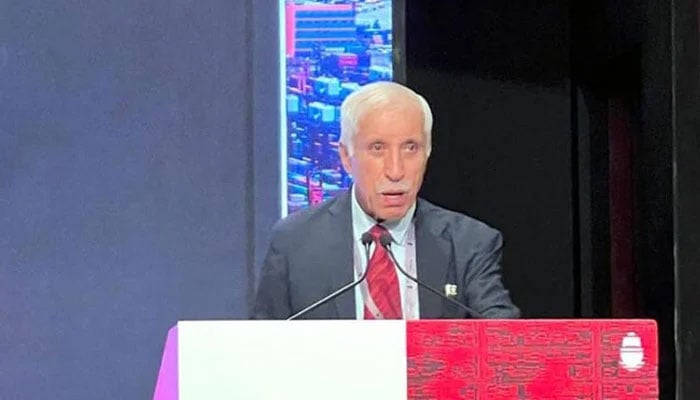
Federal Minister for Investment Qaiser Ahmed Sheikh has called upon the corporate sector to channel the maximum share of its philanthropic and corporate social responsibility (CSR) resources towards educating and imparting skills to children from deprived communities, terming it the most effective route to Pakistan’s accelerated socio-economic progress.
He was speaking as the chief guest at the 18th Annual CSR Summit and Awards 2026 organised by the National Forum for Environment and Health (NFEH), where 70 organisations were recognised for their outstanding contributions in sustainability and philanthropy.
He observed that CSR had evolved into an essential pillar of modern business strategy. Investment, he noted, could no longer be measured solely through financial indicators and it must also improve lives, generate employment, reduce poverty and strengthen social stability.
“Businesses today are not merely economic actors but key partners in social progress,” he remarked.
Referring to China’s transformative development journey, Sheikh highlighted how consistent long-term planning, robust industrial policy, technological advancement and sustained investment in education and skills enabled the country to lift hundreds of millions out of poverty. He stressed that education, innovation and human capital development remained the cornerstones of sustainable growth.
Emphasising the need for public–private partnerships, he stated that investment in human resources was the most reliable pathway to poverty alleviation and economic stability. Strengthening education, research and skill development, he said, was essential for inclusive and enduring national progress.
Former federal minister for investment Muhammad Azfar Ahsan described the presence of 26 million out-of-school children as one of Pakistan’s gravest development challenges. He warned that meaningful national progress would remain elusive unless this crisis is urgently addressed, urging the business community to step forward under its sustainability and CSR commitments.
Former chief of the naval staff, Muhammad Asif Sandila shared the progress of the Mowain Foundation established by him in 2015. Beginning with the adoption of two government schools, the foundation now managed 338 schools with an enrolment of 45,000 students, 60 per cent of whom are girls. He further revealed that 76 per cent of its 3,300 graduates had become self-employed after receiving vocational training.
Musarrat Jabeen, executive director of the Securities and Exchange Commission of Pakistan, highlighted ongoing regulatory efforts to strengthen sustainability reporting and enhance compliance with environmental, social and governance (ESG) and CSR standards among major corporate entities.
Humaira Zia Mufti, secretary of the National Commission on the Status of Women, pointed out that women constituted only 23 per cent of Pakistan’s formally employed workforce. While women accounted for nearly half of the agricultural workforce, she noted, most remain unpaid. She outlined the commission’s initiatives aimed at promoting financial empowerment, gender equality and access to justice through digital technologies.
NFEH President Muhammad Naeem Qureshi said the CSR Summit served as an annual platform bringing together leaders from industry, business, philanthropy, government and the public sector to align efforts in addressing pressing social and economic challenges.