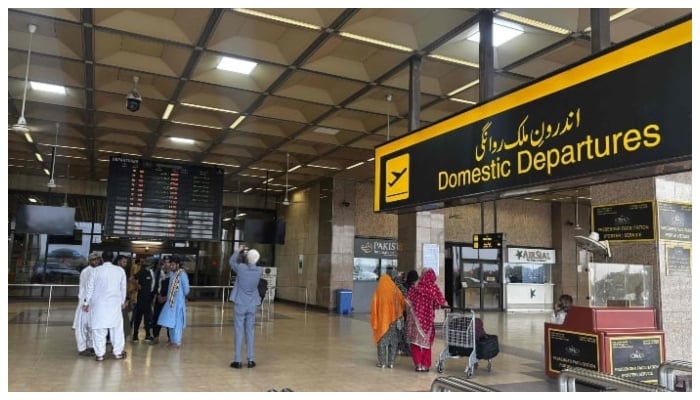
ISLAMABAD: Legislators in the National Assembly on Tuesday expressed strong concern over poor management and operational inefficiencies at Karachi’s Jinnah International Airport, particularly issues related to immigration clearance and arrival procedures.
Raising the matter in the House, PPP lawmaker Shazia Marri highlighted the hardships faced by passengers, saying travelers were being subjected to “painful and distressing” conditions due to alleged incompetence on the part of the Civil Aviation Authority (CAA). She urged the federal government to take immediate notice and asked how soon the situation would be resolved. She clarified that the issue was not related to flight delays but specifically concerned immigration procedures and CAA-related matters.
MQM leader Aminul Haq said the Jinnah International Airport was deteriorating rapidly and urged the government to upgrade the immigration system, warning that passengers were facing humiliation due to poor facilities. MNA Sahar Kamran said the offloading policy also needed to be reviewed. MNA Ijaz Hussain Jakhrani pointed out that immigration clearance often takes three to four hours, causing passengers to miss their flights. He added that conditions at the Islamabad International Airport were similarly poor. MNA Syed Aminul Haq said passengers were forced to stand in queues stretching into the hundreds and urged the government to initiate expansion and improvement works, warning that the airport’s infrastructure was approaching a state of collapse. Abdul Qadir Patel questioned whether the government had any plans to outsource airport operations to improve efficiency.
Responding to the concerns, Minister for Parliamentary Affairs Dr Tariq Fazal Chaudhry acknowledged the economic significance of Jinnah International Airport and assured lawmakers that their suggestions would be addressed. He noted that the government was considering outsourcing airport management under a public-private partnership (PPP) model to enhance efficiency and passenger facilitation. He said a policy was being formulated to manage certain airports through PPP arrangements and added that discussions were also underway regarding Islamabad International Airport, including consultations with the United Arab Emirates to develop a viable business model. He emphasized Karachi’s strategic role as the country’s economic hub and assured members that operational issues at the Jinnah International Airport would be resolved before extending similar management models to other airports. He said consultations with stakeholders and coalition partners would be held before any final decision.
To ensure transparency and accountability, he suggested that the matter could be referred to the Government Assurance Committee, where members would be briefed on the actions taken. He reiterated the government’s commitment to improving airport services nationwide. Earlier, proceedings of the National Assembly were interrupted shortly after the session began due to a lack of quorum. PTI member Junaid Akbar pointed out the quorum, prompting the deputy speaker to order a count, which confirmed that the quorum was incomplete. As a result, the sitting was suspended until quorum was met. Proceedings later resumed after the House was found in order.
Meanwhile, responding to a Calling Attention Notice moved by Anjum Aqeel Khan regarding Pakistani students stranded in Afghanistan due to border closures, Dr Tariq Fazal Chaudhry informed the House that 1,100 Pakistani students had returned after the border closure in October last year. Of these, 26 returned via land routes, while the remainder were repatriated by air. He said 947 Pakistani students were still in Kabul and Jalalabad, continuing their education, mostly in medical colleges. He clarified that the students were not stranded at the border and that the Pakistani Embassy in Afghanistan was in constant contact with them and providing full facilitation. The minister expressed concern over terrorism originating from Afghanistan, stating that Afghan authorities had failed to provide assurances that their territory would not be used for terrorist activities against Pakistan. During the session, three bills were laid before the House: the Trade Organizations (Third Amendment) Bill, 2026; the Prohibition of Manual Scavenging and Protection of Sanitation Workers (ICT) Bill, 2026; and the Railway Connectivity and Modernisation Bill, 2026. The chair referred the bills to the relevant standing committees.
The Capital Development Authority Bill, 2026 was also introduced. Reports of various standing committees were presented. In the absence of the chairperson of the Standing Committee on Human Rights, Zahra Wadood Fatmi presented reports on the National Commission on the Rights of Children (Amendment) Bills, 2024 and 2025, and proposed amendments to the Child Marriage Restraint Act, 1929.
Shahbaz Babar presented reports of the Standing Committee on Interior, including the Corrosive Substances Assault (Prevention and Protection) Bill, 2024, the Islamabad Capital Dowry Restraint Bill, 2025, the Islamabad (Preservation of Landscape) (Amendment) Bill, 2025, and the Criminal Law (Amendment) Bill, 2025.
On behalf of the Standing Committee on Science and Technology, Nighat presented a report on the Pakistan General Cosmetics (Repeal) Bill, 2025. Chairman of the Standing Committee on Overseas Pakistanis, Agha Rafiullah, presented the committee’s report on the Industrial Relations (Amendment) Bill, 2025. In the absence of the chairperson of the Standing Committee on Religious Affairs, Asia Naz Tanoli presented the committee’s report on the National Commission for Minorities’ Rights Bill, 2025. The Minister for Law informed the House that a committee had already been constituted on certain matters and that while the cabinet had discussed them, the standing committees’ reports were formally presented.