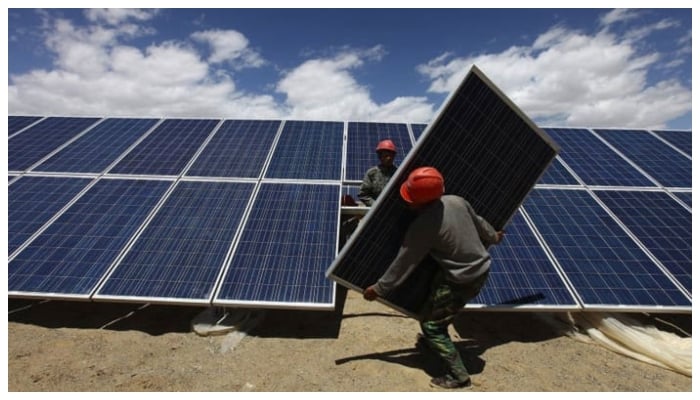
LAHORE: The government’s choice to end net-metering by lowering tariffs for solar prosumers has raised alarms that it could hinder efforts to enhance the efficiency of the national grid and deter private investments in green energy.
The rationale behind this action is that solar energy imposes a burden on other consumers and exerts financial strain on the national grid. However, this viewpoint fails to recognise a fundamental truth: solar energy is, in fact, at least Rs12 per unit cheaper than energy generated from other sources when accounting for the transmission and distribution losses that are avoided by producing energy directly at load centres.
With this poorly considered decision to abandon solar power, the federal government has effectively limited the contribution of rooftop energy to the national grid to a minimal level. The energy mix already has a low proportion of renewable energy, and the government has squandered the opportunity to enhance it with minimal effort.
Grid-tied rooftop distributed solar power serves as a vital and strategic tool for stabilising the energy sector and addressing the ongoing issue of excessive losses, which contribute to escalating circular debt. While it may not be a comprehensive solution for all structural fiscal challenges, maintaining a favourable net metering policy offers a decentralised, market-oriented approach that directly addresses the underlying causes of the power sector’s financial instability.
One of the most immediate advantages of rooftop solar is the seamless reduction in technical and commercial losses for distribution companies (Discos). In a country like Pakistan, where inefficiencies and theft can result in revenue losses of up to 90 percent in certain areas, solar power enables electricity to be consumed close to the generation point. By largely circumventing the loss-prone distribution and transmission infrastructure, distributed solar enhances collection ratios and diminishes the cash shortfall between Discos and the operator.
Moreover, solar energy incurs no fuel costs and has minimal expenses, enabling it to replace costly generation from imported fuels. This phenomenon, known as the “merit order effect,” reduces the average cost of power procurement, effectively bridging the gap between production expenses and revenue collection.
Importantly, solar energy—valued at around Rs26 per unit by the power manager—is actually more economical by estimated Rs12 per unit when considering the transmission and distribution losses that are avoided by generating energy directly at load centers.
In response to the policy change, critics contend that this decision effectively limits the contribution of rooftop solar to the national grid and deters the essential private investment required for green energy. While the government portrays solar as a financial burden on the grid and other consumers, this viewpoint fails to recognise the inherent savings and efficiency improvements associated with decentralised generation. By penalising “prosumers,” the state risks alienating the private sector, which has historically addressed the shortcomings of inadequate public energy infrastructure.
In addition to immediate savings, rooftop solar is a crucial instrument for reducing peak demand. By producing maximum power during daytime hours—aligning with peak summer demand—it lessens the need to activate the grid’s most expensive “peaking” power plants. This diminishes the requirement for new capacity contracts and slows the escalation of capacity payments, which constitute a significant portion of the accumulated national circular debt.
Global success stories further highlight the effectiveness of grid-tied models. In India, over 11 GW of rooftop solar has empowered consumers while alleviating financial pressure on utilities, while Brazil has experienced growth surpassing 25 GW by maintaining consumer incentives. With a double-digit share in the energy mix, Germany and Australia also offer examples of how distributed solar can reduce tariffs and improve grid resilience.
Grid-tied rooftop solar could serve as an optimal solution for addressing circular debt and bolstering energy security in the domestic context. The worldwide success stories demonstrate that through proactive grid management and market reforms, the overall economic advantage of distributed solar is significantly positive, resulting in a cleaner and ultimately more cost-effective electricity system. Have we missed this opportunity?