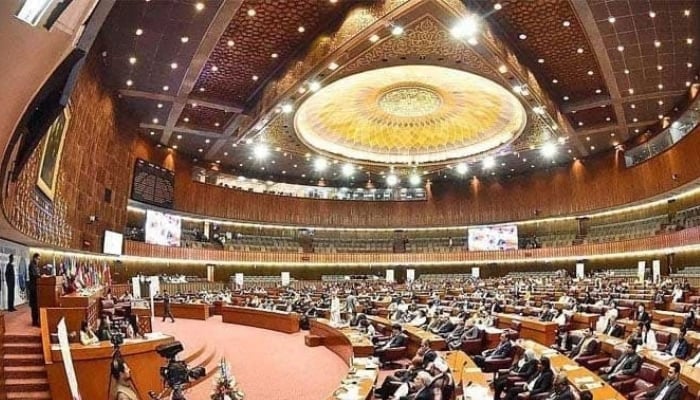
ISLAMABAD: A new FAFEN report on the NA Attendance Report for the 23rd Session highlights a crisis of attendance in the National Assembly with the Prime Minister absent and key ministers missing their Question Hour duties.
If this was not all only 56 of 332 lawmakers attended the entire 23rd session of the National Assembly.
The NA Attendance Report for the 23rd Session was scheduled to hold seven sittings and held between January 12 and 22, 2026, only 56 members out of 332 (17 per cent) attended all sittings, while 47 members (14 per cent) were absent for the entire session, according to the Free and Fair Election Network (FAFEN) National Assembly Attendance Report – 23rd Session.
The House held Question Hour despite the Minister for Parliamentary Affairs suggesting deferring it due to low attendance.
During the session, 29 federal ministers, including 23 MNAs and six senators, were scheduled to respond to members’ queries during Question Hour.
However, 19 ministers were marked absent on the day when their questions were listed for answers, while only 10 ministers attended as required. As many as 10 Calling Attention Notices required responses from eight ministers.
Five of these notices were addressed by the respective ministries, one was responded to by another cabinet colleague, two were answered by the parliamentary secretary of the same ministry, and two were not taken up.
The Prime Minister did not attend any sitting during the session. The Leader of the Opposition attended all four sittings after his appointment on January 16, 2026.
As many as 32 members were suspended for not submitting annual statements of their assets and liabilities as required under Section 137 of the Election Act, 2017. The suspensions of 30 members were lifted during the session, while two remained suspended until the prorogation of the session. Meanwhile, four seats remained vacant during the session, including NA-1 (Chitral Upper-cum-Chitral Lower), NA-175 (Muzaffargarh-I), NA-251 (Sherani-cum-Zhob-cum-Killa Saifullah), and one reserved seat for women from Khyber Pakhtunkhwa.
During the sitting with the highest attendance (sixth), the House observed a Private Members’ Day and witnessed the passage of the Elections (Amendment) Bill, 2025 and the Corporate Social Responsibility Bill, 2025.
The former bill sought to limit the public disclosure of legislators’ assets and liabilities on the grounds that it could compromise their security and privacy.
The other bill formalised guidelines for corporate social responsibility (CSR) expenditure by for-profit companies registered with the Securities and Exchange Commission of Pakistan (SECP).
During the sitting with the lowest attendance (third), the House saw the introduction of eight government bills and the laying of two ordinances.
The National Assembly currently has representation from 13 parliamentary parties and 79 independents, as per the official website of the House.
As many as eight of these parties and four independents sit on the government benches, while five parties and 75 independents sit on the opposition benches. Overall, a majority of the members attended more than 50 per cent of sittings; however, attendance patterns varied across parties.