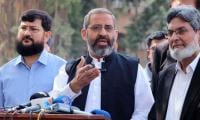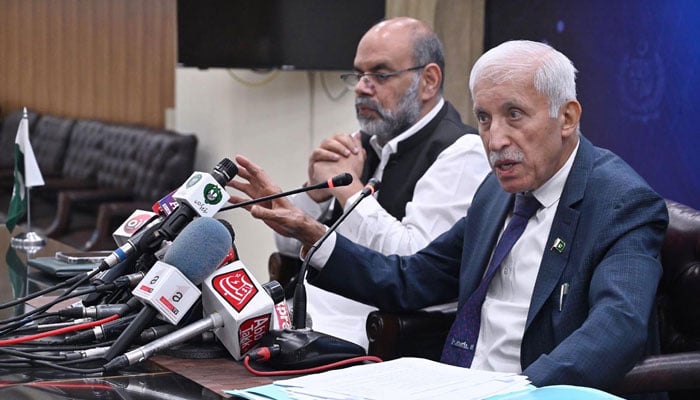
Federal Investment Minister Qaisar Ahmed Sheikh has urged a broader reflection on development outcomes in Karachi, noting that despite substantial fiscal transfers to the provinces, the country’s largest commercial centre continues to face deep-rooted infrastructure and environmental challenges.
Sheikh said that 57 per cent of the federal revenues under the National Finance Commission Award were allocated to the provinces, adding that the Centre remained willing to provide additional resources too. However, he added, it was equally important to assess what had been achieved with the funds already disbursed.
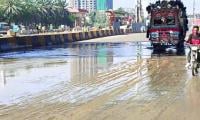
Speaking at a climate conference organised by the Karachi Chamber of Commerce & Industry at the Expo Centre on Saturday, he pointed towards the deteriorating condition of the city’s roads, the unresolved water shortage and high levels of pollution.
He said that despite these issues, Karachi remained Pakistan’s largest commercial and industrial hub. Describing himself as both an industrialist and a federal minister, he said he saw himself as a representative of the business community.
Sheikh praised the federal government’s economic performance under Prime Minister Shehbaz Sharif, saying that Pakistan had moved away from the threat of default. He said that foreign exchange reserves had improved, interest rates had been slashed from 22.5 per cent to 10.5 per cent, and inflation had eased from 22 per cent to six per cent.
Calling for national cohesion, the federal minister cautioned against comparing development in different cities. “We should not measure progress by what is happening in Lahore or Karachi. Pakistan belongs to all of us, and we must work together for it.”
He cited the example of a businessman who recently offered to bear the operating costs of a proposed bullet train in Chiniot, describing it as a spirit the country needed.
Highlighting investment prospects, Sheikh said Pakistan offered numerous opportunities, including 6,000 acres of land in the Bin Qasim area of Karachi valued at approximately Rs70 million per acre, which the government was prepared to allocate free of charge for investment purposes.
At the same time, a company from Abu Dhabi had expressed interest in acquiring the entire area. He said the government preferred to distribute 500 to 1,000 acres among multiple stakeholders to ensure broader participation. He added that special investment zones would be offered duty-free status for 10 years.
On climate change he said Pakistan contributed less than half a per cent of global carbon emissions but remained among the 10 countries most affected by climate-related impacts.
He cited earthquakes, floods and winter smog caused by crop residue burning as major concerns. Plastic pollution, he said, was a significant contributor, noting that while a plastic-based road had been constructed in Islamabad, much more work was required in recycling and reuse.