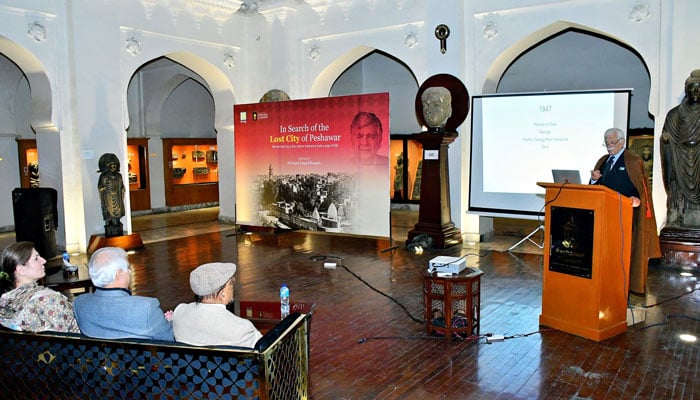
PESHAWAR: A United States-based intellectual from Peshawar, Prof Dr Sayed Amjad Hussain, advocated interfaith dialogue along with rewarding friendships and humanity as he delivered his annual lecture at the Peshawar Museum.
The event, entitled “In Search of the Lost City of Peshawar” was organised by Creative Co in collaboration with the Directorate General of Archaeology and Museums KP. At the outset of his lecture, Dr Amjad clarified the meaning of the “lost” city. He explained that what Peshawar has lost is not geography but values, particularly tolerance.
The writer defined tolerance not as the mere absence of violence, but as the willingness to accept difference, coexist with disagreement and respecting the dignity of others regardless of faith, language or lifestyle.
Historically, he said, tolerance in Peshawar meant peaceful coexistence among ethnicities, respect for other faiths and social spaces where disagreement did not immediately turn into hostility.
Tracing the erosion of these values, Dr Amjad posed a question: when was Peshawar truly lost? In 1947, with partition that uprooted a large number of Hindus and Sikhs from the region, or in 1978 and beyond, when the Afghan war and narratives of hatred altered social consciousness.
He observed that Muslims and Hindus were not at each other’s throats before 1947, and argued that the dictator Zia-ul-Haq era entrenched intolerance by preaching hatred under the shadow of the Afghan war.
Yet, he emphasised hope. Recalling his visits to India, he spoke of warmth and hospitality, asserting that there existed a reservoir of goodwill between ordinary people on both sides, if politics is set aside.
Pointing to Peshawar’s Sikh community, its functioning gurdwaras and thriving businesses, he described this as a living opportunity to reclaim the city’s pluralistic soul. A question and answer session followed during which Dr Amjad reflected on his own evolving views. He shared how living in the US exposed him to acceptance across cultures, inspiring him to host Eid gatherings that now bring together over 400 people from different faiths.