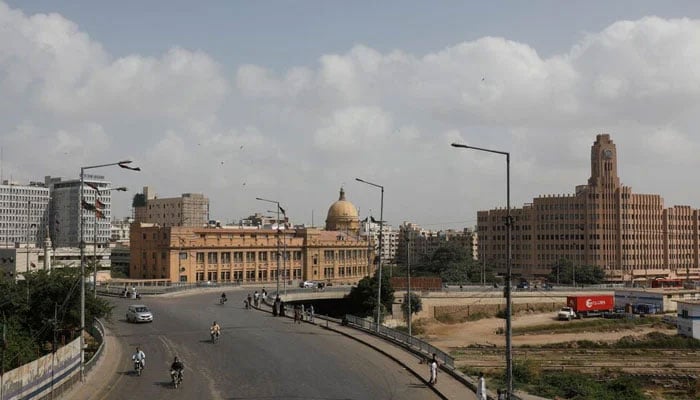
The recent call by the MQM for federal intervention and takeover of Karachi has once again dragged Article 149(4) of the constitution of Pakistan into public debate.
This debate is not new. It resurfaces every few years, typically during periods of the MQM’s political weakness, electoral setbacks or administrative failures. It is almost always framed in a way that creates more confusion than clarity for Karachi’s residents. A sober constitutional reading, stripped of political theatre, shows that much of what is being claimed has little to do with what Article 149(4) actually allows.
Article 149(4) states that the executive authority of the federation extends to giving directions to a province as to the manner in which its executive authority is to be exercised, for the purpose of preventing any grave menace to the peace or tranquillity or economic life of Pakistan or any part thereof. The wording matters. It speaks of directions, not control. It refers to the manner of exercising authority and it is triggered by exceptional circumstances involving a grave menace, not routine governance failures or political dissatisfaction.
The Supreme Court of Pakistan examined the scope of Article 149 in Iftikhar Hussain Shah’s case. Although the case concerned land acquisition, the court made an important constitutional observation. It held that the federation’s power does not extend to supplanting, substituting, or taking over provincial functions where the constitution only permits the giving of directions and where the province acts in accordance with law. In simple terms, the federation cannot step into the shoes of the province merely by invoking Article 149. Authority remains provincial. The federation may guide, but it cannot govern.
The Sindh High Court echoed this understanding in Farough Ahmed Siddiqui v Province of Sindh. A full bench held that federal directions to a province can only relate to matters within the Federal Legislative List and, at that time, the Concurrent List. The 18th Amendment later abolished the Concurrent List and transferred wide powers to the provinces. Article 149(4), however, was retained, along with the Federal Legislative List. The result is that the federation may still issue binding directions, but only within its constitutional sphere and only to avert a grave national or regional threat.
Despite decades of political rhetoric, the precise contours of Article 149(4) remain largely untested in Pakistani jurisprudence. It has rarely been invoked and is more often misunderstood than applied. What is clear is what it is not. It is not a shortcut to a federal takeover of a city. Nor is it a tool to bypass provincial governments simply because they are unpopular or ineffective.
Comparisons with India are often made and are useful mainly for what they reveal Pakistan deliberately chose not to adopt. Articles 256 and 257 of the Indian constitution empower the union to issue directions to States to ensure compliance with parliamentary laws and to prevent obstruction of union executive power. These provisions are reinforced by Article 365, which allows the president to conclude that constitutional machinery has failed in a state if it ignores union directions, thereby justifying President’s Rule.
In State of Rajasthan v Union of India, the Indian Supreme Court upheld the union’s authority to issue such directions, even in politically sensitive matters such as dissolving state assemblies. Pakistan’s constitution contains no equivalent to Article 365. While emergency provisions exist, including Article 234, there is no automatic constitutional consequence if a province fails to comply with directions under Article 149(4). This omission is deliberate and reflects the post-18th Amendment commitment to provincial autonomy, however unevenly implemented.
Seen in this light, the MQM’s repeated invocation of Article 149(4) is not a serious constitutional proposal. It is a political tactic. For decades, the party has relied on constitutional ambiguity and ethnic anxiety to mobilise support in Karachi. Whenever its relevance declines, the language of federal intervention, separation of Karachi or division of Sindh returns. This pattern predates the minus-Altaf formula and persists thereafter. The aim is not governance reform but confusion, fear, and consolidation of a shrinking vote bank, especially after the MQM failed to win a single seat on the infamous Form-45 in Karachi.
It must also be said plainly that Article 149(4) cannot be used to separate Karachi from Sindh. Article 239(4) of the constitution is explicit: no province can be altered unless a two-thirds majority of the concerned provincial assembly approves the change. In Sindh, that means 112 of 168 members voting in favour. Given political realities and public sentiment, this is virtually impossible. Yet the fear is repeatedly invoked because it serves political ends, not constitutional ones. Whatever the noise around new provinces or speculative amendments, the constitutional position remains that division of Sindh is not realistically on the table and is widely opposed by its people.
The real tragedy is that this debate diverts attention from what has actually crippled Karachi. Successive Sindh governments have systematically weakened local governments. Powers meant for elected city representatives have been pulled back to the province. Local governments have been underfunded, delayed, dissolved, and redesigned to ensure political control rather than service delivery. Article 140A, which mandates political, administrative and financial devolution to local governments, has been treated as an inconvenience rather than a constitutional command.
University Road is a daily reminder of this failure. The second busiest road in Karachi, after Sharae-Faisal, is now little more than rubble. Vehicles are damaged, traffic crawls for hours and women and children frequently fall from motorcycles and suffer injuries. This was once a local government responsibility. It was taken over by the province and for years residents have paid the price. The reason is not capacity but politics. The ruling party has never won an election there and likely never will.
The federation, meanwhile, has failed Karachi in equally fundamental ways. Despite being Pakistan’s economic engine, federal investment in Karachi’s infrastructure has been sporadic and symbolic. Core issues such as water supply, mass transit, disaster preparedness and urban planning remain unresolved. If the federation has struggled to fulfil its existing constitutional responsibilities towards Karachi, there is little reason to believe that invoking Article 149(4) would suddenly deliver results.
The K-4 water project illustrates this failure. As Mohammad Younus Dagha has explained, a project intended to address Karachi’s water shortage was transformed into a political and administrative debacle. More than a decade later, the project remains incomplete. Despite assuming control of the project, the federation has achieved little. It is fair to ask why anyone should believe that federal control of Karachi itself would fare any better.
The 2024 general elections offer a final piece of the puzzle. Allegations of rigging, result manipulation and administrative interference have deeply eroded public trust. The PTI, contesting without a symbol, swept Karachi, only to lose most seats after results were declared. When people believe their mandate has been stolen, debates about federal directions sound hollow. Governance cannot be imposed from above when democracy is undermined below.
Karachi’s solution does not lie in constitutional shortcuts or political slogans. It lies in respecting the people’s mandate, strengthening local governments, enforcing constitutional obligations and holding both the province and the federation accountable.
Article 149(4) is a narrow, exceptional provision meant for grave threats to peace or economic life. It is not a cure-all and not a substitute for democracy.
The writer is a barrister.