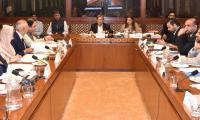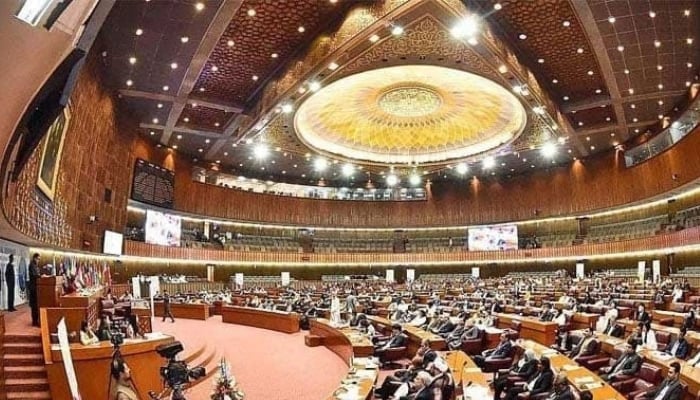
ISLAMABAD: The National Assembly on Tuesday passed a resolution strongly condemning the recent terrorist incidents in Balochistan.
The resolution, moved by Minister for Parliamentary Affairs Tariq Fazal Chaudhry, commended the timely and effective action of security forces, law enforcement agencies, the provincial government of Balochistan and civil administration. It expressed solidarity with the families of martyrs and those injured in the terror incidents. The House regretted and voiced concerns that terrorist networks are attempting to use women against the state and society through exploitation, coercion, mental pressure and blackmail which, it stated, is completely contrary to Islamic, Pakistani and Baloch values. It made it clear that attacks on the civilian population, women and children are unpardonable crimes and that the State must take decisive action against such elements on the principle of zero tolerance.
The House drew attention to the fact that in several incidents, the available evidence points to external patronage, expressing serious concerns about the role of India. It noted that some neighbouring countries are promoting terrorism through logistics and operational facilitation, financial support, training and propaganda networks.
The resolution demanded an immediate, coordinated and effective national response on an emergency basis against foreign sponsors and internal facilitators, smuggling and propaganda by combining political, diplomatic, military, intelligence, legal and narrative fronts.
Describing unity as the need of the hour in the fight against terrorism, the National Assembly expressed the commitment that the State will ensure peace and security for the protection of its people.
While winding up the discussion on Balochistan, Minister of State for Interior Talal Chaudhry rejected the notion of intelligence failure and defended the law and order situation. He said security forces are effectively fulfilling their responsibilities, and with intelligence support, they successfully thwarted terrorists’ nefarious designs in the province. He stated that 177 terrorists were killed by security forces while engaging them at different locations. “India is supporting terrorist elements in Balochistan. Our security forces and political leadership defeated terrorism in the past and will do so again,” he said.
“This is not a war of freedom; it is terrorism,” Talal Chaudhry argued, stating that the objective of militant groups was to destabilise Pakistan and sabotage its development trajectory. He alleged that the Balochistan Liberation Army (BLA) and other militant organisations were engaged in extortion and looting, and were targeting development to create instability.
Listing development indicators, the minister said the province had 13 cadet colleges, 321 technical education institutions, 13 hospitals, 757 basic health units, airports in cities with populations as low as 200,000, and more than 25,000 kilometres of roads. He asked that if this is a fight for rights, why are schools and hospitals attacked. He also questioned the destruction of bridges and link roads. “Banks are meant for public convenience,” he added, arguing that attacks on economic infrastructure were meant to cripple normal life. He emphasised the need for all political parties to stand united and fully support the security forces.
Usman Badini said the ground realities in Balochistan could not be ignored, saying that when the state failed to provide opportunities to Baloch children, hostile elements stepped in and were now using them against Pakistan. He said traditional tribal leadership had become ineffective and stressed that educated Baloch youth must be treated as stakeholders.
PTI leader Asad Qaiser said Pakistan’s economy was closely linked with Afghanistan and reiterated PTI’s commitment to eliminating terrorism and implementing the National Action Plan. Ijazul Haq opposed any dialogue with terrorists and called for a review of NFC allocations over the past 20 years to assess actual spending in Balochistan.
Meanwhile, the National Assembly also passed a resolution urging the international community, including the United Nations, to play its due and effective role in resolving the Jammu and Kashmir dispute in accordance with the aspirations of the Kashmiri people. The resolution was moved by Parliamentary Committee on Kashmir Chairman Rana Qasim Noon. It called upon the world community to force India to immediately end human rights violations in Indian Illegally Occupied Jammu and Kashmir, lift all repressive measures, release all political prisoners, and allow unhindered access to international human rights organisations and observers. The resolution welcomed the US President Donald Trump’s initial offer of mediation to resolve the Jammu and Kashmir dispute after the May conflict between Pakistan and India. The House also rejected any unilateral decision by India regarding the Indus Waters Treaty, stressing that such actions threaten regional peace and stability and considered this illegal step as an act of war.