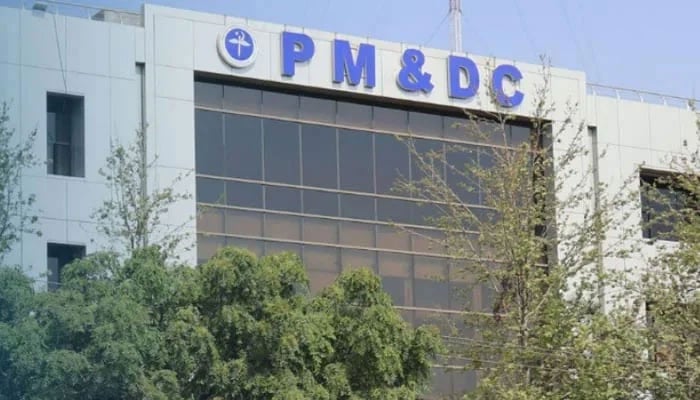
ISLAMABAD: The Pakistan Medical and Dental Council (PMDC) and the Pakistan Association of Private Medical and Dental Institutions (PAMI) have jointly reaffirmed a cap of Rs1.8 million on annual tuition fees for private medical and dental colleges for the 2025–26 academic session, warning that any institution found charging more than the approved amount will face regulatory action and may be required to refund or adjust excess fees collected from students.
The decision was announced through a joint statement issued after detailed deliberations by a high-level committee chaired by the Deputy Prime Minister, which reviewed fee rationalisation, audited financial records of private institutions, cost-per-student data and legal requirements.
The committee unequivocally upheld the PMDC Council’s earlier decision to fix annual tuition fees for MBBS and BDS programmes at Rs1.8 million, in accordance with the law.
Under the agreed framework, the Rs1.8 million fee cap applies strictly to tuition and does not include ancillary charges such as hostel fees, transportation, university charges, examination fees or PMDC registration fees. However, the joint statement makes it clear that no private medical or dental college is permitted to charge tuition beyond the capped amount without prior approval from the regulator.
Officials involved in the process said that any fee charged above Rs1.8 million without PMDC approval would be deemed unauthorised, exposing institutions to regulatory action. They added that colleges found to have already collected excess tuition would be liable to refund the additional amount to students or adjust it against future dues, in line with PMDC regulations and enforcement powers.
The statement allows a maximum annual increase of five percent in tuition fees, applicable from the 2025–26 session onward, with future adjustments linked to the Consumer Price Index (CPI) as notified by the PMDC. It also sets a ceiling of 20 percent on the profit margin private institutions are allowed to earn from their revenue, a move aimed at curbing unchecked commercialisation in medical education.
At the same time, the framework provides a conditional mechanism for institutions seeking higher fees. Private colleges may apply to the PMDC for approval to charge tuition beyond Rs1.8 million, up to a maximum of Rs2.5 million per year, but only on the basis of audited financial accounts. Officials clarified that such requests would be assessed strictly on verified data, with no reliance on bank statements or tax returns, and approvals, if granted, would be college-specific. The joint statement further notes that fee determinations made for the 2025–26 session on the basis of audited accounts would also apply to the 2024–25 session, where relevant. Any disputes arising during the process will be settled by the same committee, which includes three members nominated by PAMI, with its decision to be treated as final.
In a significant development, PAMI announced that it has agreed to withdraw its petition challenging the fee cap, which was pending before the Islamabad High Court. The association said the decision was taken in light of the reaffirmation of the regulatory framework and assurances regarding transparency, consultation and lawful implementation.
Both PMDC and PAMI reiterated their commitment to protecting students and the public interest through strict enforcement of tuition fee regulations, while ensuring accountability, transparency and quality in medical and dental education. PAMI and its member institutions acknowledged the binding nature of the fee cap and pledged full compliance with PMDC directives, the statement said.