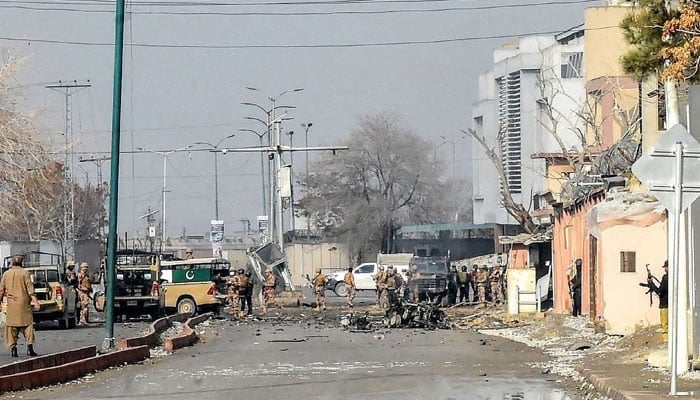
ISLAMABAD: The Balochistan government, in close coordination with security forces and intelligence agencies, has undertaken a multi-layered campaign to curb terrorism, dismantle militant networks and strengthen internal security across the province, official data shows.
Shared by a Balochistan government source on the request of The News, the details show that at the core of this effort have been province-wide intelligence-based operations (IBOs) targeting terrorists, their facilitators, weapons, logistics and financing channels. Between January 1 and December 31, 2025, a total of 90,224 IBOs were conducted, resulting in the neutralisation of 784 terrorists, a figure officials describe as a significant blow to militant infrastructure in the province.
To institutionalise coordination, the Provincial Intelligence Fusion and Threat Assessment Centre (PIFTAC) has been operationalised as a unified platform for threat analysis, prioritisation and joint action. PIFTAC integrates inputs from police, Counter Terrorism Department (CTD), Special Branch, the Levies transition structure, Frontier Corps and the civil administration, enabling faster and more coherent responses.
This coordination, the sources said, has been further strengthened through the institutionalisation of daily situation reports shared among CTD, Intelligence Bureau, police, Special Branch and Military Intelligence, ensuring a common operating picture and quicker decision-making. District Coordination Committees have also been fully linked through installed equipment, live dashboards and designated focal persons.
On the governance side, KPI-based performance management has been introduced across departments, with routine data sharing with the National Intelligence Fusion and Threat Assessment Centre (NIFTAC). The Civil Defence Department has been abolished and merged into the Special Branch to eliminate duplication and reinforce internal security intelligence.
A major structural reform has been the notification of B-Area to A-Area conversion, aimed at removing long-standing grey zones, standardising policing arrangements and extending the writ of the state to previously weakly governed areas.
Recognising the role of information warfare, the government has launched a structured counter-misinformation and narrative response, shifting from reactive statements to anticipatory, fact-based communication backed by lawful enforcement. The “Nazarban” mechanism has been established to monitor misinformation and hostile propaganda and enable timely responses. In parallel, a Centre of Excellence for Countering Violent Extremism (CVE) has been initiated to support research, training, youth engagement and policy development, with CVE policy guidelines based on the 5Rs framework now under roadmap formulation.
The legal framework has also been substantially strengthened. Key legislation enacted includes the Counter Violence and Extremism Act, 2024, and the Security of Vulnerable Establishments Act, 2024. Further amendments including ATA Amendment 11-EEEE with Rules 2026, ATA Amendment 21-AAA on faceless courts, the Witness Protection Amendment 2025 and BFSA Amendment 2025, have aimed to improve prosecution, witness safety and judicial efficiency.
Under the 11-EEEE framework, detention centres have been operationalised with safeguards such as mandatory medical evaluation, family access and a strict prohibition on physical abuse. Monitoring under the Fourth Schedule has been intensified, with 800 individuals added over the past two years.
Prosecution and investigation capacity has also seen marked improvement, claim the sources, stating that over the last two years, 528 prosecution sanctions have been granted, 145 Joint Investigation Teams notified and 25 Mutual Legal Assistance cases forwarded to the Ministry of Interior. A case-management clean-up led to the transfer of 105 cases to specialised branches and the withdrawal of 12 FIRs where legally required. Litigation outcomes have improved, with 339 cases disposed of in 2024 and 435 in 2025, while success ratios stood at 85 percent and 84 percent respectively.
Digitisation has emerged as a central pillar of security governance. The Home Department has implemented E-Office and document management systems, HRMIS and biometric or geo-fenced attendance. Security-specific digitisation includes monitoring modules for BISA and the Fourth Schedule, crime and incident dashboards, complaint systems and financial and procurement digitisation. Field monitoring has been enhanced through mobile applications with geotagging, time-stamped reporting and logistics tracking. Reforms, officials say, also help counter propaganda by providing verifiable service delivery.
Alongside counterterrorism, the province has scaled up anti-narcotics and narco-disruption operations. Across 17 districts, 43,027 acres were surveyed, 4,219 acres of poppy eradicated, 427 bores dismantled and 518 solar systems confiscated. Enforcement follow-through included 56 FIRs and Fourth Schedule monitoring of 368 individuals. These operations were supported by enhanced logistics such as tractors, drones and spray machines.
Funding for security projects is being closely tracked. Of a total allocation of Rs 6 billion, approximately Rs2.059 billion has been spent, with a balance of around Rs3.942 billion available. Fortification of police stations and posts has progressed through PDWP approval, release of finances and tendering, with district-level releases completed.
Officials describe the overall approach as an integrated security model combining kinetic action, legal sustainability, institutional coordination, digitisation and prevention. This has also included large-scale implementation of the Illegal Foreigners Repatriation Programme, under which over one million Afghan nationals have been repatriated, reducing facilitation risks, identity misuse and grey-population vulnerabilities.
In a related legal reform, the Balochistan Establishment of Special Courts (Overseas Pakistanis’ Property) Act, 2025, has been enacted to provide expeditious protection and dispute resolution for properties owned by overseas Pakistanis through dedicated special courts. Security officials say the cumulative impact of these measures is a more coherent, legally grounded and technology-enabled security architecture one aimed not only at suppressing terrorism but at sustaining peace and state authority across Balochistan.