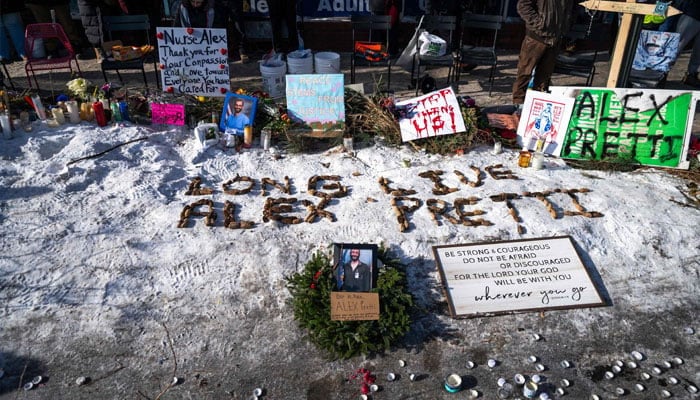
When US Border Patrol agents shot and killed Alex Pretti in Minneapolis, they were 300 miles from the US-Canada border. That’s well outside the ‘border zone’ – an area extending 100 miles inland from the border, which the US established in the late 1940s as defining a ‘reasonable distance’ for patrol purposes.
In December, the Border Patrol’s Operation Metro Surge deployed 3,000 federal agents, 1,000 of them from US Customs and Border Protection and about 2,000 from Immigration and Customs Enforcement. This joint task force, led by Border Patrol commander Greg Bovino, extended the US border – and the extraconstitutional powers of its enforcers – into the country’s interior.
As a CBP official told me in 2018, “We are exempted from the Fourth Amendment,” which protects against unwarranted searches and seizures. Now the borderland zone of exception, which has developed for decades, has vividly expanded. The whole country has become the border.
As historian Greg Grandin writes, the Border Patrol has been a “cult of brutality” since 1924, when it was created. The Border Patrol “has operated with near-complete impunity, arguably serving as the most politicized and abusive branch of federal law enforcement.” Over the years, the Border Patrol’s activities have included mass roundups and deportation operations in the 1930s and 1950s, but it began to gain significant power during the Operation Gatekeeper era of the 1990s. Then, after 9/11, it was supercharged with the creation of the Department of Homeland Security. Counterterrorism became its priority mission, and its budgets increased accordingly. In calling both Pretti and Renée Good “domestic terrorists,” the Trump administration’s rhetoric aligned with the DHS’s long-term mission. The word choice feels intentional.
When I was writing ‘Border Patrol Nation’, a book published in 2014, many were concerned about the growing powers of the post-9/11 Border Patrol. Joanne Macri, for example, who was the director of the Criminal Immigration Project of the New York State Defenders Association, called the Border Patrol “an agency that doesn’t have limitations” and described them as becoming the “national security police.” I interviewed Macri at the height of the ‘transportation raids’ – as DHS termed them – when the Border Patrol boarded Amtrak trains and Greyhound buses in New York, arresting 2,776 people from 2005 to 2009, classifying them by their skin color. As with ICE’s “wartime recruitment plan,” the Border Patrol offered agents various incentives – including Home Depot gift certificates, cash bonuses, and vacation time – to apprehend more people.
There have been many clues over the years that foreshadowed what is happening now in Minnesota and other cities. From 1994 to 2012, the Border Patrol grew from 4,000 to 21,000 agents, with yearly budget increases, each bringing more capabilities and allowing the agency to expand to more locations, regardless of the president’s politics. For decades, CBP has been deployed at large events like the Super Bowl – no matter where it is – and at presidential inaugurations (Washington, DC, is in the 100-mile zone). In 2014, constitutional lawyer John Whitehead called DHS “America’s standing army,” noting that it possessed about 260 million rounds of ammo, or about 1,400 rounds per agent.
In his essay, Whitehead also mentioned license plate readers, detention camps, cell phone tracking, military drills in US cities, checkpoints, spy networks, searches, surveillance cameras, drones, and spybots. These observations, at the time, barely made a blip on the national media’s radar.
Meanwhile, the US government maintained the borderlands, both south and north, as a zone of exclusion, which it used to test out policies, practices, and strategies – including the use of force and other forms of suppression like walls and surveillance systems.
This article is excerpted from: ‘Border Patrol Nation?’. Courtesy: Counterpunch.org