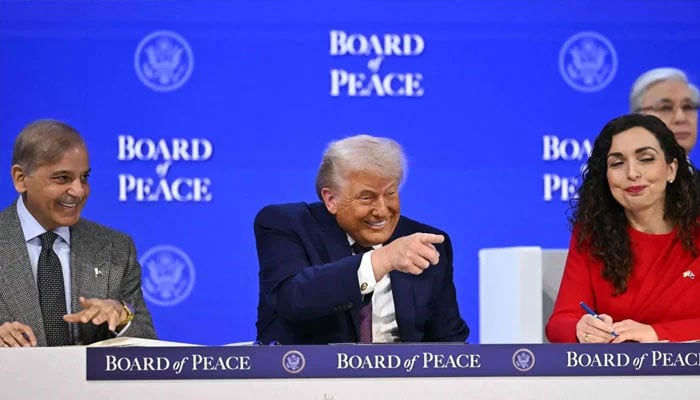
At a ceremony presided over by President Donald Trump at Davos on January 22, Pakistan signed the Charter of the Board of Peace together with the leaders and senior officials of 19 countries.
In addition to Pakistan, 11 other Muslim countries, including Azerbaijan, Bahrain, Indonesia, Jordan, Kazakhstan, Morocco, Qatar, Saudi Arabia, Turkiye, the UAE and Uzbekistan, signed the Charter of the Board of Peace. Only seven other countries from different regions were among the charter’s signatories. Notably, other than the US, all the permanent members of the UN Security Council, including France, UK, Russia and China, refrained from signing the charter, as did India and Japan. Thus, the Board of Peace, as currently constituted, cannot claim to represent the will of the international community comprising over 190 countries.
The proponents of President Trump’s Board of Peace link its legitimacy to UN Security Council resolution 2803, adopted on November 17, 2025, which welcomes the formation of an international Board of Peace as a transitional governing authority to supervise reconstruction, governance and political transition in Gaza.
The responsibilities of the UNSC-approved Board of Peace were limited to Gaza. However, the Charter of Trump’s Board of Peace, signed at Davos, is much more expansive in both scope and responsibilities. Its stated mission as an international organisation is to promote stability, restore lawful governance and secure lasting peace initially in Gaza but potentially in other areas affected by conflict. The charter explicitly establishes the Board of Peace as a body outside traditional UN structures. Further, it grants President Trump, as its chairman, extensive powers over its membership, subsidiary bodies and decisions.
Trump’s Board of Peace, thus, reflects a classic ‘bait and switch approach’ as it deviates from the provisions of the UNSC resolution 2803 while claiming legitimacy from it and is a crude attempt to legitimise whatever decisions President Trump may take for the restoration of peace and future governance in Gaza. It also has the potential to weaken the authority of the UN Security Council, which under the UN Charter carries primary responsibility for the maintenance of international peace and security. It thus constitutes a major challenge to the UN. Little wonder then that most major world powers have not signed the Charter of Trump’s Board of Peace, which is likely to meet its natural death when President Trump’s term as the US president comes to an end.
President Trump’s declared disdain for the UN and international law as exhibited in the US air strikes on Iran’s nuclear facilities in June 2025, its attack on Venezuela to abduct its president and wife, the declaration of Trump’s corollary to the Monroe Doctrine and the sustained support extended by the US under his watch to Israel in its genocide in Gaza leaves little hope that the Trumpian Board of Peace would act fairly for the restoration of durable peace in Gaza and resolution of the Palestine issue in accordance with the UN Security Council resolutions.
What is more likely is that the authority vested in the Board of Peace would be misused by the US and Israel for the continued suppression of the people of Gaza behind the facade of a ceasefire and for the continued denial of the legitimate national rights of the Palestinian people.
It is, therefore, all the more surprising that twelve Muslim states including, amongst others, Pakistan, Turkiye, Saudi Arabia, Egypt and Indonesia, signed the charter of the Board of Peace. Their membership may be based on the vain hope that the declaration of cease-fire in Gaza, which is being violated frequently by Israel, may end the agony of the people of Gaza and open the path for a fair settlement of the Palestine issue. But as explained above and as the past record of close US-Israel collaboration in defying the will of the international community relating to Palestine suggests, these hopes are unlikely to be realised. The danger, therefore, is that the Board of Peace by legitimising the trampling of the national rights of the Palestinian people may turn out to be a Board of Capitulation by the Muslim world.
Pakistan, after signing the Charter of the Board of Peace, did emphasise its hope for a settlement of the Palestine issue through the establishment of an independent Palestinian state with Al-Quds as its capital. It was explained that signing the charter would enable Pakistan to be a relevant participant in future negotiations regarding Gaza and Palestine. It was also stated that the signing of the charter was a ‘strategic necessity’ for Pakistan, meaning thereby that the importance of Pakistan-US friendship left Islamabad with no other choice.
The US, besides being the largest destination for Pakistan’s exports, exerts dominant influence within the IMF. We also have a long history of friendly relations and cooperation with the US in different fields. In any case, the US, being the most powerful country in the world economically, financially, and militarily, has enormous capacity to harm or benefit other countries. This is particularly important under a capricious President like Trump, as India is finding to its dismay. Finally, Pakistan, to its credit, decided to sign the charter alongside seven other important Muslim states.
Pakistan decided to sign the Charter of the Board of Peace in its best national interests. This decision has negative aspects that Islamabad should seek to minimise in coordination with the seven other Muslim states that were party to the decision to sign the charter. Sustained coordination of policies within this group of eight Muslim states may help in ensuring the welfare and security of the people of Gaza and enhancing the prospects of the realisation of an independent Palestinian state with Al-Quds as its capital.
The recognised position of the Muslim world should be reiterated from time to time so that the seriousness that the Muslim countries attach to the national rights and welfare of the Palestinian people is duly registered in the working of the Board of Peace and its subsidiary bodies.
Finally, while it is important for Pakistan to maintain friendly relations with the US for the reasons outlined above, this should not come at the expense of our national security, which calls for strengthening the Pakistan-China strategic partnership, which is growing in importance over time.
In the face of the enduring threat posed by a Hindutva-driven and hegemonic India and the possibility that the Indo-US friendship may regain strength after the departure of Trump from the US Presidency or even before that, Pakistan should not lower its guard and take all appropriate measures for developing Pakistan-China relations in economic and security fields and for the successful implementation of CPEC II.
The writer is a retired ambassador and author of ‘Pakistan and a World in Disorder – A Grand Strategy for the Twenty-First Century’. He can be reached at: [email protected]