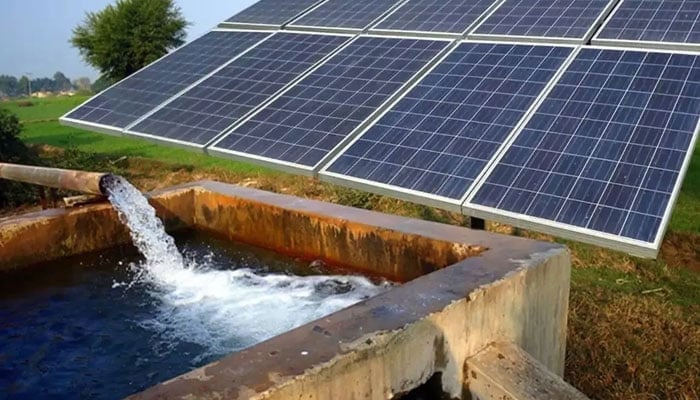
Rahim is installing his third tubewell turbine in fifteen years. Each time, the water table has fallen beyond the reach of the previous pump.
Now, to keep his sugarcane alive, he is drilling past 100 feet, one of around 1.4 million private tubewells in Punjab, most of them outside any formal provincial water accounting, all chasing water that retreats faster than crops can grow. Rahim may not know it, but he is living the definition of water bankruptcy.
The United Nations University Institute for Water, Environment and Health (UNU-INWEH) January 2026 report, ‘Global Water Bankruptcy: Living Beyond Our Hydrological Means in the Post-Crisis Era’, offers a diagnostic lens that cuts through comfortable myths.
For decades, we have treated water as a ‘crisis’, something acute that can be managed before returning to normal. The report argues this framing has become misleading because it assumes the baseline remains viable. In many regions, that assumption has collapsed. Rivers fail to reach the sea, aquifers are pumped until land subsides, wetlands disappear and glaciers retreat.
Water bankruptcy, the report argues, is a persistent post-crisis condition in which long-term use exceeds renewable inflows and safe depletion limits, causing damage so severe that prior levels of supply cannot realistically be restored.
South Asia is identified as a hotspot. That is Pakistan in one sentence. That is Rahim’s tubewell in one diagnosis.
Bankruptcy has two components: insolvency, the use of more resources than are available and irreversibility, the damage to the system’s storage and ecological functions. Pakistan exhibits both. In Lahore, the water table has dropped from below five metres in the 1950s to over 60 metres today; in some areas, potable water now requires drilling to depths of over 800 feet. The damage is not only to quantity; arsenic is also present in groundwater across Punjab, with traces detected in human hair and milk.
The metaphor used in the report is simple. Renewable flows are income. Long-term storage, groundwater, wetlands, glaciers, soils is savings. Bankruptcy begins when societies rely on savings to fund routine expenditures. Pakistan’s irrigation economy has normalised groundwater as a substitute for unreliable canal supplies to quench the thirst of water-intensive sugarcane and rice crops.
What began as emergency pumping has become a permanent practice. That is not resilience; it is liquidation, temporary comfort bought at permanent cost. And solar-powered tubewells have removed even the price signal of scarcity, with marginal pumping costs near-zero, farmers have no economic reason to stop.
Here is Pakistan’s deeper problem: when claims exceed carrying capacity, the contest becomes political, not hydrological. Our internal water debate, between provinces, between canal commands, between head and tail farmers, resembles a dispute over ‘missing water’, measurement credibility and trust. In a bankrupt system, when the ledger is disputed, everything becomes a grievance.
The Cholistan Canal crisis illustrated this perfectly. Sindh raised objections repeatedly through the Council of Common Interests. The CCI, the constitutional forum with exclusive jurisdiction over inter-provincial water disputes, did not decide. Punjab moved to launch the project in early 2025. Soon after, the Sindh Assembly passed a unanimous resolution against construction. IRSA issued a water availability certificate overriding the dissent of Sindh’s representative, who warned that the Indus basin “already exceeds availability”. By April, the project was halted, but only after technical disagreement had escalated into provincial confrontation. The institutions designed to resolve conflict had amplified it.
Pakistan does not lack a constitutional framework. The 1991 Water Apportionment Accord exists. IRSA exists. The CCI exists. What we lack is an operating culture of transparent accounting, enforceable rules, and political ownership that would enable these institutions to function as bankruptcy managers rather than dispute amplifiers.
The report’s core distinction matters: crisis management tries to survive the shock and return to normal. Bankruptcy management accepts the baseline may not return and focuses on rebuilding a viable system: recognising debts, reconciling claims with reality and constructing a new balance sheet.
For Pakistan, that means three things. First, technical fixes cannot substitute for political settlement. New canals and storage cannot compensate for unresolved shortage-sharing rules and unregulated groundwater. Infrastructure without credible institutions is simply more capacity for conflict.
Second, we must protect the processes that produce water, not only the water itself. Environmental flows are an investment in delta survival, not a luxury one province demands. Every tubewell Rahim drills deeper is a withdrawal from an account with no deposit slip.
Third, unavoidable losses must be treated as a governance challenge rather than a political scandal. In most years, the system does not meet every demand. The question is: who bears the shortfall, by what rule, verified by what measurement?
Fix water accounting as a trust-building national project. Codify shortage-sharing rules that work under scarcity. Regulate groundwater; those 1.4 million tubewells cannot remain invisible. Rebalance agricultural incentives away from rewarding depletion.
None of this requires a revolution, only the discipline to measure honestly, decide transparently, and enforce consistently.
UNU-INWEH does not present water bankruptcy as a form of resignation. It presents it as the starting point for honesty, before the remaining natural capital is lost. Pakistan’s choice is stark: manage water as an endless emergency, or confront the reality that water is now a balance-sheet problem requiring governance, measurement and political settlement.
In a bankrupt system, the harshest outcome is not shortage. It is a collapse of trust. And once trust collapses, the federation is under threat.
The writer is a former Punjab minister for irrigation and finance, with extensive experience in Pakistan’s provincial and federal legislatures.