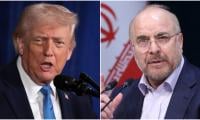
ISLAMABAD: Arab and Muslim states are mounting a last-ditch effort to avert a new war between the US and Iran as concerns grow that Tehran will not yield to Donald Trump’s tough demands.
Gulf powers, including Qatar, Oman and the United Arab Emirates, have been engaging with both the US and Iran in a bid to de-escalate tensions that intensified after the US president on Wednesday warned Tehran that “time was running out”, Financial Times reported.
Trump is demanding that Iran agree to permanently cease all uranium enrichment, accept limits on its ballistic missile programme and end support for regional militant groups, including Hizbollah in Lebanon and Houthi rebels in Yemen, diplomats and analysts said. “Efforts are continuing but there has been no breakthrough,” one diplomat said.
US Defence Secretary Pete Hegseth said on Thursday that Iran had “all the options to make a deal” but “should not pursue nuclear capabilities”. It was unclear whether the Trump administration had decided on a plan of action. “We will be prepared to deliver whatever this president expects of the war department,” Hegseth said.
Arab and Muslim states have cautioned Trump against an attack, fearing it could trigger a broader conflict in the Middle East and cause Tehran to target oil and gas facilities in the Gulf.
A critical hurdle to diplomacy is that Tehran views the US’s conditions as akin to surrender, which Ayatollah Ali Khamenei, the supreme leader and ultimate decision maker, would not countenance. The Islamic regime, which insists any talks with the US must take place on equal terms, is also loath to be seen to be negotiating under duress or from a position of weakness, analysts say. “The fact that the Iranian leadership continues to message that they are open to diplomacy shows they are trying to buy time, but they are not yet signalling that they are ready to accept that this is not a negotiation but a submission,” said Sanam Vakil, Middle East director at Chatham House.
Analysts say Khamenei, during his more than four decades in power, has typically attempted to project defiance and resistance under pressure. “Ayatollah Khamenei’s governing philosophy has long been simple: never yield to pressure, but act decisively and use all instruments of power,” said Mohsen Milani, author of Iran’s Rise and Rivalry with the US in the Middle East. “Today, however, Iran faces an unprecedented challenge, credibly threatened by the world’s most powerful military. History will judge if this approach can still hold — or flexibility becomes unavoidable.”
The diplomat also said that Tehran and Washington were speaking past each other in their respective conditions for negotiations, and that this has led to a sense of disrespect and a perceived lack of seriousness.
Vakil said agreeing to Trump’s demands, which would severely diminish the core elements of Iran’s national defence strategy, was more serious for the regime as it would be “akin to acknowledging ideological defeat”.
In a sign of the growing angst in Iran, Ahmad Zeidabadi, a reformist analyst, urged Pezeshkian to show “courage” and grab any opportunity to talk to American officials and embrace Turkey’s role as an intermediary. “Even if anyone [in the ruling system] is stopping you, please announce it publicly so that it remains in history who they are and with what motivation they are pushing the country towards destruction,” Zeidabadi wrote in a blog. But diplomatic efforts are further complicated by Trump’s decision to back Israel’s war in June on the eve of the sixth round of indirect talks with the US over Iran’s nuclear programme.
That deepened Iran’s huge distrust of the US and exacerbated opposition to any engagement with Washington, particularly among hardliners. “The only thing the regime deems more dangerous than suffering from US strikes is surrendering to US terms,” said Ali Vaez, an Iran expert at Crisis Group think-tank. “It erodes the last bastion of the regime’s legitimacy with its ideological core constituency.”