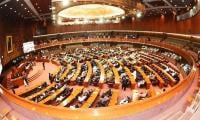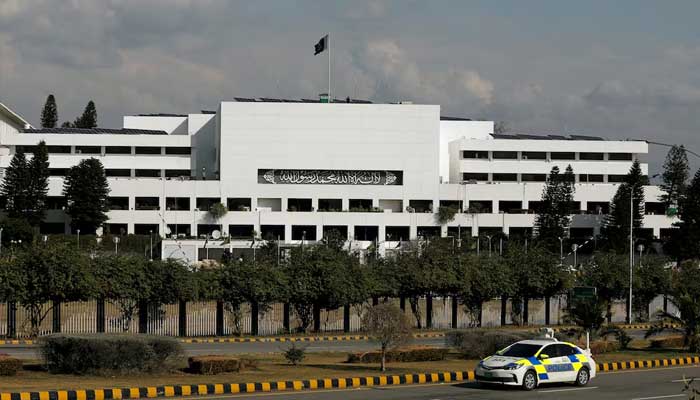
ISLAMABAD: The government and opposition in the Senate traded heated accusations, with the opposition alleging “institutional overreach” and “election fraud”, while the government accused the opposition of “economic terrorism” and mismanaging the economy.
Speaking on his calling attention notice, Pakistan Tehreek-e-Insaf’s Parliamentary Leader in the House, Barrister Ali Zafar, strongly criticised the government, which he claimed had rendered the Parliament irrelevant and meaningless.
Terming the tendency of keeping the Parliament uninformed, as a betrayal of the constitutional principle of civilian supremacy. He said issues pertaining to economy, security, and foreign policy are not presented before parliament and critical decisions are taken elsewhere in private settings. He strongly regretted that even agreements crucial to the country’s future are signed while bypassing parliament, reminding legislators that they are sworn to uphold the constitution.
Barrister Ali Zafar called for the restoration of civilian authority and challenged the Senate to move beyond its role as a mere rubber stamp, urging it to actively address the nation’s pressing issues. He emphasised the need to ensure that the law serves not just the powerful, but stands as the true law of the land. “The very foundations of our country have been shaken,” he stated. Since the February 8th general elections, Pakistan is grappling not only with electoral disputes but with over a dozen critical controversies that are eroding the core of our system. This has escalated into a full-blown constitutional crisis.”
He insisted that the people delivered a clear decision (in the elections), yet democracy was attacked, and the public mandate was not only ignored but also systematically destroyed through manipulation and fraud. He contended further, “This strikes at the heart of democracy itself. It contradicts principles set by Quaid-e-Azam and Liaquat Ali Khan. He emphasized the government’s authority comes from people’s consent, citing Jinnah’s August 11 address and Liaquat Ali Khan’s views on democracy.
Referring to PTI’s stance, he maintained that this is not merely a political party’s grievance, it is an alarm bell signalling national peril, emphasising that when the people’s mandate is crushed, the installed government loses both legal legitimacy and moral authority. Criticising the incumbent regime, he claimed that such a government cannot make difficult decisions, unite the nation, or lead the country through crisis.
“That is why we see no vision, no policy, and no governance,” Zafar claimed. Terming inflation as not only an economic indicator but a noose around the neck of every citizen, Zafar contended that the “unelected government” survives on debt and instead of progress, distributes misery. He noted that public debt had risen to Rs 80 trillion rupees, increasing by 13 per cent in just one year, and challenged the government to explain its plan to bolster the economy. The situation has led to the economic slaughter of the people, he added.
In his response, Minister of State for Finance and Revenue Bilal Azhar Kayani demanded that Pakistan Tehreek-e-Insaf to apologise to the nation for the “economic terrorism” it perpetrated during its tenure.
“They should apologise to the nation for their repeated attempts to push Pakistan towards default and deliberately derailing the IMF programme upon seeing their government dismissed,” he said. The minister said the government “revived the IMF programme and took drastic measures to save Pakistan from default,” despite PTI’s sabotage attempts.
He alleged the previous PTI government was formed through electoral irregularities (RTS fiasco) and its economic policies pushed millions into poverty, bringing the country to the brink of default. Kayani slammed PTI’s economic record, citing four finance ministers, rejection of an IMF programme, and sabotage for politics.
Referring to the opposition party’s decision to resign from House standing committees, he said the standing committees were available for constructive engagement, but opposition members often failed to contribute meaningfully.
Separately, according to the Senate Secretariat, Chairman Senate Syed Yousaf Raza Gilani has been appointed as Honorary Patron of the Global Muslim Business Forum (GMBF)— months after making history as the Founding Chairman of the Inter-Parliamentary Speakers’ Conference (ISC) and hosting a record-breaking summit in Pakistan. “The nomination reflects growing international recognition of Chairman Gilani’s stature as a senior statesman, parliamentarian, and advocate of constitutional governance and regional cooperation,” the statement says.