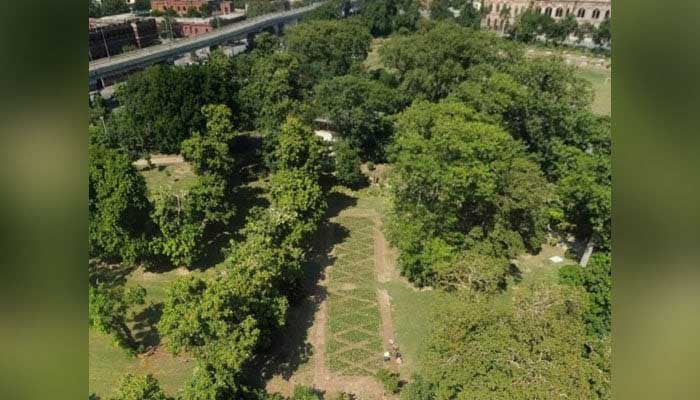
LAHORE: Bulldozers moved into Nasir Bagh last November, tearing through one of Lahore’s oldest public parks despite mounting environmental concerns and legal challenges.
For decades, the park had functioned as an informal campus for thousands of students in the city. Now, it is being excavated to make way for an underground parking facility.
For Abuzar Madhu, Nasir Bagh was not simply a park near his college, the National College of Arts (NCA). It was an extension of student life beyond lecture halls and studios.
“I spent eight years in this park”, Madhu, now 32, told The News. “It was where we came when we wanted to study, to discuss ideas. Nasir Bagh was a space of learning for me. A space where I could breathe”.
Established before Partition, Nasir Bagh is one of Lahore’s oldest public parks. It is surrounded on three sides by some of the city’s most prominent academic institutions: Government College Lahore, the National College of Arts and Punjab University.
Over the years, the park has hosted protests, political meetings and social gatherings. Its most consistent presence, however, has been students from these surrounding institutions, using the space to read, debate and spend time between classes.
Named after Gamal Abdel Nasser, the former president of Egypt, Nasir Bagh spans more than 110 kanals. In a city where public green spaces have steadily disappeared, it remains one of the few large, accessible open spaces in Lahore, Pakistan’s second-most-populous city.
That space is now being permanently altered.
According to government officials, more than 10 kanals of Nasir Bagh were dug up late last year and at least 123 trees uprooted by the Punjab government to construct an underground parking facility.
Hammad ul Hassan, the project director at the Traffic Engineering and Transport Planning Agency (TEPA), the government body responsible for traffic and transport infrastructure in Lahore, told The News that the project would cost Rs1.6 billion. Once completed by mid-October, the facility is expected to accommodate 300 cars and 500 motorcycles at one time.
Hassan said the park was selected because of its central location in an area already choked with traffic, owing to the presence of Old Anarkali, Urdu Bazaar, civil courts and several educational institutions.
“This area gets congested during the daytime”, he said. “Where do you park your car? This [new parking facility] will create a space for visitors to park and then move around in the colonial areas of Lahore”.
He also acknowledged that 123 trees had been “transplanted” to alternative locations to make way for the project and said new trees would be planted once construction is complete.
Environmentalists and urban planners remain unconvinced.
“How can you replace mature, old trees with new saplings?” asked Hammad Naqi Khan, the director general of World Wildlife Fund-Pakistan (WWF-Pakistan). “You are converting a public park into a parking plaza for a minority of people who drive cars”.
Lahore, a city of nearly 13 million people, has a green cover of just 1.8 per cent of its total area, according to a report by the government-run Urban Unit titled ‘Lahore City of Biodiversity Action Plan’, published in June 2025. International urban standards suggest that green cover should
exceed 20 per cent in major cities.
Hammad Naqi Khan said the rapid pace of urbanisation and the steady loss of green spaces are disrupting Lahore’s entire ecosystem.
“There was a time when you could see a wide variety of birds in Lahore because of the trees”, he said. “Now all you see are scavengers and crows”.
In December, a group of concerned citizens, academics and activists petitioned the Lahore High Court, seeking an immediate halt to what they described as the “environmental destruction of Nasir Bagh”.
“The project incentivises private transportation in a city that is already experiencing recurring episodes of some of the worst air quality in the world”, the petitioners said. Lahore has repeatedly ranked among the world’s most polluted cities.
The petitioners further argued that the Punjab government should instead consider alternative, non-park sites for any proposed parking facility.
They also questioned why no Environmental Impact Assessment (EIA) was conducted before the project began and why no public hearing was held. Under the Punjab Environmental Protection Act 1997, a project likely to cause adverse environmental effects cannot commence without submitting an EIA, and the law requires that the EIA be reviewed with public participation. But for now, construction continues at full pace.