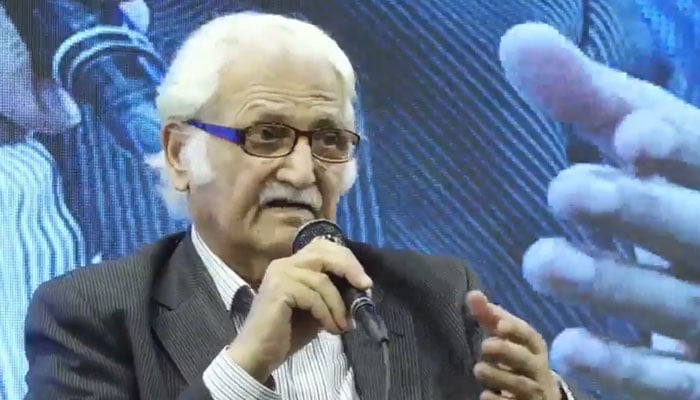
HYDERABAD: Former senator and PPP leader Farhatullah Babar has disclosed details of a Washington backchannel message conveyed to Mohtarma Benazir Bhutto in December 2001, stating that she would not be allowed to return to Pakistan before 2007 and that US priorities would focus on counterterrorism rather than democratic restoration.
Speaking at the Hyderabad Literature Festival during the launch of his book ‘Benazir Bhutto: She Walked into the Fire’, Babar said the message also warned that Pakistan’s opposition would not be permitted to derail General Pervez Musharraf.
He posed a pointed question to the audience: if foreign actors had decided in 2001 that Benazir Bhutto would not return before 2007, was her assassination upon return also similarly foretold?
Babar said the message was conveyed through a Pakistani-American interlocutor, identified only as Tee, who had longstanding access to US policy and decision-making circles. According to Babar, Tee formally invited Benazir Bhutto (then living in exile in Dubai) to engage with what was described as a commission of US policy circles working on a plan to (end militancy and restore democracy) in Pakistan.
Benazir Bhutto asked Babar to represent her in Washington. After the meeting, Babar said he briefed Benazir Bhutto in Dubai on what he described as the core elements of the message: she would not be allowed to return to Pakistan before 2007 or participate in the 2002 elections; counterterrorism would take precedence over democratic restoration; her party could face a split; and a broader regional blueprint was being shaped.
This blueprint, he said, included proposals related to Kashmir and Siachen, an unusual idea for a UN climate observatory at a mountain site, and an (architecture of peace), alongside promises of debt relief and budgetary support for Pakistan in exchange for regional cooperation.
Babar said the message appeared to be more than rhetoric, referring to General Musharraf’s reported private engagement with Indian Prime Minister Atal Bihari Vajpayee during the Agra Summit in July 2001.
He noted that Musharraf’s later public articulation of a phased approach to Kashmir was consistent with what had been conveyed earlier through the backchannel. According to Babar, Benazir Bhutto rejected the proposition of prolonged exile but chose to keep the channel open to test whether regional peace and democratic restoration could be meaningful.
Over the following years, he said, she was alternately offered inducements and issued warnings (carrots and sticks) and told that the plan would proceed with or without her. He said Benazir Bhutto instructed him to maintain a written record of communications and meetings as a historical account of how dictatorship, backed by a superpower, denied Pakistanis their democratic choices. Among the inducements conveyed to her, he said, were offers such as becoming chairperson of the Senate or serving as ambassador-at-large, which she dismissed as too good to be true.
The memoir also highlights other themes, including Benazir Bhutto’s call for a parliamentary probe into nuclear proliferation, rejecting the narrative that it was the work of a lone individual. Farhatullah Babar said she believed others were protected and wanted parliament to establish responsibility.
He further revealed that following a magistrate’s verdict in the Swiss cases, Benazir Bhutto was deeply affected by what he termed character assassination and at one point seriously considered quitting politics. Exile, he said, transformed her from a politician into a stateswoman, deepening her concern about constitutional breakdowns and Pakistan’s international standing.
The book also rejects portrayals of her marriage to Asif Ali Zardari as merely a political arrangement, with Babar stating that most stories of marital discord were fabricated. Eminent journalist Ghazi Salahuddin and publisher Ameena Saiyid also spoke at the event, which was moderated by anchor Junaid Ansari.